
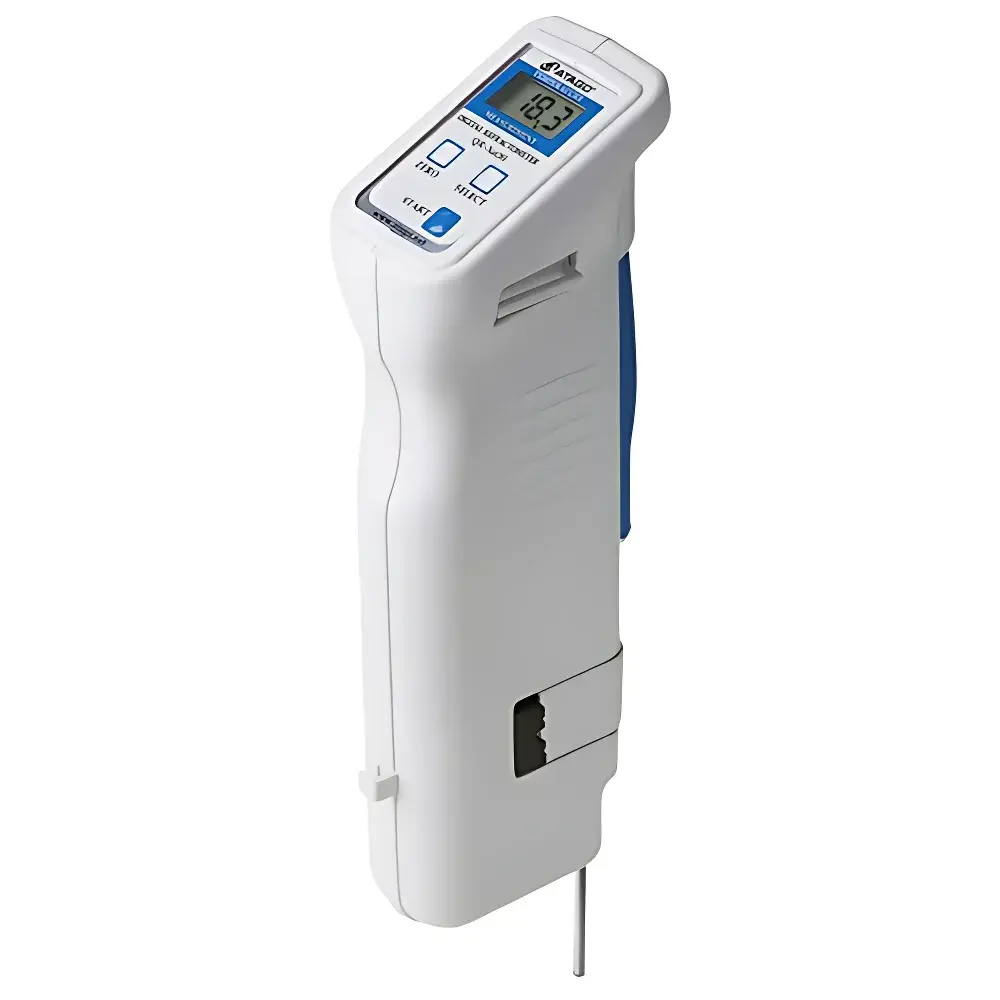
ATAGO QR-NaOH Digital Handheld Refractometer for Sodium Hydroxide Solution Concentration Measurement
| Brand | ATAGO |
|---|---|
| Origin | Japan |
| Model | QR-NaOH |
| Product Type | Handheld Refractometer |
| Display | Digital LCD |
| Temperature Range | 5–40°C |
| NaOH Concentration Range | 0.0–38.0% (w/w) |
| NaOH Accuracy | ±0.2% |
| Temperature Accuracy | ±1°C |
| Temperature Compensation | Automatic (ATC, based on built-in thermistor) |
| Sample Introduction | Aspiration via Flexible PVC Tubing |
| Prism Material | High-Refraction Sapphire-Coated Glass |
| Calibration | Single-point with distilled water or standard NaOH solution |
| Power | 2×AAA batteries (approx. 10,000 measurements per set) |
| IP Rating | IP65 (dust-tight and protected against low-pressure water jets) |
| Compliance | ISO 21747-1:2020 (Refractometers — Part 1: General requirements), JIS K 0061:2018 (Methods of test for refractive index) |
Overview
The ATAGO QR-NaOH is a purpose-engineered digital handheld refractometer designed exclusively for rapid, non-destructive concentration measurement of aqueous sodium hydroxide (NaOH) solutions. It operates on the fundamental optical principle of critical angle refraction: as light passes from the sapphire-coated glass prism into the sample, the degree of bending—and thus the critical angle at which total internal reflection occurs—is directly correlated to the solution’s refractive index, which in turn exhibits a well-characterized, linear relationship with NaOH mass concentration across the 0.0–38.0% (w/w) range. Unlike conventional drop-on refractometers requiring manual pipetting and surface contact, the QR-NaOH integrates an integrated micro-aspiration system: users simply immerse the flexible PVC sampling tube into the solution and press the START button—the instrument draws a precise, sub-100 µL sample volume into the sealed prism chamber under controlled negative pressure. This eliminates direct operator contact with caustic or volatile media, significantly reducing exposure risk and cross-contamination—critical for routine QC in chlor-alkali plants, electroplating baths, semiconductor cleaning lines, and pulp & paper digesters.
Key Features
- Aspiration-based sample introduction: Enables fully hands-free, single-button operation without open handling of hazardous NaOH solutions.
- Digital temperature-compensated measurement: Built-in thermistor continuously monitors prism temperature and applies real-time correction per ISO 21747-1 algorithms, ensuring accuracy across 5–40°C ambient conditions.
- Sapphire-coated optical prism: Provides exceptional chemical resistance to concentrated alkalis and mechanical durability against abrasion during repeated cleaning.
- High-contrast backlit LCD display: Shows NaOH concentration (%) and measured temperature (°C) simultaneously with 0.1% resolution and ±0.2% repeatability.
- IP65-rated enclosure: Dust-tight and resistant to incidental splashes—suitable for industrial floor environments and wet-process areas.
- Battery-powered portability: Operates on two standard AAA cells with auto-power-off after 3 minutes of inactivity; typical service life exceeds 10,000 measurements per battery set.
Sample Compatibility & Compliance
The QR-NaOH is validated for use with clear, homogeneous aqueous NaOH solutions free of suspended solids or emulsified oils. It is not suitable for highly viscous, turbid, or non-aqueous alkaline mixtures (e.g., NaOH in glycol or ethanol). The instrument conforms to ISO 21747-1:2020 for refractometer metrological performance and JIS K 0061:2018 for refractive index testing methodology. Its design supports GLP-compliant workflows: calibration records (date, standard used, operator ID) can be documented externally, and the fixed-wavelength LED light source (589 nm) ensures long-term photometric stability without drift. While not FDA 21 CFR Part 11 certified out-of-the-box (as it lacks electronic audit trail functionality), its measurement traceability aligns with ISO/IEC 17025 laboratory accreditation requirements when used within defined SOPs.
Software & Data Management
The QR-NaOH is a standalone, embedded-system instrument with no onboard data logging or Bluetooth/Wi-Fi connectivity. All measurements are displayed in real time only; no internal memory or export capability is provided. For integration into digital quality systems, users may manually transcribe results into LIMS or Excel-based tracking templates. ATAGO recommends pairing the device with its optional QR Series Calibration Kit (Cat. No. 2503) containing NIST-traceable NaOH reference standards (e.g., 5.0%, 15.0%, 25.0% w/w) to support periodic verification per ASTM D1218 or internal calibration schedules. Firmware updates are not field-upgradable; hardware revision control is maintained via serial-number-based manufacturing logs.
Applications
- Real-time monitoring of NaOH concentration in caustic soda storage tanks and dosing loops.
- Verification of lye strength prior to saponification or neutralization reactions in fine chemical synthesis.
- Process control of alkaline cleaning baths in metal finishing and aerospace component manufacturing.
- Concentration checks of spent electrolyte in chlor-alkali membrane cells.
- Field verification of NaOH titrant stock solutions in environmental testing laboratories (e.g., EPA Method 9040C).
- Quality assurance of commercial drain cleaners and industrial degreasers during batch release.
FAQ
Can the QR-NaOH measure other alkalis like KOH or Na₂CO₃?
No. Its optical calibration curve is specific to NaOH–water binary systems. Using it for KOH or carbonate solutions will produce inaccurate readings due to differing partial molar refractions.
How often should I calibrate the instrument?
ATAGO recommends daily calibration before first use using distilled water (0.0%) and/or a certified NaOH standard matching your typical working concentration. More frequent calibration is required if operating in environments with rapid temperature fluctuations or after exposure to high-concentration samples (>30%).
Is the aspiration tube reusable? How do I clean it?
Yes—the PVC tube is chemically resistant to ≤40% NaOH at room temperature. Rinse thoroughly with deionized water immediately after each use; soak in 5% citric acid solution for 5 minutes if residue persists. Replace the tube every 6 months or if kinking, clouding, or reduced suction is observed.
Does the instrument require temperature equilibration before measurement?
No. The built-in ATC system compensates dynamically; however, ensure the sample itself is within the 5–40°C operating range—do not measure chilled or heated samples outside this window.
What is the minimum sample volume required?
Approximately 80 µL is drawn into the prism chamber. Ensure the sampling tube remains submerged throughout aspiration to avoid air ingestion, which causes erroneous low readings.



