
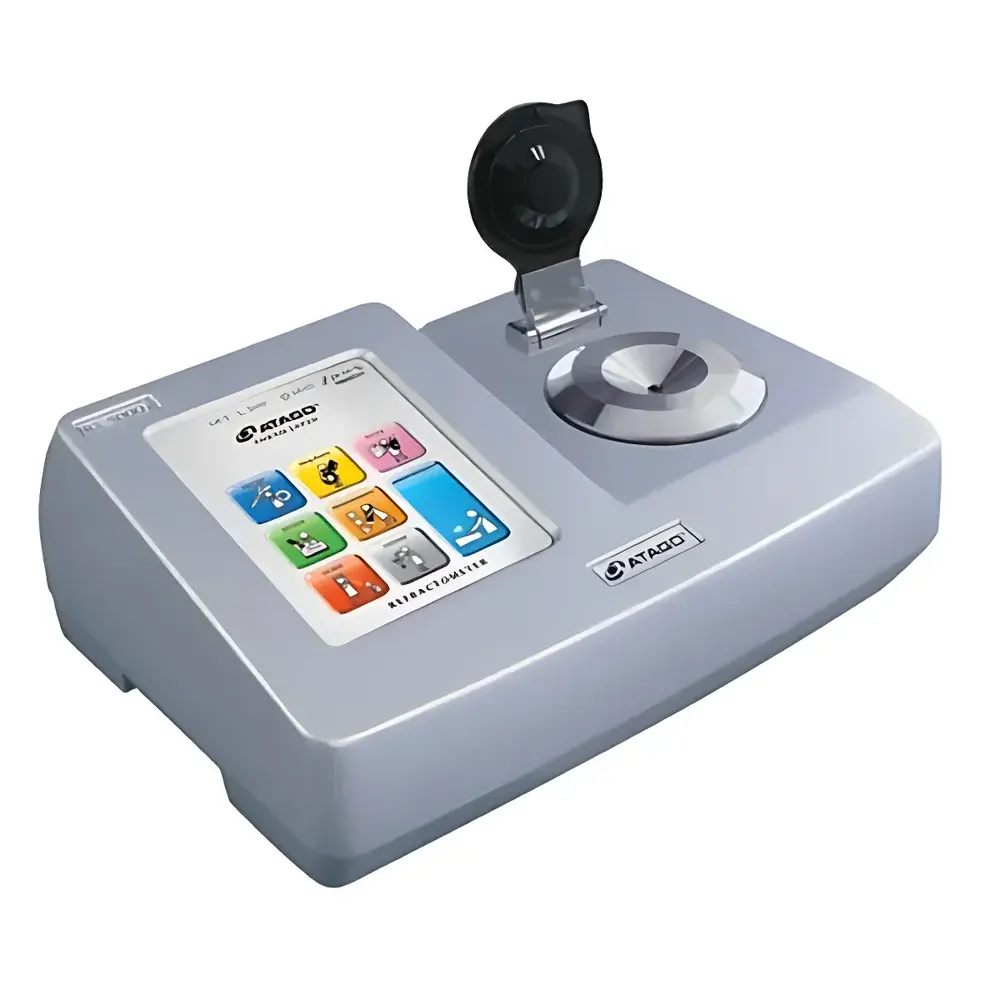
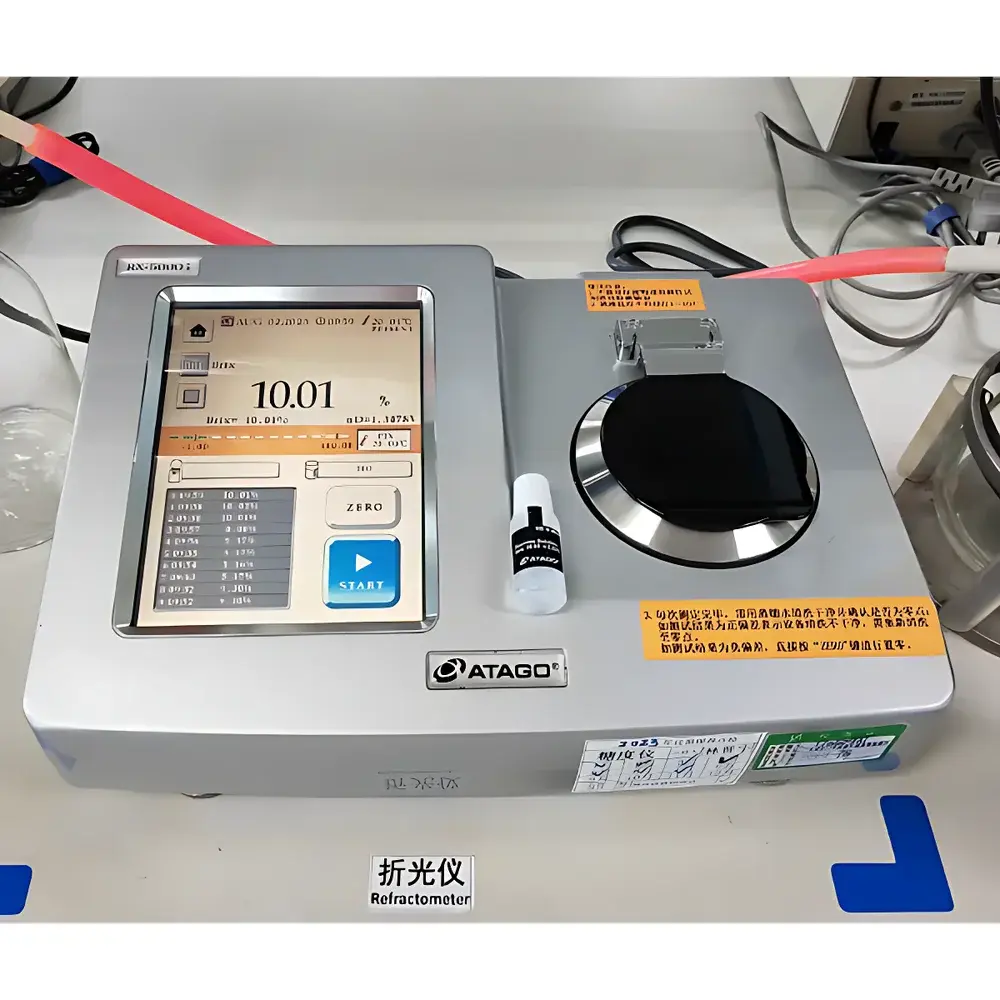
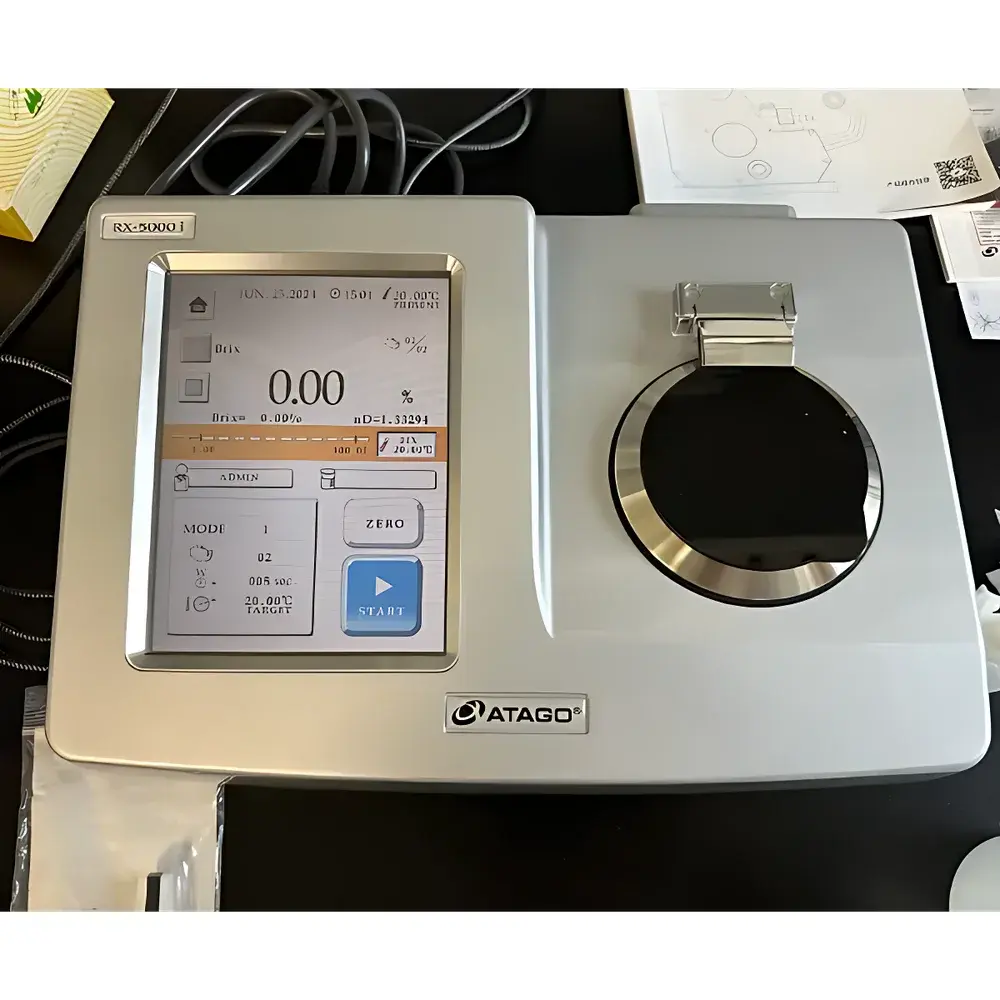
ATAGO RX-5000i Benchtop Automated Digital Refractometer
| Brand | ATAGO |
|---|---|
| Origin | Japan |
| Model | RX-5000i |
| Measurement Range | Refractive Index (nD): 1.324200–1.580000 |
| Brix | 0.00–100.00% (ATC) |
| Accuracy | nD: ±0.000040 |
| Brix | ±0.03% |
| Temperature Control Range | 5.00–75.00 °C |
| Temperature Accuracy | ±0.05 °C |
| Resolution | nD: 0.000001 |
| Brix | 0.01% |
| Temperature | 0.01 °C |
| Prism Material | Synthetic Sapphire |
| Sample Tray Material | SUS316 Stainless Steel |
| Interface | RS-232C, USB |
| Data Storage | ≥500 measurements |
| Predefined Scales | 24 |
| User-Defined Scales | 100 |
| Power Supply | AC 100–240 V, 50–60 Hz |
| Dimensions & Weight | 37 × 26 × 14 cm, 6.6 kg |
| Power Consumption | 90 VA |
Overview
The ATAGO RX-5000i is a high-precision benchtop automated digital refractometer engineered for laboratories requiring traceable, temperature-controlled refractive index and Brix measurements in liquid samples. It operates on the principle of total internal reflection at the prism–sample interface, where the critical angle of incident light is measured and converted into refractive index (nD) using calibrated optical path geometry and wavelength-specific compensation (589.3 nm sodium D-line equivalent). The instrument integrates a Peltier-based thermoelectric temperature control system, enabling precise thermal stabilization without external water baths—critical for compliance with ISO 21748, ASTM D1218, and USP guidelines governing refractometric analysis in quality control and R&D environments. Designed for repeatable operation across diverse sample matrices—including aqueous disinfectants, glycol solutions, ethanol–water blends, pharmaceutical excipients, and food-grade syrups—the RX-5000i delivers metrological integrity through its synthetic sapphire prism and stainless-steel (SUS316) sample tray, ensuring chemical resistance and long-term calibration stability.
Key Features
- Peltier-driven temperature regulation (5.00–75.00 °C) with ±0.05 °C accuracy and 0.01 °C resolution, eliminating reliance on external thermostatic baths
- High-resolution optical detection system achieving nD resolution of 0.000001 and Brix resolution of 0.01%, supporting stringent method validation requirements
- Four configurable measurement modes: MODE-1 (temperature-equilibrated precision mode), MODE-2 (interval-sampled dynamic monitoring), MODE-3 (non-temperature-controlled rapid assay, ~4 s response), and MODE-S (stability-triggered acquisition for volatile or thermally sensitive samples)
- Intelligent self-diagnostic routine verifying prism surface cleanliness, ambient light interference, and spectral consistency prior to each measurement cycle
- Touchscreen HMI with intuitive icon-based navigation, real-time graphical display of temperature convergence, and on-device data review
- Comprehensive scale library: 24 preloaded industry-standard scales (e.g., % w/w NaCl, % v/v ethanol, HFCS, glycerol, propylene glycol) plus support for up to 100 user-defined calibration curves
Sample Compatibility & Compliance
The RX-5000i accommodates a broad range of transparent to mildly turbid liquids with refractive indices from 1.324200 to 1.580000—covering common disinfectant formulations (e.g., 70% isopropyl alcohol, quaternary ammonium solutions, hydrogen peroxide dilutions), buffer systems, surfactant solutions, and biopharmaceutical process intermediates. Its SUS316 sample tray and synthetic sapphire prism resist corrosion from halogenated compounds, oxidizers, and low-pH sanitizers. The instrument supports GLP/GMP-aligned workflows via optional FDA 21 CFR Part 11-compliant data logging software, providing electronic signatures, audit trails, and secure export of raw measurement records (nD, Brix, temperature, timestamp, operator ID, and scale selection). Calibration verification follows ATAGO’s traceable standards (NIST-traceable reference fluids), and routine performance checks align with ISO/IEC 17025 internal quality assurance protocols.
Software & Data Management
Data capture and reporting are supported through native RS-232C and USB interfaces. The optional PC application enables full instrument control, method scripting, statistical process monitoring (SPC), and PDF/CSV report generation compliant with laboratory information management systems (LIMS). All measurements—including intermediate temperature readings and stability thresholds—are timestamped and stored onboard (≥500 entries with full metadata). Export formats include tab-delimited text for integration with JMP, Minitab, or LabArchives. Audit logs record user logins, parameter changes, calibration events, and firmware updates—meeting requirements for regulated environments governed by EU Annex 11 and ICH GCP.
Applications
- Concentration verification of hospital-grade disinfectants (e.g., alcohol-based hand rubs, sporicidal peracetic acid blends)
- In-process monitoring of cleaning-in-place (CIP) solution strength in pharmaceutical manufacturing
- Raw material identity testing and lot release of glycerin, propylene glycol, and ethylene glycol used in formulation
- Stability studies tracking refractive index drift in sterilant solutions under accelerated aging conditions
- QC screening of aqueous polymer solutions (e.g., PVP, HPMC) where viscosity–refractivity correlations are established
- Academic research in colloid science, solvation thermodynamics, and electrolyte activity coefficient modeling
FAQ
Does the RX-5000i require external cooling or heating equipment?
No. Its integrated Peltier module provides both heating and cooling within the 5.00–75.00 °C range, independent of ambient lab conditions.
Can the instrument measure non-aqueous solvents like acetone or chloroform?
Yes—provided the sample is optically clear and does not chemically attack sapphire or SUS316. Refer to ATAGO’s chemical compatibility matrix before use.
Is temperature compensation automatic during Brix measurement?
Yes. The ATC (Automatic Temperature Compensation) algorithm applies ISO-defined polynomial corrections to Brix values based on real-time prism temperature.
How is calibration traceability maintained?
Using certified ATAGO standard reference fluids (e.g., NIST-traceable sucrose solutions or pure water), with calibration certificates documenting uncertainty budgets per ISO/IEC 17025.
What happens if the prism surface is contaminated during measurement?
The built-in optical diagnostic detects reduced signal intensity or scattering anomalies and prompts immediate cleaning before proceeding.




