
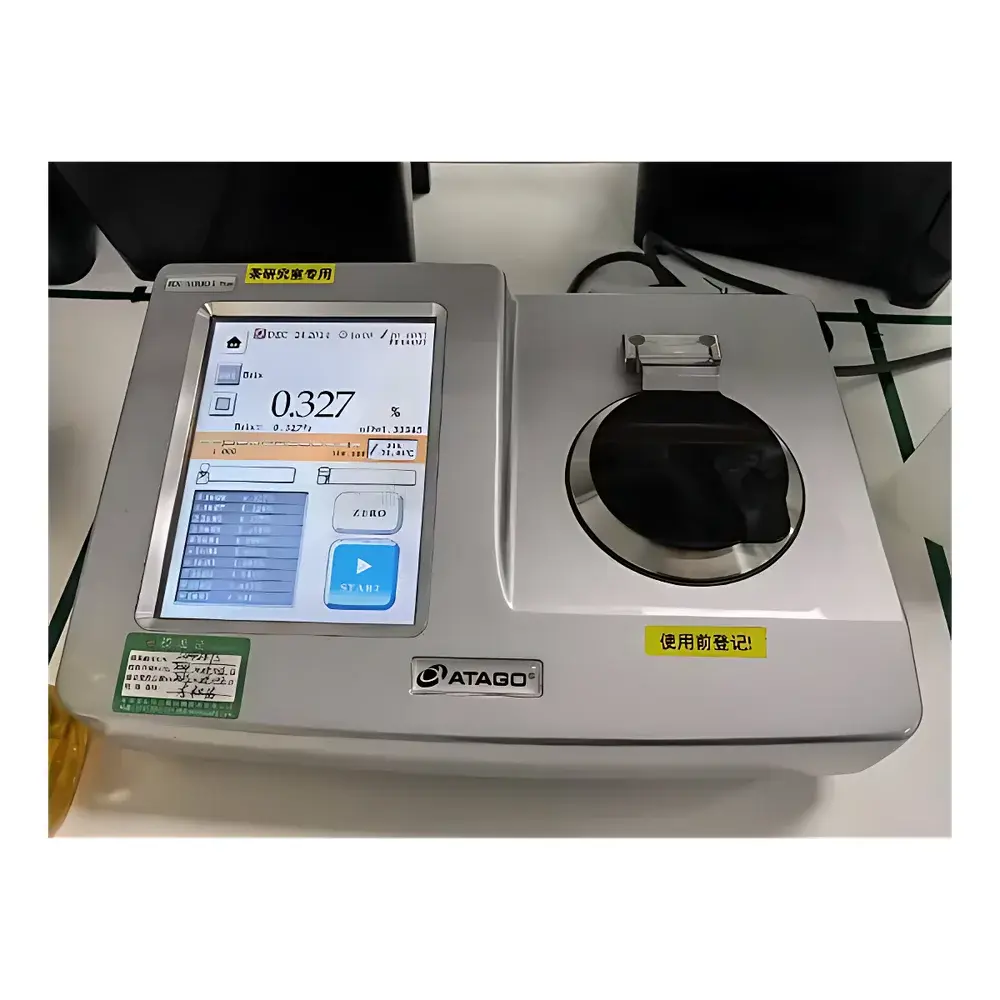
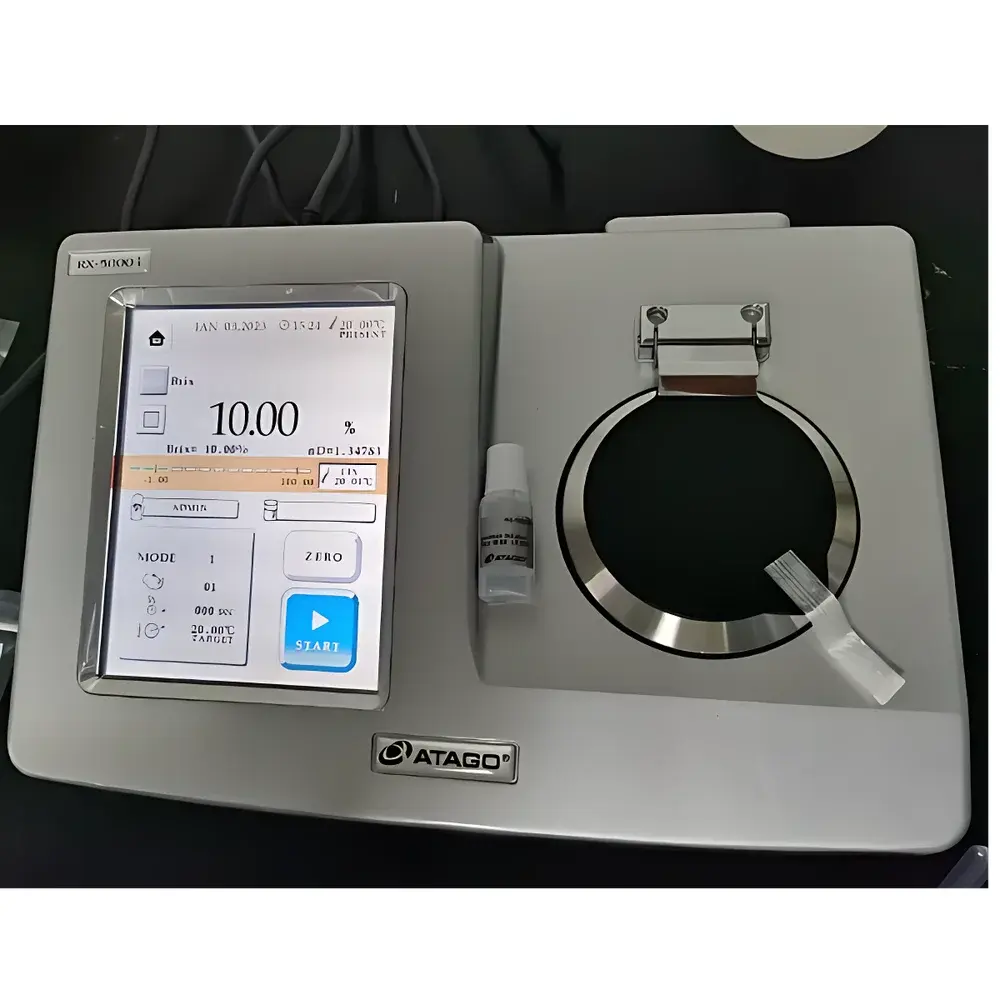
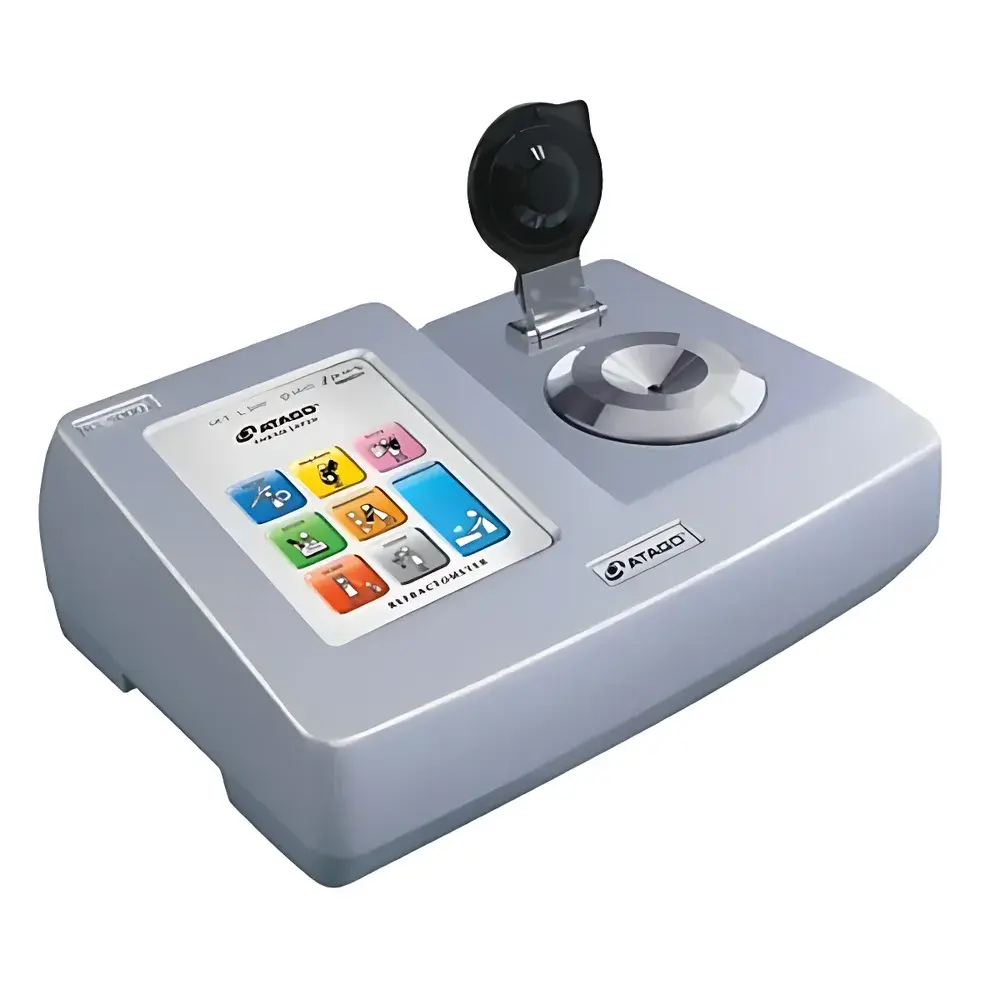
ATAGO RX-5000i Benchtop Digital Refractometer for Plant Extract Concentration Measurement
| Brand | ATAGO |
|---|---|
| Origin | Japan |
| Model | RX-5000i |
| Product Type | Benchtop Refractometer |
| Temperature Control | Peltier-based, 5.00–75.00 °C |
| Display | Touchscreen LCD |
| Measurement Range | Refractive Index (nD): 1.324200–1.580000 |
| Brix | 0.00–100.00% (ATC) |
| Accuracy | nD: ±0.000040 |
| Brix | ±0.03% |
| Resolution | nD: 0.000001 |
| Brix | 0.01% |
| Temperature Resolution | 0.01 °C |
| Prism Material | Synthetic Sapphire |
| Sample Well Material | SUS 316 Stainless Steel |
| Data Storage | ≥500 measurements (auto-saved) |
| Interface | RS-232C |
| Predefined Scales | 24 built-in |
| Custom Scales | Up to 100 user-defined |
| Power | AC 100–240 V, 50–60 Hz |
| Dimensions & Weight | 37 × 26 × 14 cm, 6.6 kg |
| Power Consumption | 90 VA |
Overview
The ATAGO RX-5000i is a high-precision benchtop digital refractometer engineered for rapid, traceable quantification of soluble solids concentration—expressed as Brix (% w/w)—in plant extracts, herbal decoctions, and other thermally sensitive aqueous solutions. It operates on the fundamental optical principle of critical angle refraction: when a collimated light beam passes from a high-refractive-index medium (synthetic sapphire prism) into a sample solution, the angle at which total internal reflection occurs is directly correlated to the solution’s refractive index (nD), which in turn is a function of solute concentration. Unlike gravimetric methods such as the Chinese Pharmacopoeia (2010 Edition, Volume I, Appendix XA) “extractives determination by drying and weighing”, the RX-5000i eliminates thermal degradation artifacts—e.g., volatilization of essential oils or denaturation of heat-labile phytochemicals—by delivering results in seconds without sample heating. Its integrated Peltier temperature control ensures measurement compliance with standardized reference conditions (e.g., 20 °C or 25 °C), satisfying method validation requirements under ISO 2173, AOAC 932.12, and USP .
Key Features
- Precision Peltier thermoregulation (5.00–75.00 °C, ±0.01 °C resolution) enables fully automated temperature equilibration and measurement initiation—no external water bath required.
- High-stability synthetic sapphire prism (Mohs hardness 9) and SUS 316 stainless steel sample well ensure long-term optical integrity and resistance to aggressive botanical solvents and cleaning agents.
- Four configurable measurement modes: MODE-1 (temperature-stabilized precision mode), MODE-2 (time-synchronized refractive index/temperature logging), MODE-3 (non-temperature-controlled ultrafast mode, <4 s response), and MODE-S (stability-triggered acquisition for viscous or settling samples).
- Intelligent prism self-diagnostic system continuously monitors surface cleanliness and ambient optical interference, flagging potential contamination before measurement to safeguard data validity.
- Touchscreen interface with intuitive icon-driven navigation supports multilingual operation (English, Chinese, Japanese, Korean) and real-time display of nD, Brix, temperature, and measurement status.
Sample Compatibility & Compliance
The RX-5000i is validated for use with aqueous plant extracts—including tinctures, decoctions, juice concentrates, and hydroalcoholic solutions—across a broad refractive index range (1.324200–1.580000). Its ATC (Automatic Temperature Compensation) algorithm applies NIST-traceable polynomial correction per ISO 1042 and ASTM D1218, ensuring Brix values remain accurate across its full operating temperature span. The instrument meets GLP/GMP documentation requirements when paired with the optional FDA 21 CFR Part 11-compliant data management software, providing electronic signatures, audit trails, and secure user access levels. All firmware and calibration routines are factory-certified against ATAGO’s internal metrology standards, aligned with JIS Z 8013 and ISO/IEC 17025 principles.
Software & Data Management
Data output is supported via RS-232C serial interface to PCs or label printers (optional accessories). The onboard memory retains ≥500 measurement records—including date/time stamp, operator ID, temperature, nD, Brix, and selected scale—with automatic overwrite protection. The optional PC software enables export to CSV, PDF, or Excel formats; generation of calibration reports; trend analysis across batches; and integration into LIMS environments. User-defined scales (up to 100) allow direct correlation of nD to custom concentration units (e.g., mg/mL glycyrrhizin, % polysaccharide), supporting method transfer and internal SOP alignment.
Applications
- Rapid QC screening of herbal extract batches during production and release testing.
- Process monitoring of concentration steps in phytochemical isolation (e.g., rotary evaporation, membrane filtration).
- Stability studies tracking solute loss or precipitation over time under varying storage conditions.
- Method development for pharmacopoeial alternatives to gravimetric extractives assays—reducing assay time from hours to seconds while preserving analyte integrity.
- Research applications in ethnopharmacology, natural product standardization, and formulation development where thermal stability is a limiting factor.
FAQ
Does the RX-5000i require external calibration verification?
Yes—ATAGO recommends quarterly verification using certified NIST-traceable sucrose standards (e.g., 10%, 30%, 60% Brix) and annual recalibration by an ATAGO-accredited service center.
Can the instrument measure non-aqueous plant extracts (e.g., ethanol-based tinctures)?
It can quantify Brix-equivalent values in hydroalcoholic solutions up to ~40% v/v ethanol; however, users must establish and validate a custom correlation curve for each solvent matrix due to refractive index deviations.
Is the RS-232C interface compatible with modern Windows/macOS systems?
Yes—via USB-to-serial adapters with signed drivers; the communication protocol (ASCII-based, 9600 bps) is documented in the technical manual for third-party LIMS integration.
What maintenance is required for the sapphire prism?
Wipe gently with lens tissue and spectroscopic-grade methanol after each use; avoid abrasive cleaners or ultrasonic baths. Prism inspection is included in scheduled service visits.
How does MODE-S handle unstable samples like suspensions or emulsions?
MODE-S dynamically evaluates refractive index drift over time and triggers measurement only when variation falls below 0.000010 nD/second for ≥2 seconds—ensuring representative readings without manual timing intervention.




