
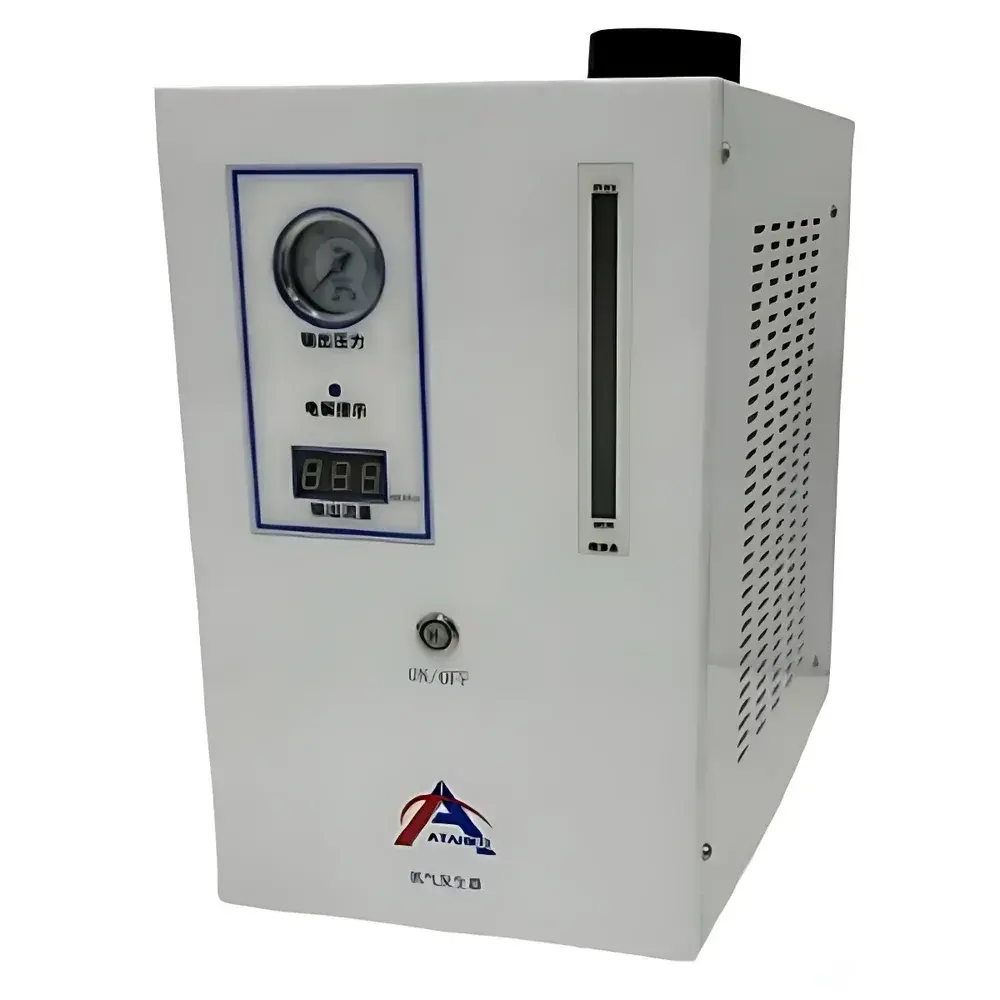
ATARICO ATEH-360 Hydrogen Generator
| Brand | ATARICO |
|---|---|
| Origin | Beijing, China |
| Manufacturer Type | Direct Manufacturer |
| Model | ATEH-360 |
| Hydrogen Generation Principle | PEM Electrolysis of Deionized Water |
| Output Flow Rate | 0–360 mL/min |
| Output Pressure Range | 0–0.4 MPa |
| Hydrogen Purity | 99.999% |
| Power Consumption | 300 W (0.3 kW) |
| Dimensions (W×D×H) | 400 × 220 × 280 mm |
| Net Weight | 12 kg |
| Operating Ambient Temperature | 1–40 °C |
| Relative Humidity Limit | <85% RH |
| Pressure Stability | ±0.001 MPa |
| Electrical Supply | 220 V ±10%, 50 Hz |
Overview
The ATARICO ATEH-360 Hydrogen Generator is a laboratory-grade, on-demand hydrogen source engineered for precision analytical and process applications. It employs proton exchange membrane (PEM) electrolysis of deionized water—a zero-carbon, closed-loop gas generation method—to produce high-purity hydrogen continuously without reliance on compressed gas cylinders. Unlike alkaline or traditional electrolytic systems, the ATEH-360 integrates a solid polymer electrolyte membrane that enables rapid startup, stable pressure regulation, and minimal maintenance. Its design targets critical use cases where gas purity, flow consistency, and operational safety are non-negotiable—particularly in gas chromatography (GC) carrier and fuel gas supply, semiconductor annealing atmospheres, catalytic research, and hydrogenation reaction support. The unit operates within ambient conditions of 1–40 °C and maintains output stability across variable load demands, making it suitable for integration into automated lab environments and continuous 24/7 operation protocols.
Key Features
- Ultra-high-purity hydrogen output at ≥99.999% (5.0 grade), compliant with ISO 8573-1 Class 1 for gaseous contaminants (H2O, O2, total hydrocarbons)
- Continuous flow range of 0–360 mL/min at regulated pressure (0–0.4 MPa), with pressure stability maintained within ±0.001 MPa under dynamic load
- Integrated intelligent control system featuring real-time water-level monitoring, automatic shutdown upon low-water condition, and dual-stage overpressure protection
- PEM-based electrolyzer stack with platinum-group catalysts, ensuring high current efficiency (>75% at rated load) and long service life (>5,000 operating hours)
- Modular internal architecture enabling field-replaceable consumables—including ion-exchange membrane cartridge and deionized water reservoir—without specialized tools
- Front-panel LED indicators for power status, electrolysis activity, water level, and fault alerts; all status parameters visible without software interface
- Low thermal signature and acoustic noise (<55 dB(A)), optimized for benchtop placement in shared analytical laboratories
Sample Compatibility & Compliance
The ATEH-360 is fully compatible with all major GC platforms—including Agilent, Thermo Fisher Scientific, Shimadzu, PerkinElmer, and Waters—regardless of detector type (FID, TCD, PID) or column configuration. Its output meets ASTM D7217–22 requirements for hydrogen purity in GC carrier gas applications and satisfies USP and EP 2.5.27 specifications for pharmaceutical-grade hydrogen. As a self-contained generator, it eliminates cylinder handling hazards and complies with OSHA 1910.101 and EU Directive 2010/35/EU (PED) for pressure equipment. The device supports GLP/GMP audit readiness through traceable operational logs (via optional RS-232/USB data export) and adheres to IEC 61010-1:2012 for electrical safety in laboratory instrumentation.
Software & Data Management
While the ATEH-360 operates autonomously via embedded microcontroller logic, optional firmware-enabled connectivity (RS-232 or USB-C) allows integration into centralized lab management systems. Logged parameters include cumulative runtime, total hydrogen volume generated, average pressure deviation, and water consumption rate—exportable as CSV for trend analysis. The system does not require proprietary software; raw serial data conforms to ASCII-based SCPI-like command syntax for third-party scripting (e.g., Python, LabVIEW). Audit trails meet FDA 21 CFR Part 11 requirements when paired with validated timestamping and user-access controls at the host system level.
Applications
- Carrier and fuel gas supply for flame ionization detectors (FID) and thermal conductivity detectors (TCD) in routine and trace-level GC analysis
- Reducing atmosphere generation in materials science labs for metal oxide reduction studies and thin-film deposition pre-treatment
- Inert purge gas for glovebox and Schlenk line operations requiring ultra-dry, oxygen-free hydrogen
- Hydrogen feedstock in catalytic hydrogenation reactors and electrochemical cell testing setups
- Calibration gas standard preparation in metrology labs supporting ISO/IEC 17025-accredited methods
- Sustainable alternative to cylinder-based supply in LEED-certified or ISO 50001-compliant facilities seeking energy-efficient gas infrastructure
FAQ
What type of water must be used with the ATEH-360?
Deionized water with resistivity ≥15 MΩ·cm and total organic carbon (TOC) <10 ppb is mandatory. Tap water, distilled water, or reverse-osmosis-only water will damage the PEM stack and void warranty.
Does the ATEH-360 require periodic catalyst replacement?
No. The PEM electrode assembly is designed for the full operational lifetime of the unit (≥5,000 hours). Only the water reservoir and optional particulate filter require scheduled servicing.
Can the output pressure be adjusted while connected to a GC?
Yes. Pressure is digitally regulated via front-panel knob or remote analog signal (0–5 VDC input); changes are reflected in real time without interrupting gas flow or requiring system reboot.
Is the ATEH-360 certified for use in explosion-hazard areas?
No. It is rated for general laboratory use (IEC 60529 IP20) and must be installed outside classified hazardous zones per NEC Article 500 and ATEX Zone 2 guidelines.
How often should the deionized water reservoir be refilled?
At maximum continuous flow (360 mL/min), the 2.5 L reservoir lasts approximately 7 hours. Refill frequency depends on duty cycle; most GC labs refill once per shift or daily.



