
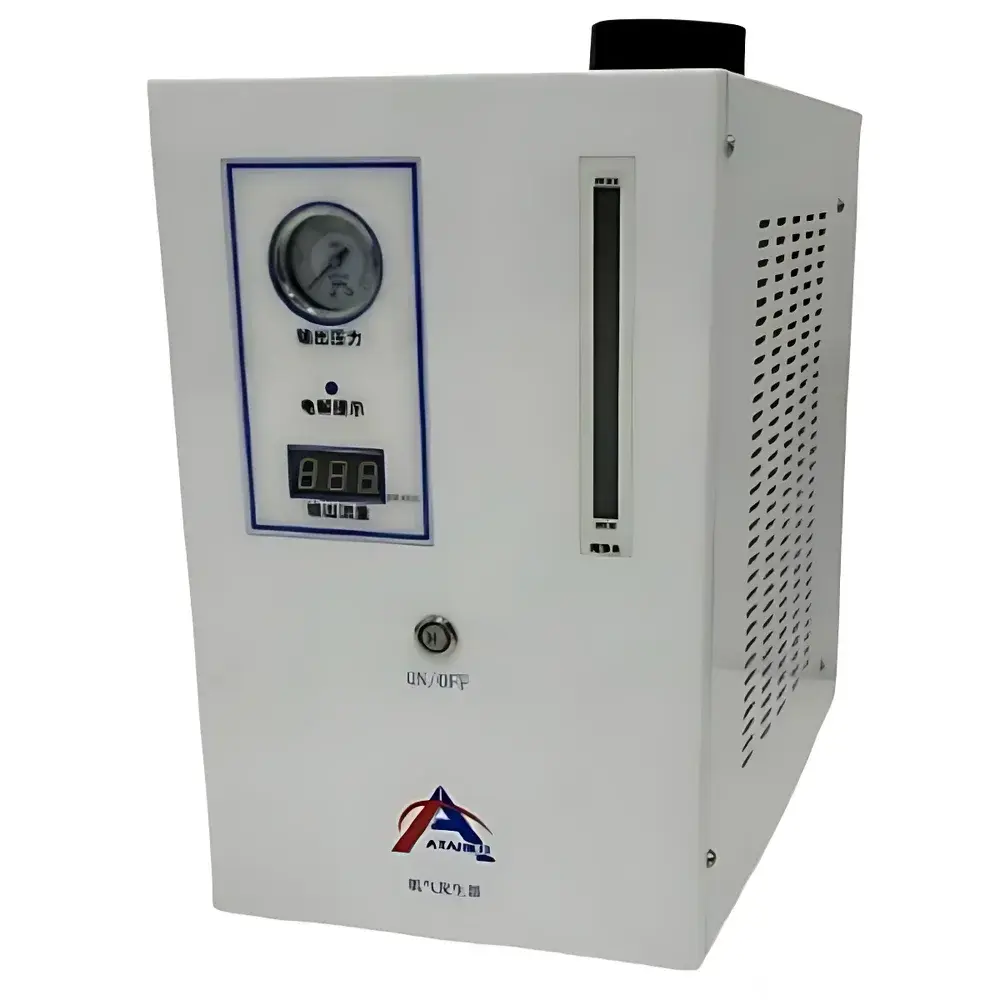
ATARICO ATEH-520 Hydrogen Generator
| Brand | ATARICO |
|---|---|
| Origin | Beijing, China |
| Manufacturer Type | Direct Manufacturer |
| Model | ATEH-520 |
| Hydrogen Generation Principle | PEM Electrolysis of Deionized Water |
| Maximum Hydrogen Flow Rate | 520 mL/min |
| Output Pressure Range | 0–0.4 MPa |
| Hydrogen Purity | 99.999% |
| Power Consumption | 0.5 kW (500 W) |
| Operating Ambient Temperature | 1–40 °C |
| Relative Humidity | <85% RH |
| Dimensions (W×D×H) | 400 × 220 × 280 mm |
| Weight | 12 kg |
| Electrical Requirement | 220 V ±10%, 50 Hz |
Overview
The ATARICO ATEH-520 Hydrogen Generator is a laboratory-grade, on-demand hydrogen source engineered for precision gas supply in analytical and process-critical applications. It utilizes proton exchange membrane (PEM) electrolysis of deionized water—a zero-carbon, closed-loop electrochemical process—to generate high-purity hydrogen without reliance on compressed gas cylinders. This principle ensures consistent, controllable output with no risk of air ingress or hydrocarbon contamination. Designed for integration into sensitive instrumentation environments—including gas chromatography (GC), semiconductor annealing, fuel cell testing, and catalytic research—the ATEH-520 delivers stable flow and pressure under dynamic load conditions. Its compact footprint, low thermal signature, and passive cooling architecture make it suitable for benchtop deployment in ISO Class 5–7 cleanrooms and standard analytical laboratories alike.
Key Features
- PEM-based electrolysis system with integrated deionized water reservoir and automatic level control—eliminates manual refilling and prevents dry-electrolyte operation
- Hydrogen purity ≥99.999% (5.0 grade), verified by onboard electrochemical sensor and compliant with ISO 8573-1:2010 Class 1 for particulate and oil content
- Regulated output pressure from 0 to 0.4 MPa with stability ≤±0.001 MPa (typical), supporting both constant-pressure and flow-controlled GC carrier gas modes
- Dual-stage pressure regulation with mechanical safety relief valve and electronic overpressure cutoff (0.42 MPa threshold)
- Intelligent monitoring suite: real-time LED status indicators for power, electrolysis activity, water level, and fault conditions; audible alarm for low-water and overtemperature events
- Modular internal layout enables field-replaceable electrolyzer stack and desiccant cartridge—no specialized tools required for routine maintenance
- Energy-efficient operation at 0.5 kW nominal draw; achieves >75% electrical-to-hydrogen energy conversion efficiency at rated load (520 mL/min)
Sample Compatibility & Compliance
The ATEH-520 is fully compatible with all major GC platforms—including Agilent, Thermo Fisher Scientific, Shimadzu, PerkinElmer, and Waters—regardless of carrier gas configuration (split/splitless, multi-port, or microfluidic interfaces). Its output meets ASTM D6866-22 requirements for isotopic purity verification and satisfies the hydrogen quality specifications outlined in USP for pharmaceutical residual solvent analysis. The unit complies with IEC 61010-1:2012 for laboratory electrical safety and carries CE marking per EU Directive 2014/30/EU (EMC) and 2014/35/EU (LVD). Optional documentation packages support GLP/GMP audit readiness, including factory calibration certificates traceable to NIST standards and full 21 CFR Part 11–compliant electronic log export capability via USB interface.
Software & Data Management
While the ATEH-520 operates as a standalone hardware device with analog control logic, its digital diagnostics subsystem supports data logging via optional RS-232 or USB-C serial output (firmware v2.1+). Logged parameters include cumulative runtime, total H₂ volume generated, average pressure deviation, and event-triggered fault codes (e.g., E03 = low water, E07 = temperature exceedance). Exported CSV files are compatible with LabArchives, Benchling, and custom LIMS integrations. Remote monitoring is achievable through third-party SCADA systems using Modbus RTU protocol (add-on module required). All firmware updates are delivered via signed binary packages with SHA-256 checksum verification to ensure integrity and regulatory compliance.
Applications
- Carrier gas supply for capillary and packed-column gas chromatography, including FID, TCD, and PID detectors
- Reducing atmosphere generation in thermal gravimetric analysis (TGA) and differential scanning calorimetry (DSC)
- Feedstock gas for plasma-enhanced chemical vapor deposition (PECVD) and atomic layer deposition (ALD) systems
- Inert purge and blanketing in glovebox and Schlenk line operations requiring ultra-high-purity reductive environments
- Calibration gas generation for hydrogen sensors and leak detection equipment (e.g., helium leak testers with H₂ tracer mode)
- Sustainable lab infrastructure: replaces cylinder logistics, reduces carbon footprint associated with transport and rental cycles, and aligns with institutional net-zero roadmaps
FAQ
What type of water is required for operation?
Deionized water with resistivity ≥1 MΩ·cm (ASTM D1193 Type II or higher) must be used. Tap water, distilled water, or reverse-osmosis-only water will cause rapid electrolyzer fouling and void warranty coverage.
Can the ATEH-520 be operated continuously for 24/7 applications?
Yes—designed for unattended, continuous duty cycle operation within specified ambient conditions (1–40 °C, <85% RH). Mean time between failures (MTBF) exceeds 15,000 hours based on accelerated life testing.
Is external drying or purification necessary to achieve 99.999% purity?
No. The integrated dual-stage palladium-silver diffusion membrane and molecular sieve dryer deliver final-stage purification inline. No external purifier is needed for GC-grade performance.
How often does the electrolyzer stack require replacement?
Under normal operating conditions (≤8 h/day at 400 mL/min), stack service life exceeds 5 years. Replacement is indicated when flow rate drops >10% at nominal voltage or when pressure regulation deviates beyond ±0.002 MPa.
Does the unit support pressure ramping or programmable flow profiles?
No—output is manually set via front-panel rotary valve. For automated pressure/flow sequencing, integration with external PLC or GC controller via 0–10 V analog input is recommended (requires optional I/O module).



