
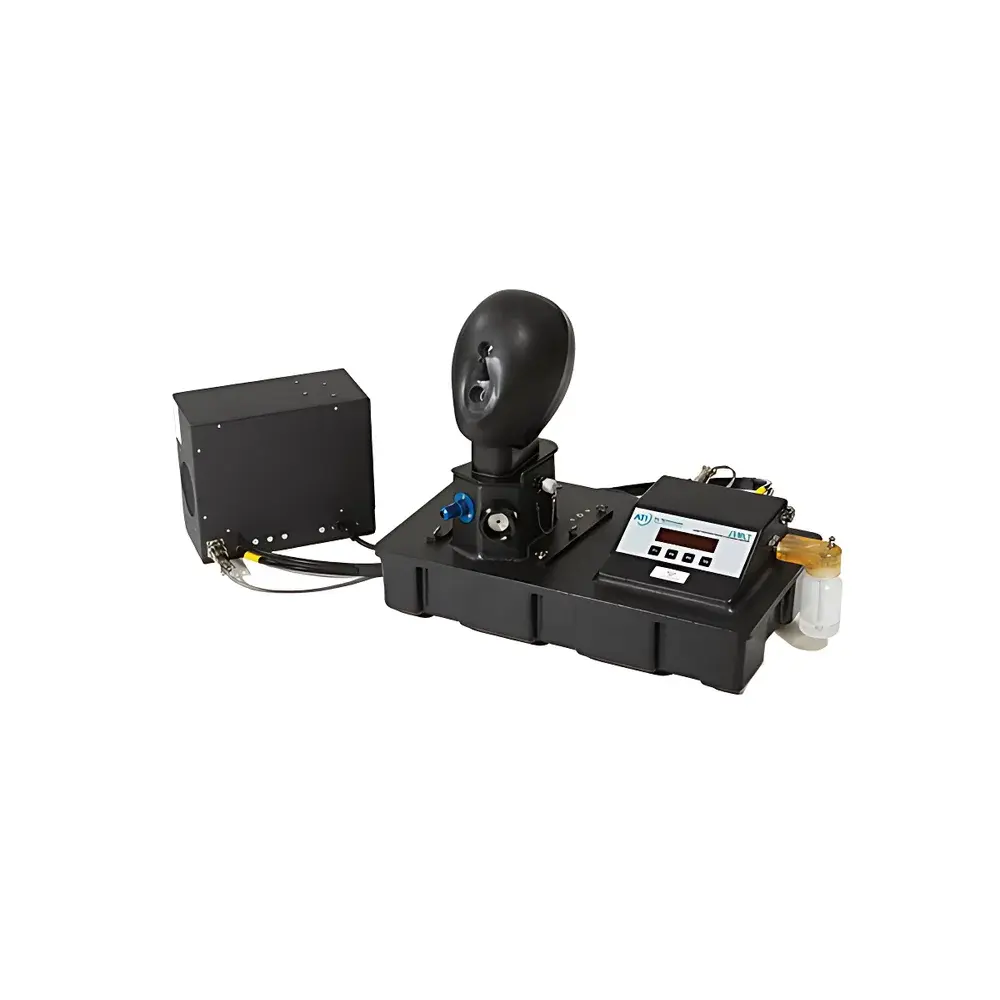
ATI PMLT Personal Mask Leakage Tester
| Brand | ATI |
|---|---|
| Origin | USA |
| Manufacturer Type | Manufacturer |
| Origin Category | Imported |
| Model | PMLT |
| Pricing | Upon Request |
| Dimensions (Packaged) | 81 cm × 57 cm × 51 cm |
| Weight (Packaged) | ~41 kg |
| Weight (Unpackaged) | ~26 kg |
| Power Supply | 100–250 V AC, 50/60 Hz |
| Aerosol Agent | Polyalphaolefin-4 (PAO-4) |
| Detection Principle | Near-forward light-scattering photometry |
| Detection Range | 0.0005–100% aerosol concentration |
| Fit Factor Limit | 200,000 |
| Data Interface | RS-232 serial port |
| Patents | US 6,435,009 |
Overview
The ATI PMLT Personal Mask Leakage Tester is a field-deployable, photometric aerosol-based instrument engineered for quantitative assessment of respirator and gas mask facepiece seal integrity. It operates on the principle of challenge aerosol generation (using PAO-4 oil mist) and real-time light-scattering photometric detection to measure inward leakage across the face-to-mask interface. Unlike qualitative fit test methods, the PMLT delivers traceable, numerical fit factor values—enabling compliance with OSHA 29 CFR 1910.134, ANSI/ASSP Z88.10-2019, and NIOSH STP-TEB-01 guidance for quantitative respirator fit testing. Its design reflects decades of collaboration with U.S. Department of Defense laboratories and CBRN defense programs, resulting in a ruggedized platform validated for use in high-stakes operational environments—including nuclear facilities, emergency response staging areas, and military field depots.
Key Features
- Quantitative, real-time fit factor measurement up to 200,000—exceeding the maximum threshold required by most regulatory frameworks for tight-fitting respirators.
- Integrated PAO-4 aerosol generator with precise output control, ensuring stable, reproducible challenge concentrations within the 0.0005–100% photometric range.
- Compact, self-contained system housed in an IP67-rated Pelican™ transit case—includes all necessary accessories, calibration tools, and operator documentation.
- Touch-panel interface with backlit digital display for intuitive navigation through test protocols, data logging, and pass/fail evaluation.
- Universal power input (100–250 V AC, 50/60 Hz) enables operation in diverse global infrastructure settings without external converters or voltage regulators.
- Leak isolation capability: allows operators to systematically isolate and identify leakage sources—including exhalation valve seals, speech diaphragms, inhalation inlet gaskets, drinking tube couplings, and filter-to-facepiece interfaces—without disassembling the mask.
Sample Compatibility & Compliance
The PMLT supports quantitative fit testing across the full spectrum of NIOSH-certified respirators, including half-mask and full-face elastomeric air-purifying respirators (APRs), powered air-purifying respirators (PAPRs), and military-grade CBRN masks (e.g., M50, JSGPM, FM12). It is compatible with both disposable and reusable facepieces, regardless of material composition (silicone, thermoplastic elastomer, or butyl rubber). All test protocols align with ISO 16900-1:2016 (Respiratory protective devices — Methods of test — Part 1: Determination of inward leakage), ASTM F1885–22 (Standard Test Method for Quantitative Fit Testing of Negative Pressure Respirators Using Ambient Aerosol), and MIL-STD-282 Annex A. The system’s photometric detection architecture meets GLP-compliant audit requirements, supporting 21 CFR Part 11–ready data capture when integrated with validated laboratory information management systems (LIMS).
Software & Data Management
While the PMLT operates as a standalone instrument with embedded firmware, its RS-232 serial interface enables direct integration with external PCs running custom or third-party data acquisition software. Logged test records include timestamp, subject ID, mask model, ambient aerosol background, challenge concentration, measured leak percentage, calculated fit factor, and pass/fail status per OSHA-defined criteria. Audit trails are retained onboard for ≥500 tests and can be exported in CSV format for long-term archival, regulatory submission, or statistical analysis (e.g., mean fit factor, standard deviation, failure root cause categorization). Firmware updates are distributed via secure ATI technical support channels and require cryptographic signature verification prior to installation.
Applications
- Regulatory-mandated annual and baseline respirator fit testing in pharmaceutical manufacturing, semiconductor cleanrooms, and radiological work zones.
- CBRN readiness validation for first responders, National Guard units, and hazardous materials response teams.
- Respirator design verification and iterative seal optimization during R&D of next-generation facepieces.
- Post-maintenance integrity verification following filter replacement, valve servicing, or harness adjustment.
- Root-cause analysis of recurring fit failures in occupational health surveillance programs.
FAQ
Does the PMLT require annual calibration by an accredited lab?
Yes. ATI recommends traceable calibration against NIST-traceable aerosol standards every 12 months—or after any impact event, major component replacement, or extended storage—to maintain measurement uncertainty within ±5% of reading.
Can the PMLT test PAPR hoods or loose-fitting respirators?
No. The PMLT is specifically designed for tight-fitting facepieces where inward leakage is governed by seal integrity. It does not meet the performance criteria for hood-style or helmet-based APR systems, which require alternative methodologies such as controlled negative pressure (CNP) or condensation nuclei counting (CNC).
Is PAO-4 the only approved challenge agent?
PAO-4 is the reference aerosol specified in ASTM F1885 and widely accepted by NIOSH. While other polydisperse oils (e.g., DOP, Ondina 300) may yield comparable photometric responses, their use requires documented equivalence validation per ISO 16900-1 Annex B and must be pre-approved by the facility’s EHS officer.
How is data integrity ensured during field deployment?
All test sessions generate immutable metadata logs—including operator ID, environmental temperature/humidity (via optional external sensor input), and system self-diagnostic flags—which are cryptographically time-stamped and stored in non-volatile memory. No test record can be edited or deleted post-execution.
What maintenance is required between tests?
Routine maintenance includes daily visual inspection of aerosol tubing, weekly cleaning of the photometer cell window with lint-free isopropyl alcohol wipes, and quarterly verification of aerosol generator output stability using the included reference filter kit.





