
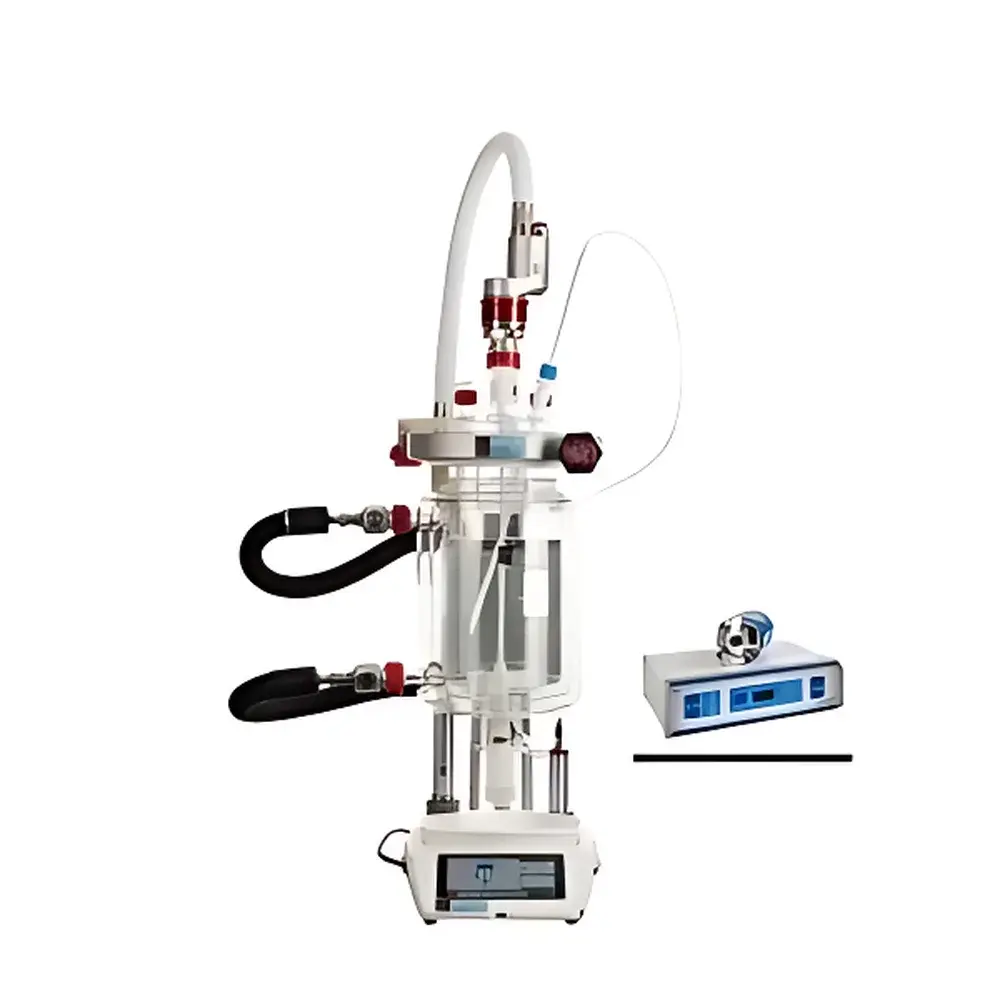
Atlas SonoLab Ultrasonic Crystallization System
| Brand | Syrris |
|---|---|
| Origin | United Kingdom |
| Manufacturer Type | Authorized Distributor |
| Origin Category | Imported |
| Model | Atlas SonoLab |
| Pricing | Available Upon Request |
Overview
The Atlas SonoLab Ultrasonic Crystallization System is an engineered platform for precision-controlled, laboratory-scale crystallization driven by high-frequency ultrasonic energy. Unlike conventional nucleation methods relying on thermal or mechanical seeding, the Atlas SonoLab utilizes focused 20–40 kHz ultrasonic cavitation to induce highly reproducible primary nucleation under isothermal conditions. This physical mechanism enables deterministic control over critical solid-state attributes—including particle size distribution (PSD), crystal habit, polymorphic form, and degree of crystallinity—without introducing foreign seeding agents or altering solvent composition. Designed specifically for process understanding and early-stage development, the system operates within standard jacketed glass reactors (10–500 mL), integrating seamlessly with Syrris’s Atlas platform for synchronized temperature, stirring, reagent addition, and real-time monitoring. Its architecture supports both continuous and pulsed sonication modes, allowing researchers to decouple nucleation kinetics from growth dynamics—a capability essential for mapping metastable zones and establishing robust crystallization design spaces per ICH Q5A and Q8(R2) guidelines.
Key Features
- Integrated digital ultrasonic generator with real-time power feedback and adjustable amplitude (0–100%), enabling precise cavitation intensity control
- Temperature-stabilized probe coupling via thermostatted horn mount, minimizing thermal drift during extended sonication cycles
- Automated protocol execution with time-synchronized logging of sonication duty cycle, bath temperature, stir rate, and dosing events
- Modular compatibility with Syrris Atlas Reactor Systems, including integration with in situ ATR-FTIR and FBRM probes for real-time solid-phase characterization
- Rugged stainless-steel transducer housing rated for continuous operation in organic and aqueous media; IP65-rated electronics enclosure
- Compliance-ready audit trail generation supporting 21 CFR Part 11–aligned electronic records when paired with Atlas software
Sample Compatibility & Compliance
The Atlas SonoLab accommodates a broad range of solute–solvent systems relevant to pharmaceutical, fine chemical, and agrochemical development—including polar protic (e.g., water, ethanol), polar aprotic (e.g., acetone, acetonitrile), and low-polarity media (e.g., toluene, heptane). It supports slurries with solids concentrations up to 30% w/w and tolerates viscosities ≤ 500 mPa·s without probe de-coupling. All wetted parts are constructed from chemically resistant materials: titanium alloy (sonotrode), PTFE-coated stainless steel (reactor lid), and borosilicate glass (vessel). The system conforms to CE marking requirements (2014/30/EU EMC Directive and 2014/35/EU Low Voltage Directive) and meets ISO 14644-1 Class 5 cleanroom compatibility standards when operated in controlled environments. Documentation packages include Factory Acceptance Test (FAT) reports and material traceability certificates compliant with GMP Annex 15 expectations.
Software & Data Management
Operation is managed through Syrris’s proprietary Atlas Software v5.x, a validated Windows-based application supporting method creation, sequence automation, and multi-parameter data acquisition at 1 Hz resolution. Raw sonication power, temperature, and stir speed signals are timestamped and stored in encrypted .atd binary format, convertible to CSV or HDF5 for third-party analysis (e.g., MATLAB, Python pandas). The software enforces user role-based access control (RBAC), electronic signatures, and full change history tracking—including parameter modifications, method recalls, and manual overrides. Audit trails are immutable and exportable in PDF/A-1b format, satisfying ALCOA+ principles for data integrity. Optional integration with LIMS platforms (via ASTM E1578-compliant API) enables automated metadata transfer to enterprise quality systems.
Applications
- Metastable Zone Width (MSZW) Mapping: Automated determination of induction times across supersaturation gradients using pulsed sonication as a consistent nucleation trigger
- Polymorph Screening: Systematic evaluation of solvent–antisolvent combinations, cooling profiles, and sonication timing to isolate thermodynamically distinct solid forms
- Crystal Size Engineering: Correlation of ultrasonic duty cycle and amplitude with final PSD (measured via laser diffraction or SEM) for targeted micronization
- Scale-up Pathway Development: Generation of geometrically and dynamically similar sonication parameters (e.g., power density, cavitation volume fraction) transferable to Prosonix pilot-scale reactors
- Reaction-Crystallization Coupling: In-line sonication during Grignard additions or imine formations to suppress oiling-out and improve phase purity
FAQ
Can the Atlas SonoLab be used with corrosive solvents such as concentrated HCl or HF?
No. While titanium sonotrodes resist many organics and mild acids, hydrofluoric acid and hot concentrated mineral acids cause rapid degradation and void warranty coverage.
Is it possible to operate the system under inert atmosphere?
Yes—standard reactor lids include septum ports and gas inlet/outlet fittings compatible with nitrogen or argon blanketing per USP environmental controls.
Does the system support Good Manufacturing Practice (GMP) validation?
Yes—the hardware and software are pre-qualified for IQ/OQ protocols; Syrris provides URS templates, test scripts, and 21 CFR Part 11 configuration documentation upon request.
What is the minimum detectable nucleation event resolution?
When integrated with FBRM or PVM, the system resolves chord length distribution shifts corresponding to ~0.5 µm particles within 2 seconds of sonication onset.
How is ultrasonic energy calibrated between instruments?
Each unit undergoes calorimetric calibration using ASTM E2432-17 methodology; certificate of calibration includes acoustic power output (W) and spatial intensity profile (W/cm²) at 25 °C.



