
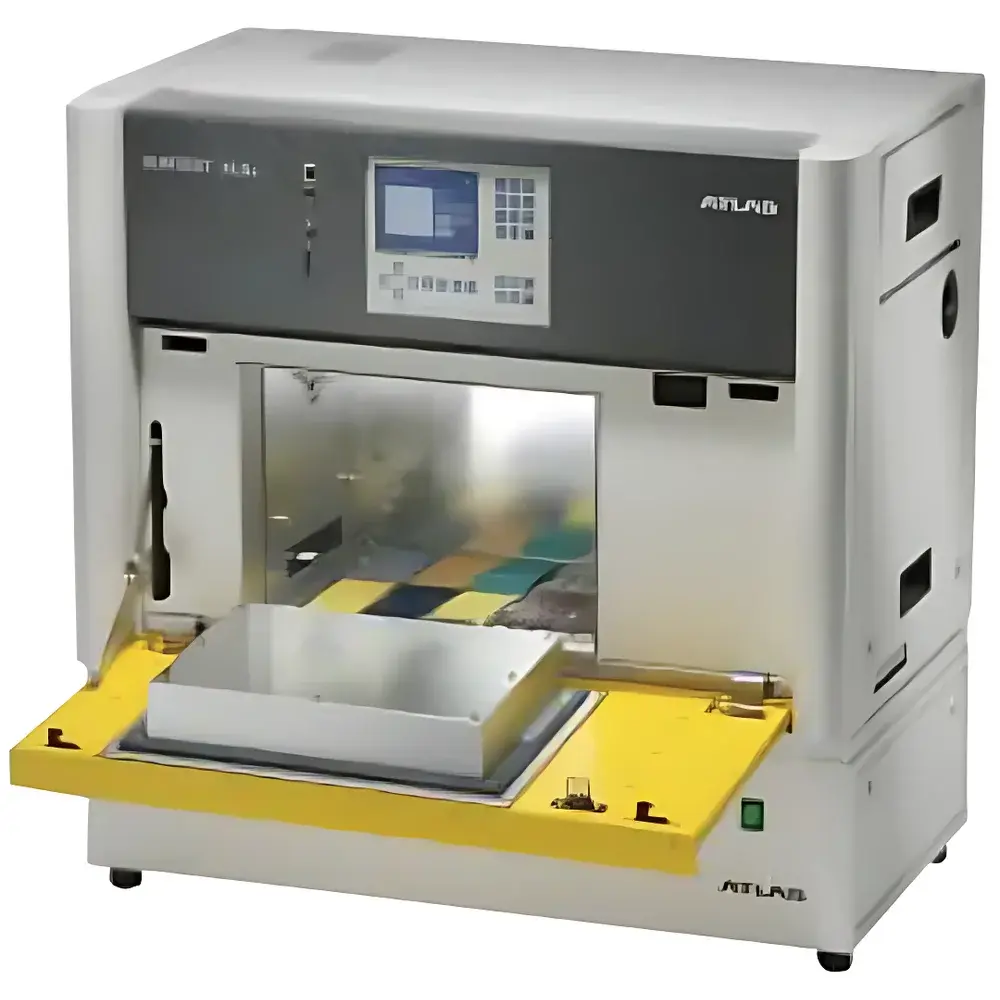
Atlas SUNTEST XLS+ Xenon Arc Weathering Test Chamber
| Brand | ATLAS |
|---|---|
| Origin | USA |
| Model | SUNTEST XLS+ |
| Chamber Dimensions | 90 × 54 × 62 cm |
| Exposure Area | 1170 cm² (39 × 30 cm) |
| Lamp | 1 × Air-Cooled 1700 W Xenon Arc Lamp |
| Irradiance Range | 30–65 W/m² (300–400 nm) |
| Black Standard Temperature (BST) | 45–100 °C |
| Control Interface | Touchscreen (13 languages), Ethernet, RS232, Internal Memory |
| Compliance | ISO 4892-1, CIE Publication No. 85 |
| Programmable Tests | 10 profiles, up to 12 stages each |
| Optional Accessories | SunSpray (spray), SunFlood (immersion), SunCool (cooling) |
Overview
The Atlas SUNTEST XLS+ is a benchtop xenon arc weathering test chamber engineered for accelerated simulation of solar radiation, temperature, and moisture exposure under controlled laboratory conditions. It employs a single air-cooled 1700 W xenon lamp to replicate full-spectrum daylight—calibrated per CIE Publication No. 85—with spectral power distribution closely matching terrestrial sunlight filtered through window glass or typical indoor lighting environments. Unlike UV-only or fluorescent-based testers, the XLS+ delivers photometrically accurate irradiance across 300–800 nm, enabling physicochemical degradation studies relevant to polymer photooxidation, pigment fading, coating chalking, and substrate embrittlement. Its 1170 cm² horizontal exposure plane accommodates both flat specimens and complex 3D components—making it uniquely suited for evaluating automotive trim, architectural façade elements, medical device housings, and consumer electronics enclosures. The system operates in accordance with ISO 4892-1 for general principles of exposure apparatus and test methods, providing traceable, reproducible aging data essential for R&D validation, quality assurance, and regulatory submission.
Key Features
- High-fidelity xenon arc source with advanced optical filtering—including uncoated fused quartz outer filter and integrated aluminum reflector—to ensure stable, spectrally accurate irradiance output over extended lamp life.
- Independent control of irradiance (300–400 nm, 340 nm, or 300–800 nm bands), black standard temperature (BST), and chamber ambient temperature within user-defined tolerance windows—enabling precise replication of real-world exposure profiles.
- Intuitive 7-inch color touchscreen interface supporting 13 languages, programmable via 10 customizable test protocols (each with up to 12 sequential stages), and preloaded with industry-standard cycles for plastics, paints, textiles, and adhesives per ISO, ASTM, and SAE specifications.
- Benchtop footprint (90 × 54 × 62 cm) optimized for space-constrained labs; tilting control panel enhances ergonomic access during setup and monitoring.
- Integrated diagnostics engine provides real-time status reporting—including lamp voltage/current, filter degradation alerts, cooling fan performance, and thermal sensor validation—to support preventive maintenance and GLP-compliant operation.
Sample Compatibility & Compliance
The SUNTEST XLS+ supports heterogeneous sample geometries—including molded parts, extruded profiles, laminated composites, and multi-material assemblies—without requiring custom fixturing. Its open-top exposure area permits direct mounting of 3D objects on adjustable sample holders, while optional accessories expand environmental fidelity: SunSpray enables cyclic wet/dry exposure per ISO 4892-2; SunFlood facilitates immersion testing under elevated temperature and irradiance; SunCool extends operational range to sub-ambient temperatures (e.g., pharmaceutical packaging stability per ICH Q1A). All BST sensors conform to ISO 4892-1 dimensional and thermal mass requirements, ensuring metrological equivalence between lab and field measurements. The instrument’s design meets CE marking criteria and supports audit readiness for ISO/IEC 17025-accredited laboratories.
Software & Data Management
Data acquisition and remote supervision are enabled via Ethernet connectivity and optional XenoTouch software suite (modules: Remote Control, Email Notification, Live Monitoring). Internal non-volatile memory logs irradiance, BST, chamber temperature, and runtime at user-configurable intervals (1–60 min resolution). Export formats include CSV and XML for integration into LIMS or statistical process control platforms. When configured with XenoTouch, the system supports FDA 21 CFR Part 11-compliant electronic signatures, role-based access control, and audit-trail generation—including timestamped parameter changes, test start/stop events, and calibration history—ensuring data integrity for GMP-regulated applications.
Applications
- Accelerated lightfastness evaluation of organic pigments, dyes, and colorants in automotive coatings and interior textiles.
- UV-induced degradation kinetics of polyolefins, polycarbonates, and thermoplastic elastomers used in outdoor infrastructure.
- Validation of protective topcoats and anti-aging additives against gloss loss, microcracking, and yellowing index (YI) shift.
- Stability assessment of printed electronics, OLED encapsulation layers, and biodegradable packaging films under simulated retail lighting.
- Correlation studies between laboratory xenon exposure and natural outdoor aging (e.g., Florida or Arizona field sites) using spectral mismatch correction algorithms.
FAQ
What standards does the SUNTEST XLS+ comply with?
It conforms to ISO 4892-1 (general principles), ISO 4892-2 (xenon arc methods), ASTM G155, SAE J2527, and AATCC TM16—supporting method transfer across global supply chains.
Can the XLS+ simulate window-filtered sunlight?
Yes—the instrument’s optical configuration replicates the spectral cutoff at ~380 nm characteristic of standard float glass, as defined in CIE 85 and ISO 4892-2 Annex A.
Is irradiance calibration traceable to NIST or equivalent national standards?
Calibration is performed using Atlas-certified reference radiometers calibrated against NIST-traceable sources; annual recalibration services include full spectral verification and sensor drift compensation.
How is humidity controlled in the XLS+?
Humidity is managed indirectly via spray (SunSpray) or immersion (SunFlood) modules—not by internal vapor generation—ensuring high reproducibility without condensation-related artifacts.
What is the expected service life of the xenon lamp and outer filter?
The 1700 W lamp maintains ≥90% nominal irradiance output for ≥1500 hours; the uncoated quartz outer filter typically lasts 3000+ hours before replacement due to transmittance decay.



