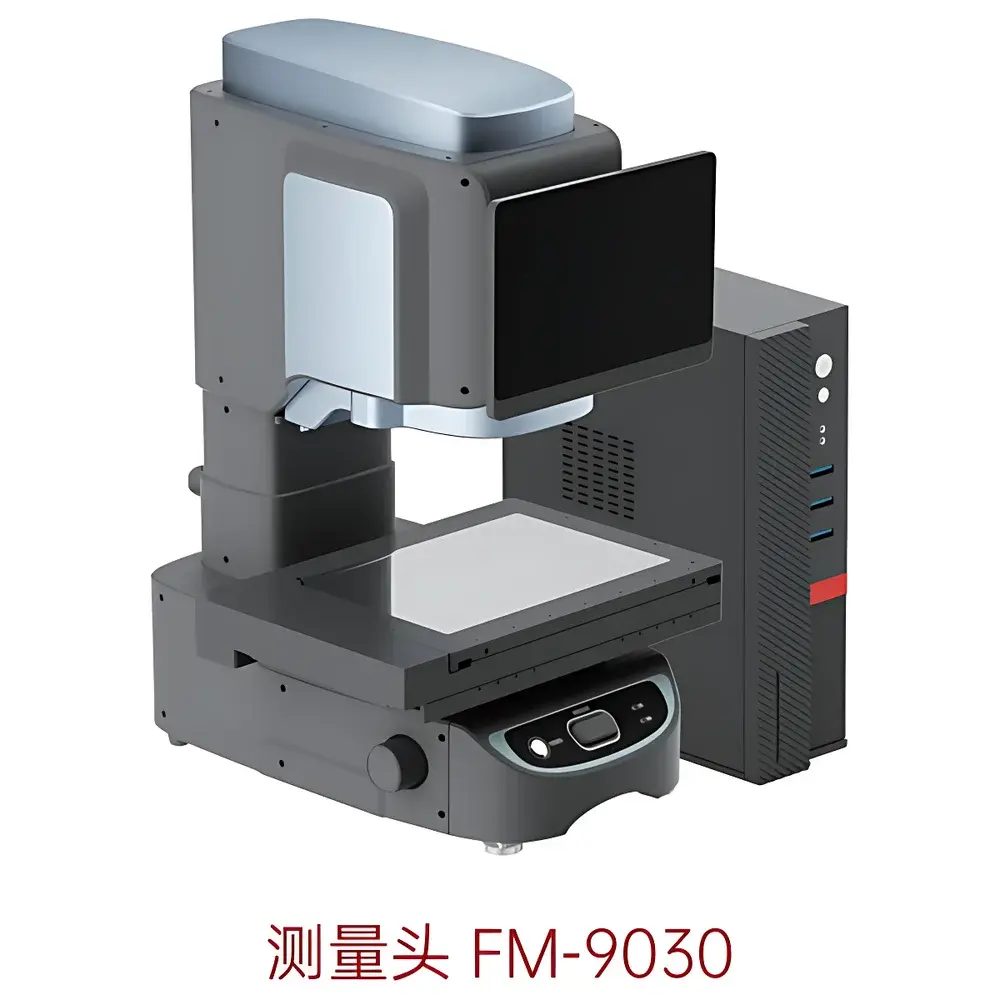
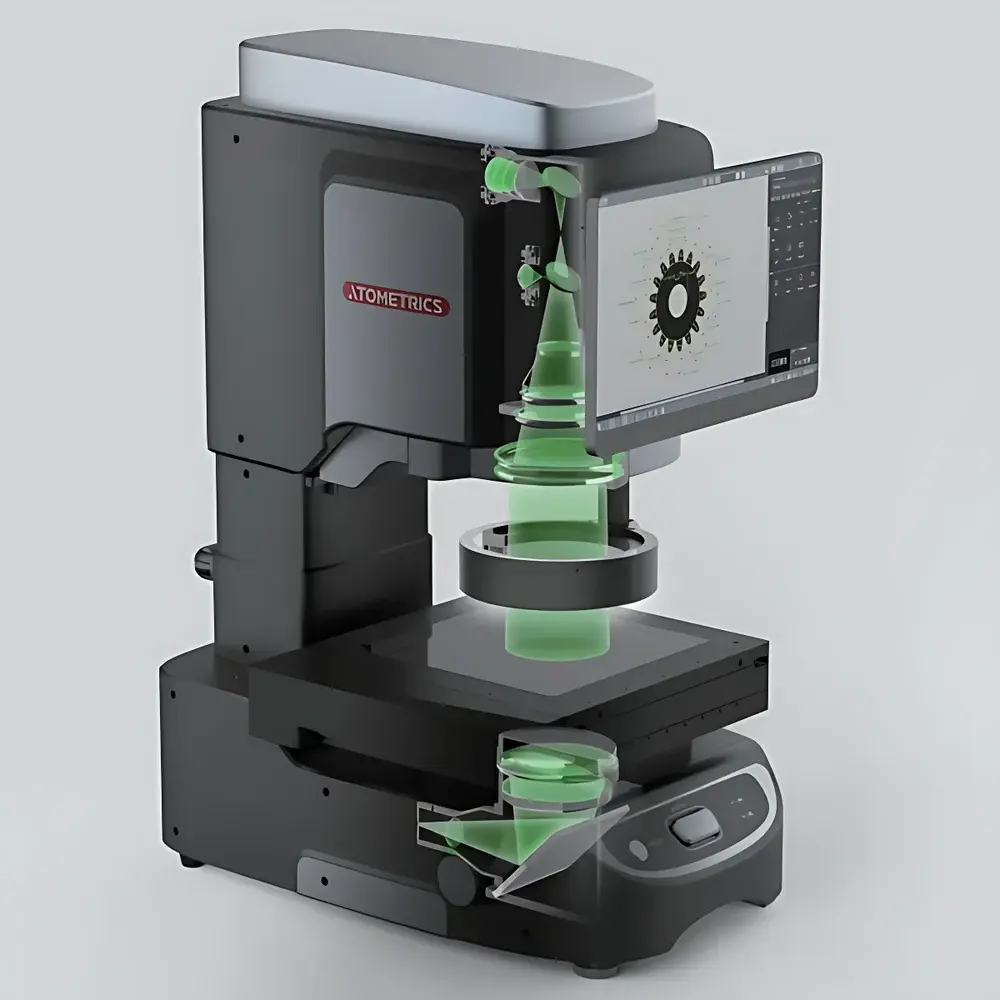
Atometrics FM-9030 Fully Automated One-Touch Vision Measuring System (2D/2.5D Image Metrology Platform)
| Brand | Atometrics |
|---|---|
| Origin | Guangdong, China |
| Manufacturer Type | Direct Manufacturer |
| Country of Origin | China |
| Model | FM-9030 |
| Operation Mode | Fully Automatic |
| Measurement Accuracy | ±1.5 µm |
| Encoders Resolution | 50 nm |
| Camera | 20 MP Monochrome CMOS |
| Illumination System | Transmission Light, Ring Light, Movable Profile Light, Slit Ring Light |
Overview
The Atometrics FM-9030 is a fully automated, high-precision vision measuring system engineered for rapid, repeatable 2D and 2.5D geometric metrology in industrial quality control environments. Unlike conventional coordinate measuring machines (CMMs), optical comparators, or manual microscope-based measurement setups, the FM-9030 eliminates dependency on operator skill through deterministic optical and motion control architecture. It employs telecentric dual-objective optics—featuring high numerical aperture (NA) and ultra-low distortion—to ensure consistent magnification and minimal perspective error across the entire field of view. Measurement is based on sub-pixel edge detection algorithms operating on monochrome CMOS imagery, enabling resolution beyond native pixel pitch (down to 0.005 pixel interpolation). The system integrates a nanometer-resolution motorized XY stage (50 nm encoder resolution, 80 mm/s max speed) with intelligent auto-focus, auto-illumination optimization, and real-time edge fitting—delivering traceable, GLP-compliant dimensional data without manual intervention.
Key Features
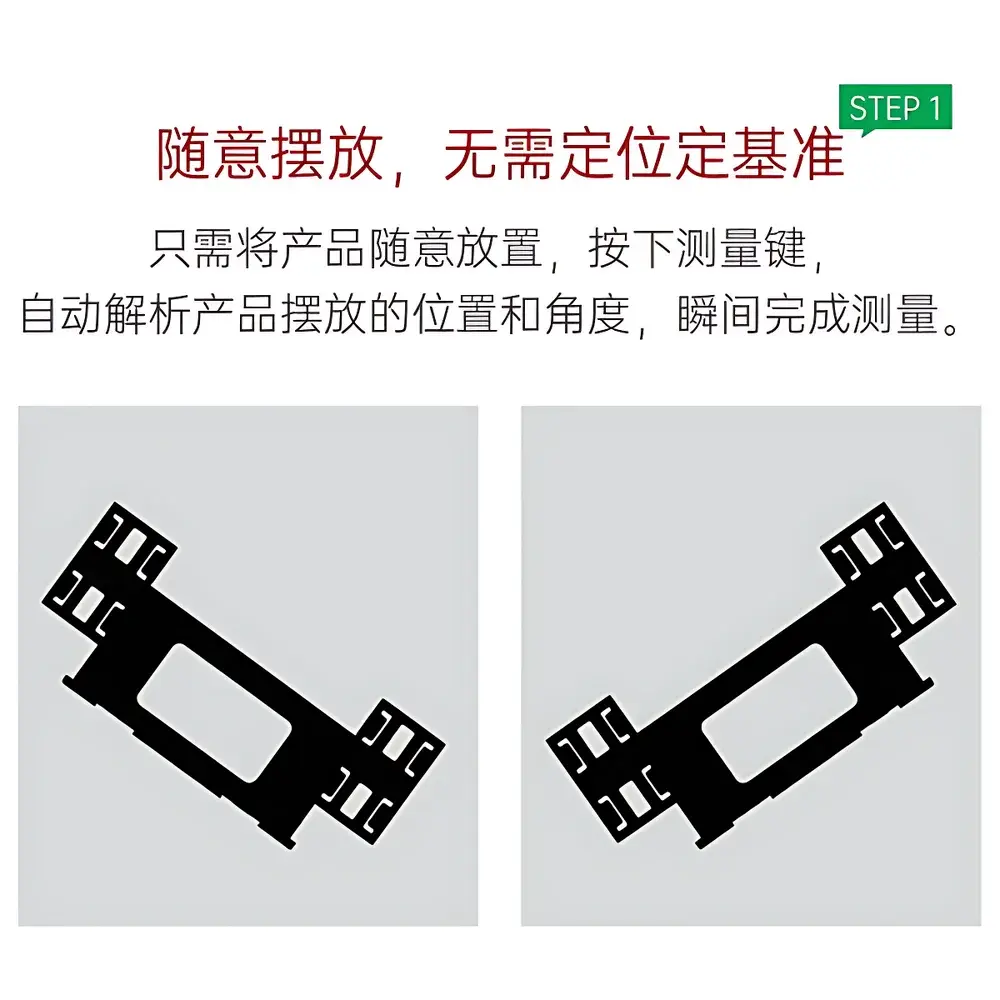
- Fully automated one-touch measurement workflow: single-button initiation triggers full sequence—global preview, auto-part recognition, multi-region imaging, edge extraction, dimension calculation, and report generation.
- Dual-field optical system: simultaneously displays both wide-field overview and high-magnification precision view—enabling rapid navigation and localized high-accuracy measurement without mechanical zoom or lens switching.
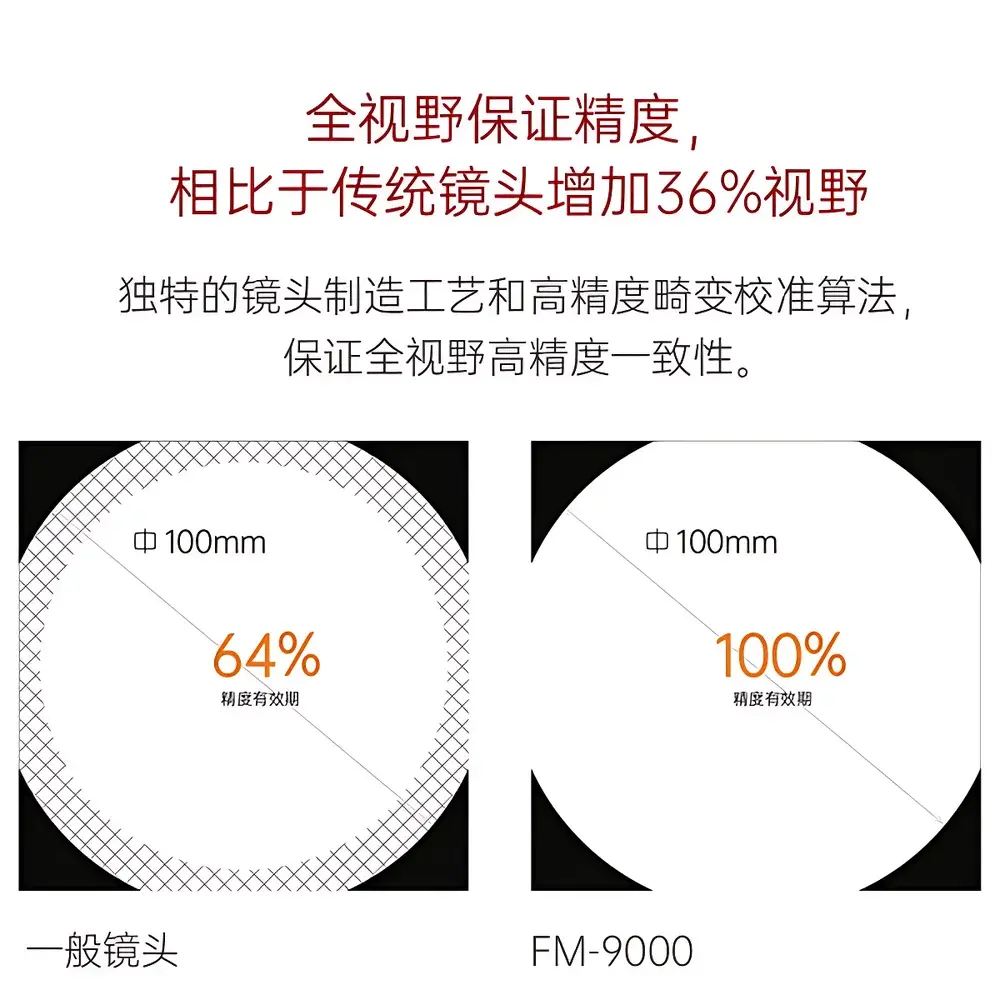
- Telecentric dual-objective lens assembly: optimized for minimal distortion (<0.02% typical) and uniform resolution across FOV; delivers 36% larger effective measurement area compared to standard non-telecentric optics at equivalent magnification.
- Sub-pixel edge detection engine: adaptive curve-fitting algorithm suppresses noise, rejects outliers (e.g., burrs, surface debris), and computes edge positions with ≤0.005-pixel repeatability—enhancing robustness under variable lighting or surface finish conditions.
- Intelligent motion platform: programmable stage with global search capability; automatically detects number and position of parts within the field prior to measurement—reducing setup time and eliminating manual part indexing.
- Multi-spectrum illumination suite: independent control of transmission backlight, coaxial ring light, adjustable profile light, and slit ring light—optimized for diverse material types (metal, plastic, rubber, thin films) and feature geometries (holes, edges, slots, contours).
Sample Compatibility & Compliance
The FM-9030 accommodates a broad range of manufactured components including stamped metal parts (e.g., connectors, terminals, spring contacts), machined shafts and gears, injection-molded plastic housings, powder metallurgy sintered parts, die-cut elastomers, and precision structural components. Its non-contact measurement principle ensures compatibility with delicate, soft, or thermally sensitive samples. The system supports ISO 10360-7 (geometric accuracy verification for vision systems), complies with GD&T principles per ASME Y14.5 and ISO 1101, and enables audit-ready data traceability aligned with FDA 21 CFR Part 11 requirements when deployed with optional secure software licensing and electronic signature modules. Calibration certificates are issued per ISO/IEC 17025-accredited procedures.
Software & Data Management
The embedded metrology software provides intuitive graphical programming, batch measurement sequencing, and customizable report templates (PDF, Excel, CSV). All measurement operations—including image capture timestamps, illumination parameters, focus position, and stage coordinates—are logged with full audit trail functionality. Data export supports SPC integration (X-bar R, Cp/Cpk) and direct linkage to MES/QMS platforms via OPC UA or RESTful API. Optional modules include GD&T evaluation (position, concentricity, profile), statistical process monitoring dashboards, and multi-instrument network synchronization for factory-floor deployment.
Applications
The FM-9030 is routinely deployed in Tier-1 automotive supply chains for incoming inspection of stamped terminals and connector housings; in medical device manufacturing for verifying tolerances on micro-machined surgical instrument components; in consumer electronics for dimensional validation of injection-molded camera module carriers; and in precision gear production for involute profile and pitch error assessment. Its speed and repeatability make it especially suitable for high-volume inline or near-line QA stations where cycle time <8 seconds per part is required—and where inter-operator variability must be eliminated to meet IATF 16949 clause 7.1.5.2.
FAQ
Does the FM-9030 require periodic recalibration?
Yes—annual calibration against traceable artifacts (e.g., NIST-traceable step gauges, grid plates) is recommended to maintain ±1.5 µm measurement uncertainty; calibration intervals may be extended under controlled environmental conditions with documented stability studies.
Can the system measure features with reflective or translucent surfaces?
Yes—the multi-angle, multi-spectrum illumination system—including movable profile light and slit ring light—enables robust edge contrast enhancement for challenging surfaces such as polished metals, transparent polymers, and anodized aluminum.
Is GD&T evaluation supported out-of-the-box?
Basic GD&T symbols (e.g., position, true position, parallelism) are included in standard software; advanced evaluations (e.g., profile of a surface, runout) require optional GD&T Plus module.
What environmental conditions are required for optimal performance?
Operating temperature: 20 ± 2 °C; humidity: 40–60% RH non-condensing; vibration isolation table recommended for sub-µm repeatability; ambient light shielding advised for consistent illumination control.
How is software validation handled for regulated industries?
Atometrics provides IQ/OQ documentation packages and supports customer-led PQ execution; software version history, change logs, and electronic signature workflows comply with FDA 21 CFR Part 11 and EU Annex 11 expectations.