
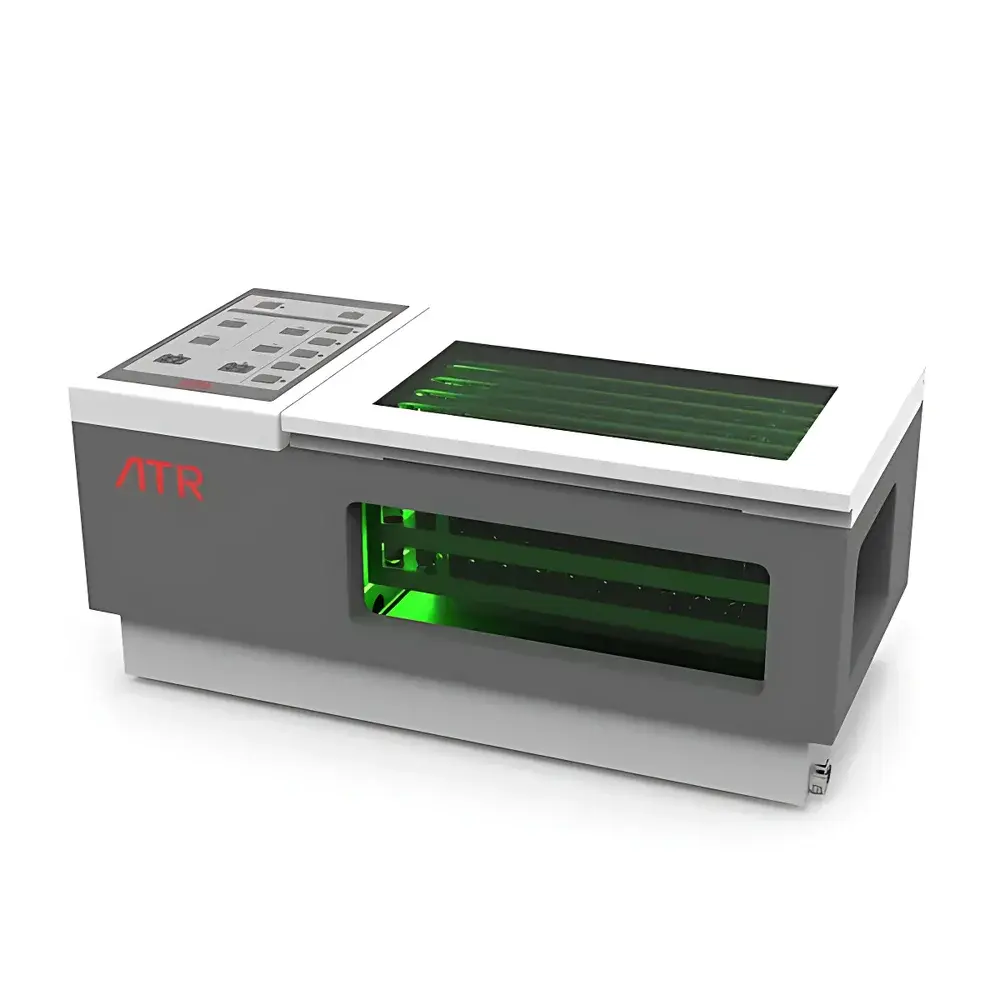
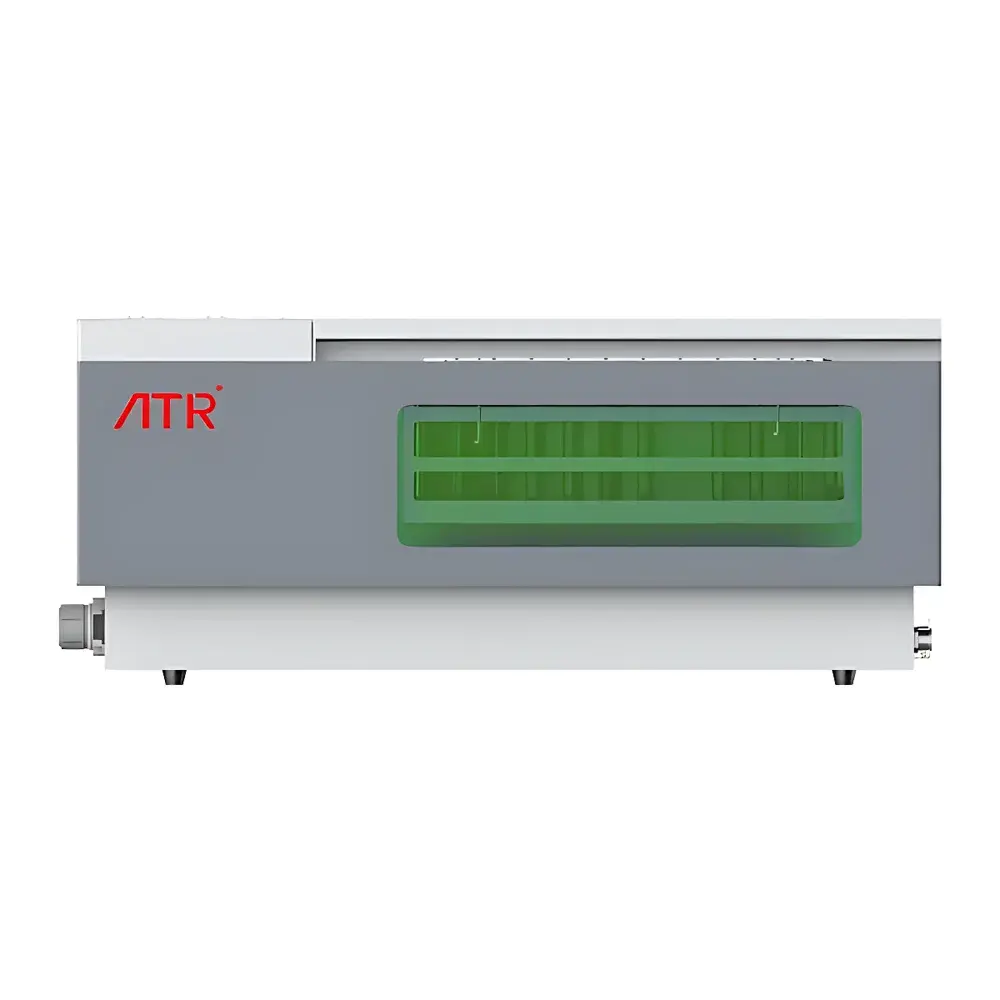
ATR AutoVap S60 Automated Nitrogen Evaporator
| Brand | ATR |
|---|---|
| Origin | USA |
| Model | AutoVap S60 |
| Heating Method | Water Bath |
| Temperature Range | Ambient to 99 °C |
| Temperature Stability | ±0.5 °C |
| Sample Vial Capacity | 1.5 mL to 50 mL |
| Gas Flow Rate | 0–8 L/min |
| Sample Positions | 60 |
| Heating Power | 800 W |
Overview
The ATR AutoVap S60 Automated Nitrogen Evaporator is an engineered solution for high-throughput solvent removal in analytical laboratories. It employs a proprietary vortex gas flow principle—distinct from conventional linear nitrogen impingement—to accelerate evaporation while minimizing sample disturbance and analyte loss. Unlike traditional open-bay nitrogen blow-down systems, the AutoVap S60 integrates precision water bath heating with five independently regulated nitrogen gas channels, each servicing 12 vials simultaneously (total 60 positions). This architecture ensures uniform thermal transfer and consistent gas shear across all samples, critical for reproducible concentration of volatile organic extracts in regulated environments. Designed for compliance-driven workflows, the system supports GLP- and GMP-aligned operations through traceable temperature logging, automated event notifications, and hardware-level safeguards against dry-run or overfill conditions.
Key Features
- Five independent nitrogen flow control channels (12 positions per channel), enabling parallel processing of up to 60 samples with individual gas flow optimization
- Water bath heating system with PID-controlled temperature regulation (ambient to 99 °C) and ±0.5 °C stability over time
- Vortex airflow design reduces splashing, suppresses aerosol formation, and improves analyte recovery (>95% for common pesticides, PAHs, and pharmaceutical standards)
- Interchangeable vial racks supporting 1.5 mL microcentrifuge tubes through 50 mL round-bottom or flat-bottom vials; rack swap completed in <10 seconds without tools
- Integrated liquid level detection with dual-mode alarm: low-water cutoff and overflow prevention via optical sensor feedback
- PTFE-coated gas nozzles and optional PTFE-lined water bath chamber for compatibility with acidic, basic, and halogenated solvents (e.g., HCl, TFA, chloroform)
- Automated drain valve with gravity-assisted drainage path; eliminates manual siphoning and reduces maintenance downtime
- Front-mounted transparent viewing window with anti-fog coating for real-time visual monitoring of sample volume reduction
- Exhaust ducting system (1.5 m length included) paired with corrosion-resistant centrifugal fan—enables safe operation outside fume hoods per OSHA 1910.1200 and NIOSH guidelines
Sample Compatibility & Compliance
The AutoVap S60 accommodates vial formats ranging from 1.5 mL Eppendorf-style tubes to 50 mL conical or cylindrical containers. Its modular rack system accepts standard ANSI/SLAS footprint configurations, ensuring interoperability with robotic liquid handlers and autosamplers. The system complies with key regulatory frameworks governing analytical sample preparation: it meets ASTM D5845-17 requirements for solvent evaporation repeatability in environmental testing, aligns with ISO/IEC 17025:2017 clause 7.2.2 on equipment suitability, and supports audit-ready data integrity when integrated with validated LIMS or ELN platforms. Optional firmware modules provide 21 CFR Part 11-compliant electronic signatures, user access controls, and immutable audit trails for temperature setpoints, run durations, and gas flow logs.
Software & Data Management
The AutoVap S60 operates via an embedded industrial-grade controller with a 7-inch capacitive touchscreen interface. All operational parameters—including target temperature, ramp rate, total run time, and per-channel gas flow—are configurable and stored in non-volatile memory. Real-time metrics (actual bath temperature, elapsed time, remaining duration) are displayed continuously. Upon completion or interruption, the system generates timestamped CSV reports containing start/stop times, maximum recorded temperature deviation, and any triggered alarms. Optional Ethernet or RS-232 connectivity enables remote monitoring and integration into centralized lab automation networks. SMS notification capability (via external GSM module) delivers alerts for endpoint confirmation or fault conditions—supporting unattended overnight operation in multi-shift facilities.
Applications
The AutoVap S60 is routinely deployed in laboratories performing residue analysis, environmental monitoring, forensic toxicology, and pharmaceutical quality control. Typical use cases include: concentration of QuEChERS extracts prior to GC-MS analysis; post-SPE cleanup of drinking water samples for EPA Method 525.3; reduction of large-volume ASE eluates (up to 100 mL per vial with optional 27-position ASE rack); and high-volume sample prep for food safety screening (e.g., mycotoxins, veterinary drug residues). Its robustness and throughput make it suitable for contract testing labs serving agricultural, clinical, public health, and regulatory agencies—including national reference laboratories conducting proficiency testing under ILAC G13.
FAQ
Does the AutoVap S60 require connection to an external nitrogen generator or compressed air line?
No—it is compatible with standard laboratory nitrogen supply lines (regulated pressure range: 30–100 psi) and includes integrated pressure regulators and flow meters per channel.
Can the system be validated for use in FDA-regulated environments?
Yes—documentation packages including IQ/OQ protocols, calibration certificates for temperature sensors and flow meters, and material compatibility data (USP Class VI, FDA 21 CFR 177.1550) are available upon request.
Is method transfer supported between different vial sizes?
Yes—the system’s adaptive gas flow algorithm automatically compensates for changes in surface area-to-volume ratio; validation studies confirm equivalent recovery across 1.5 mL, 15 mL, and 50 mL formats using identical method parameters.
What maintenance intervals are recommended for routine operation?
Daily visual inspection of water level and nozzle alignment; quarterly verification of temperature sensor accuracy using NIST-traceable reference thermometers; annual replacement of silicone gaskets and exhaust fan filters.
How does the vortex airflow design improve reproducibility compared to linear gas delivery?
Vortex flow induces controlled turbulent mixing at the liquid surface, reducing boundary layer resistance and eliminating localized hot spots or stagnant zones—resulting in tighter RSDs (<3.2% CV for replicate 10 mL hexane evaporation runs).
Related Products



