
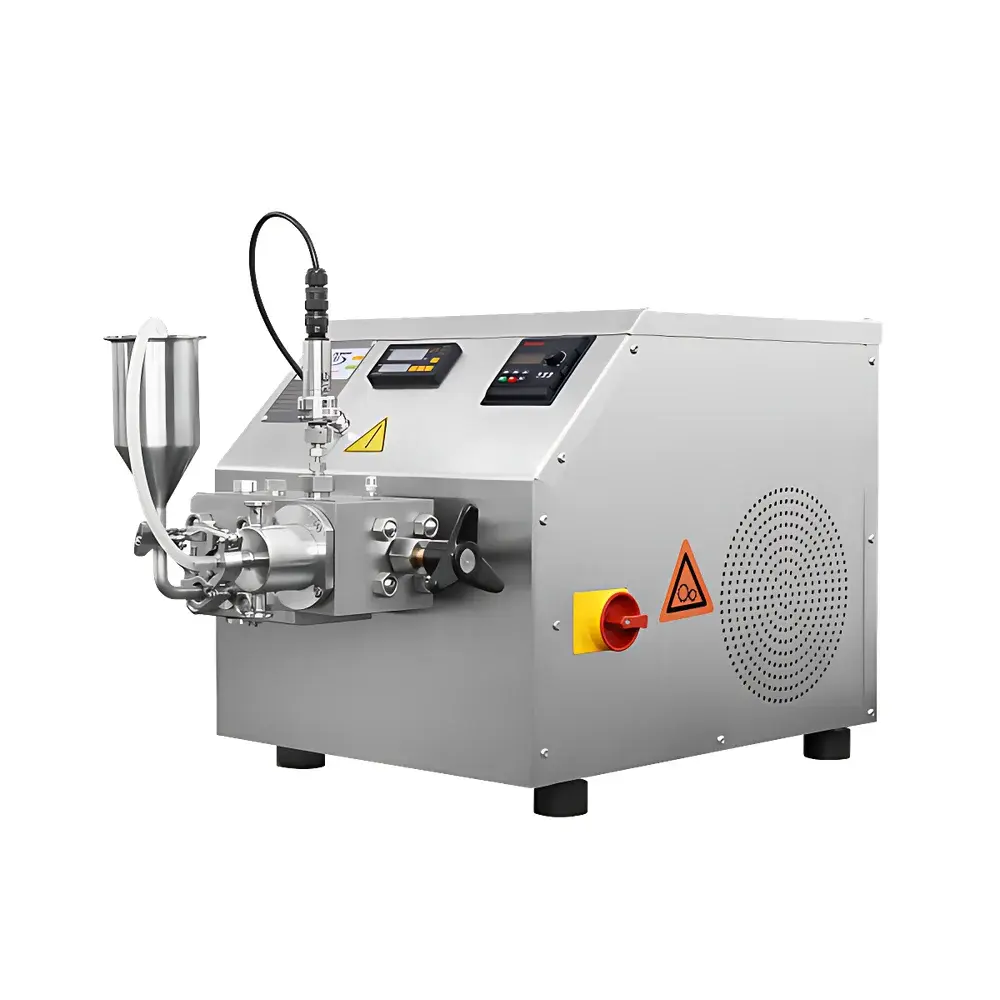
ATS AH-1500 Biological High-Pressure Homogenizer
| Brand | ATS |
|---|---|
| Origin | Jiangsu, China |
| Manufacturer Type | Authorized Distributor |
| Country of Origin | China |
| Model | AH-1500 |
| Instrument Type | High-Pressure Homogenizer |
| Maximum Design Pressure | 2000 bar |
| Maximum Operating Pressure | 1800 bar |
| Viscosity Limit | < 2000 cP |
| Flow Rate | 25 mL–15 L/h |
| Maximum Feed Particle Size | < 500 µm |
| Maximum Feed Temperature | < 90 °C |
| Dimensions (W×H×L) | 440 × 410 × 800 mm |
| Weight | 110 kg |
Overview
The ATS AH-1500 Biological High-Pressure Homogenizer is an engineered solution for reproducible, scalable cell disruption and nano-emulsion formation in life science and pharmaceutical research laboratories. It operates on the principle of high-pressure microfluidization—forcing sample suspension through a precisely engineered two-stage homogenizing valve at pressures up to 1800 bar. This generates intense shear, cavitation, and impact forces that effectively lyse microbial, mammalian, or plant cells while maintaining biomolecular integrity under controlled thermal conditions. Designed specifically for biological applications, the AH-1500 prioritizes sterility assurance, pressure stability, and process repeatability—critical parameters for GMP-aligned preclinical formulation development, vaccine antigen release, and liposomal drug encapsulation.
Key Features
- Two-stage homogenizing valve system with interchangeable ceramic or hardened alloy valve inserts—optimized for wear resistance and chemical compatibility with biological buffers, organic solvents, and acidic/alkaline formulations.
- Digital pressure display with real-time feedback and integrated electronic overpressure protection—ensuring compliance with ISO 13849-1 functional safety requirements for laboratory equipment.
- Compact footprint (440 × 410 × 800 mm) enables seamless integration into biosafety cabinets, cold rooms, or standard benchtop workflows without requiring dedicated utility infrastructure.
- Modular architecture facilitates rapid valve replacement, pump head servicing, and seal inspection—minimizing downtime and supporting routine preventive maintenance per GLP documentation standards.
- Thermally stable operation with feed temperature monitoring (<90 °C max) and optional jacketed inlet tubing—preserving heat-labile proteins, nucleic acids, and adjuvants during processing.
Sample Compatibility & Compliance
The AH-1500 accommodates a broad range of biologically relevant feedstocks: bacterial cultures (E. coli, Bacillus), yeast suspensions, mammalian cell lines (CHO, HEK293), tissue homogenates, and viscous pre-formulations including lipid nanoparticles (LNPs), polymeric micelles, and oil-in-water emulsions. Feed particle size must remain below 500 µm to prevent valve clogging; pre-filtration via 100–200 µm mesh is recommended for crude lysates. The system complies with CE marking requirements for laboratory machinery (2006/42/EC) and supports audit-ready documentation for ISO 9001-certified quality systems. While not FDA 21 CFR Part 11–validated out-of-the-box, its pressure logging capability and user-accessible service records align with ALCOA+ data integrity principles for regulated environments.
Software & Data Management
The AH-1500 operates as a stand-alone instrument with local digital pressure control and manual flow regulation. No proprietary software is required for basic operation; however, pressure profiles and runtime duration are logged via the integrated digital gauge memory (retains last 50 cycles). For laboratories implementing electronic lab notebooks (ELN) or LIMS integration, analog 4–20 mA output signals (optional add-on) enable external acquisition of pressure and temperature telemetry. All firmware updates and calibration certificates are traceable to NIST-traceable pressure standards, supporting metrological continuity across instrument lifecycles.
Applications
- Cell lysis for recombinant protein extraction and inclusion body recovery
- Preparation of uniform sub-200 nm liposomes and exosome-mimetic vesicles
- Homogenization of vaccine adjuvant emulsions (e.g., MF59-type formulations)
- Nanoparticle dispersion in topical and oral nanomedicine development
- Stabilization of protein-polysaccharide complexes for nutraceutical delivery
- High-shear processing of cosmetic actives (e.g., retinol, coenzyme Q10) into transparent microemulsions
FAQ
What is the maximum allowable viscosity for continuous operation?
The AH-1500 is rated for feed viscosities up to 2000 cP at 25 °C. Viscosities exceeding this threshold require pre-dilution or elevated feed temperature (≤90 °C) to maintain laminar flow and avoid pressure spikes.
Can the homogenizer be used with corrosive buffers such as low-pH citrate or high-salt Tris-HCl solutions?
Yes—ceramic valve components provide excellent resistance to acidic, alkaline, and saline media. Alloy valve options (e.g., tungsten carbide) are recommended for extended use with abrasive additives or phosphate-buffered formulations.
Is validation support available for IQ/OQ protocols?
ATS provides factory-issued test reports (including pressure accuracy verification and leak testing), and the modular design permits third-party qualification by certified laboratory service providers in accordance with ASTM E2500 and EU Annex 15 guidelines.
Does the system meet containment requirements for BSL-2 pathogens?
When coupled with closed-loop recirculation manifolds and sterilizable stainless-steel wetted parts, the AH-1500 supports BSL-2–compliant operation. Full containment requires integration with validated exhaust filtration (HEPA + carbon) and pressure-decay integrity testing prior to first use.
Related Products



