
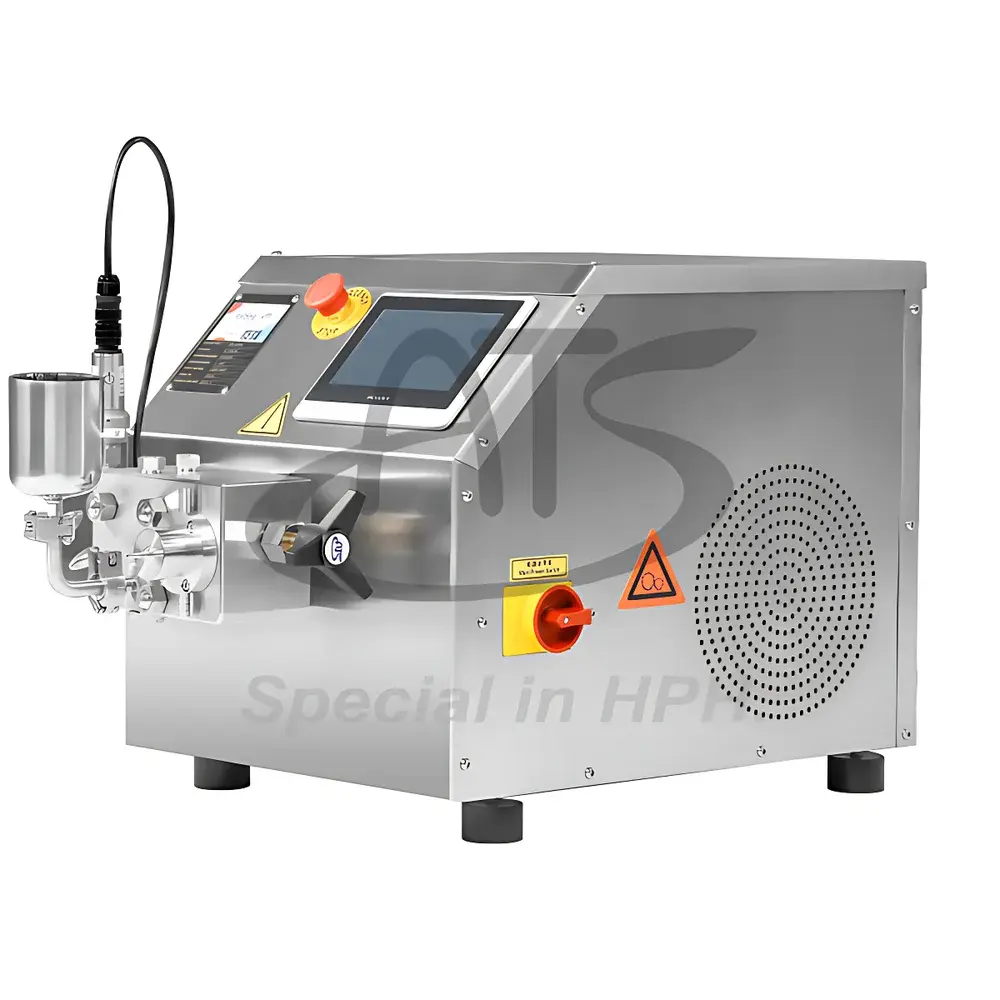
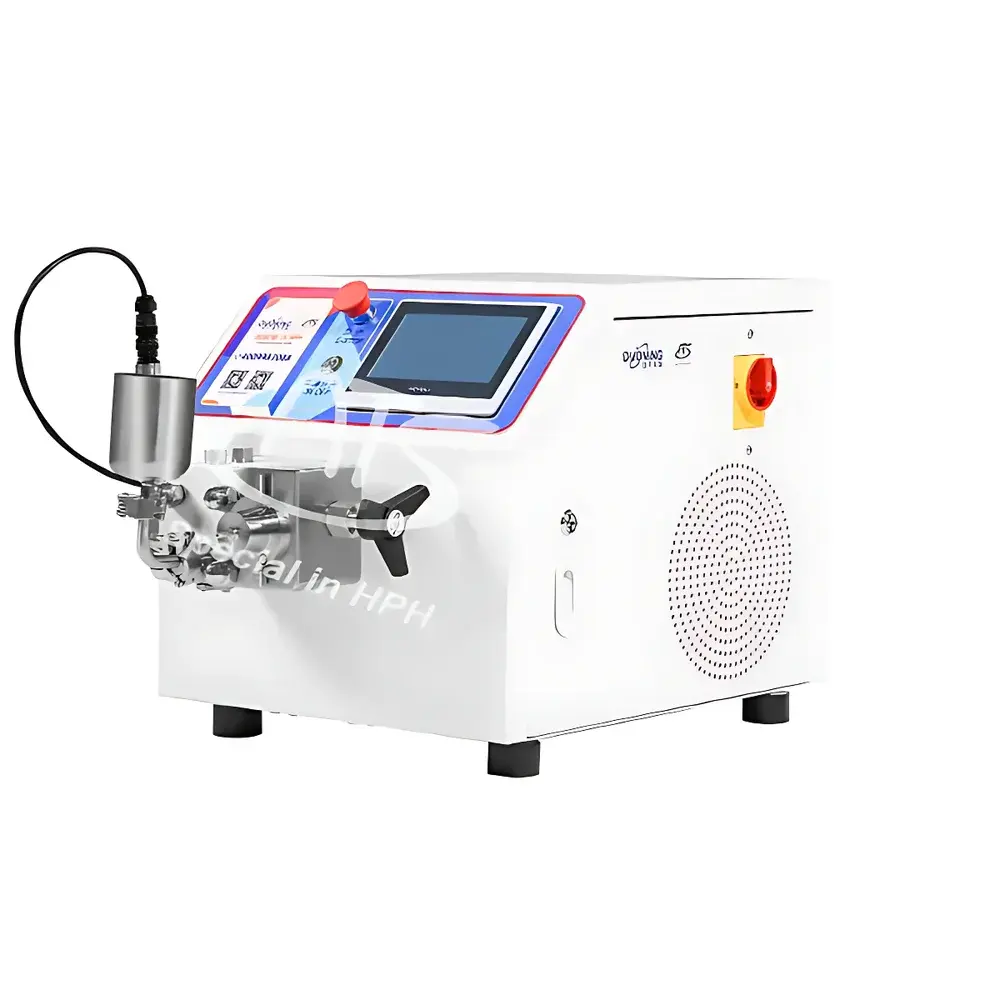
ATS AH-NANO High-Pressure Homogenizer
| Brand | ATS |
|---|---|
| Origin | Jiangsu, China |
| Manufacturer Type | Direct Manufacturer |
| Instrument Type | High-Pressure Homogenizer |
| Model | AH-NANO |
| Dimensions (W×D×H) | 440 × 800 × 410 mm |
| Processing Capacity | 15–10,000 mL/h |
| Maximum Design Pressure | 2000 bar |
| Maximum Operating Pressure | 1800 bar |
| Viscosity Limit | < 2000 cP |
| Feed Particle Size | < 500 µm |
| Feed Temperature | < 90 °C |
| Weight | 110 kg |
| Cooling Module | Integrated chiller (5–10 °C operational range) |
| Valve Configuration | Dual-stage adjustable homogenizing valve |
| Valve Materials | Ceramic or hardened alloy options |
| Pressure Monitoring | Digital pressure display with electronic overpressure protection |
| Structural Design | Modular, benchtop-integrated architecture |
| Compliance | CE-certified per EU Machinery Directive 2006/42/EC and Low Voltage Directive 2014/35/EU |
Overview
The ATS AH-NANO High-Pressure Homogenizer is an engineered laboratory-scale system designed for reproducible, scalable nano-dispersion and cell disruption under precisely controlled high-pressure conditions. It operates on the principle of positive displacement pumping coupled with controlled pressure-induced cavitation, impact, and shear forces generated as sample fluid passes through a dynamically adjustable dual-stage homogenization valve. This mechanism enables consistent particle size reduction down to sub-100 nm regimes—critical for formulation development in biopharmaceuticals, nanomaterial synthesis, and advanced colloidal systems. The unit achieves maximum design pressure of 2000 bar with stable operation up to 1800 bar, supporting both batch and semi-continuous processing across volumes from 15 mL to 10 L per hour. Its compact footprint (440 × 800 × 410 mm) allows seamless integration into ISO Class 5–7 clean benches or GMP-compliant lab environments without requiring dedicated utility rooms.
Key Features
- Dual-stage homogenization valve with interchangeable ceramic or hardened alloy inserts—optimized for wear resistance, thermal stability, and compatibility with abrasive or corrosive suspensions.
- Integrated digital pressure monitoring system with real-time display and programmable electronic overpressure cutoff (EOPC), ensuring operator safety and process integrity during extended runs.
- Benchtop modular architecture featuring tool-free access to pump heads, valve assemblies, and cooling circuits—reducing mean time to repair (MTTR) and enabling rapid reconfiguration between R&D and pilot-scale protocols.
- Onboard temperature control module maintaining sample inlet temperature between 5–10 °C—critical for thermolabile biomolecules (e.g., monoclonal antibodies, viral vectors, exosomes) where thermal denaturation must be minimized.
- CE-certified mechanical and electrical subsystems compliant with EN 61000-6-2 (EMC immunity) and EN 61000-6-4 (EMC emission) standards, supporting audit-readiness in regulated environments.
Sample Compatibility & Compliance
The AH-NANO accommodates aqueous, organic, and mixed-phase suspensions with viscosities up to 2000 cP and feed particulates ≤500 µm. It is routinely deployed in GLP-compliant preformulation studies for liposomal drug delivery, protein nanoparticle stabilization, bacterial and yeast cell lysis (including Gram-positive strains), and emulsion nanostructuring (e.g., nanoemulsions for topical corticosteroids or nutraceuticals). All wetted surfaces are constructed from FDA-compliant 316L stainless steel or chemically inert ceramics. The system meets ISO 22000-aligned hygiene design principles and supports validation documentation packages—including IQ/OQ protocols—for installation in pharmaceutical QC labs operating under USP , ASTM E2500, and Annex 11 requirements.
Software & Data Management
While the base AH-NANO operates via hardware-integrated controls, optional RS-485/Modbus RTU interface enables integration with LabVantage, Empower, or custom SCADA platforms for centralized parameter logging (pressure, temperature, cycle count, total throughput). Audit trails capture timestamped events including valve actuation, pressure excursions >±5 bar, and thermal deviation alerts—fully traceable per FDA 21 CFR Part 11 when paired with validated third-party data acquisition software. Raw pressure and temperature logs export in CSV format for statistical process control (SPC) analysis using JMP or Minitab.
Applications
- Biological: Mechanical lysis of mammalian, bacterial, and fungal cells with >99% disruption efficiency verified by ATP assay and flow cytometry.
- Pharmaceutical: Production of sterile-filterable lipid nanoparticles (LNPs), polymeric micelles, and nanocrystal suspensions meeting ICH Q5A immunogenicity thresholds.
- Materials Science: Exfoliation of 2D materials (graphene oxide, MoS₂), dispersion of quantum dots in polymer matrices, and stabilization of metal-organic frameworks (MOFs).
- Food & Cosmetics: Nanoemulsification of essential oils, vitamin E acetate, and coenzyme Q10 for enhanced bioavailability and photostability.
- Academic Research: Method development for scalable continuous-flow nanomanufacturing aligned with DOE’s Advanced Manufacturing Office (AMO) benchmarks.
FAQ
What is the minimum recommended sample volume for effective homogenization?
For optimal cavitation efficiency and pressure stability, the minimum practical volume is 15 mL per cycle; smaller volumes may require syringe-assisted priming to avoid air entrapment.
Can the AH-NANO be used for sterile processing?
Yes—when equipped with sterilizable valve cartridges and connected to a Class A/B isolator or laminar flow hood, it supports aseptic processing under ISO 14644-1 Class 5 conditions.
Is validation support available for GMP environments?
ATS provides IQ/OQ templates, calibration certificates traceable to NIST standards, and on-site protocol execution support for facilities subject to EMA or PMDA inspections.
How often does the homogenization valve require replacement?
Ceramic valves typically last ≥500 hours at 1500 bar; alloy variants exceed 1000 hours under identical load—both monitored via integrated pressure decay diagnostics.
Does the system comply with noise emission regulations for laboratory use?
Sound pressure level is ≤72 dB(A) at 1 m distance—within OSHA PEL limits and compatible with shared open-lab floorplans.



