
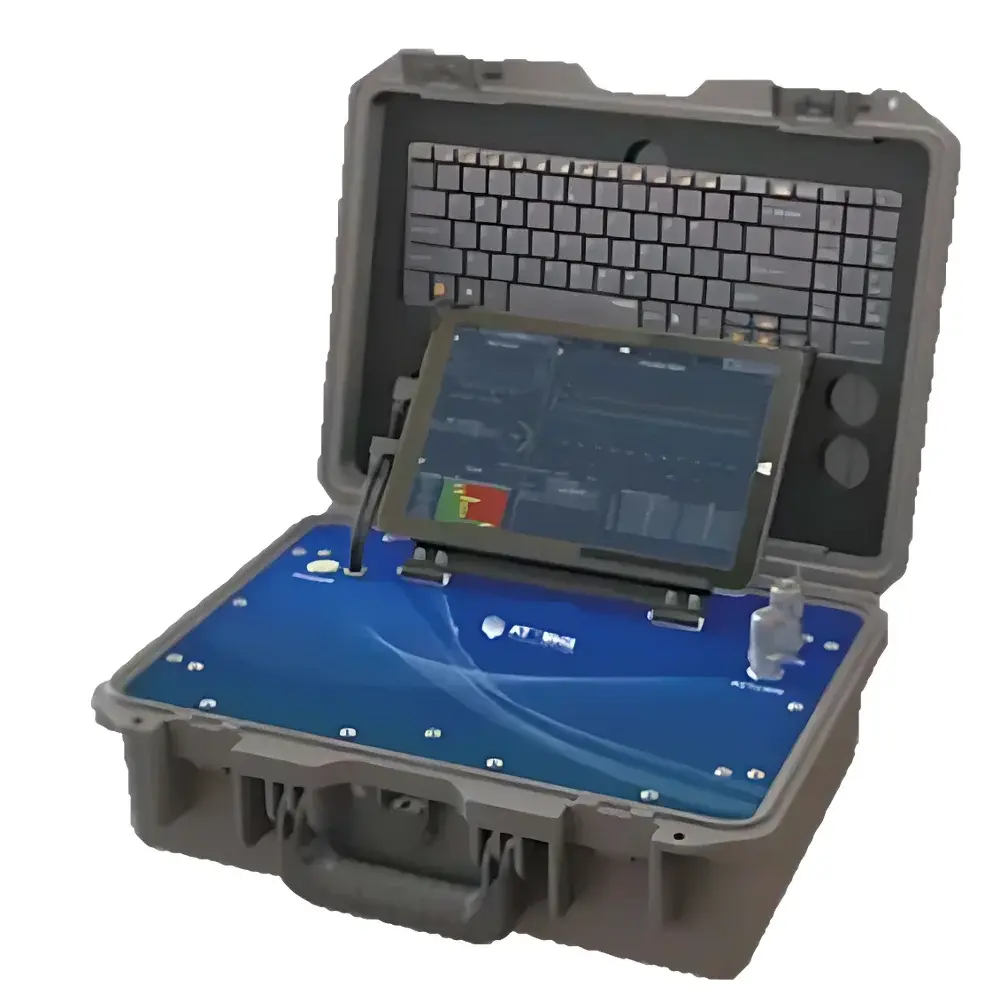
Atten2 OilCMS Portable Integrated Oil Condition Monitoring Workstation
| Brand | Atten2 |
|---|---|
| Origin | Spain |
| Model | OilCMS |
| Product Type | Portable Instrument |
| Detection Parameters | Tribological Wear Analysis |
| Oil Compatibility | Synthetic, Mineral, Organic Oils & Diesel (up to 3000 cSt) |
| Standards Compliance | ISO 4406, SAE AS4059, NAS 1638 |
| Software | Rubolab Oil Condition Monitoring Suite |
| Operating Modes | Offline (Bottle Sampling) & Online (High-Pressure Flow Cell) |
| Data Export | CSV, PDF |
| Calibration | Auto-calibration via embedded oil database (500+ lubricants), field-updatable |
Overview
The Atten2 OilCMS Portable Integrated Oil Condition Monitoring Workstation is an engineered solution for real-time, field-deployable assessment of in-service lubricants across industrial machinery, power generation assets, marine propulsion systems, and heavy-duty off-highway equipment. Built upon a dual-sensor architecture combining dielectric spectroscopy (Tan Delta-based oil life estimation) and high-resolution digital particle imaging, the OilCMS delivers quantitative, physics-based diagnostics—not empirical proxies—of lubricant degradation mechanisms. Unlike conventional single-parameter testers, it simultaneously resolves moisture saturation (% RH), particulate contamination (size, morphology, concentration), and chemical aging state through temperature-compensated dielectric loss tangent measurement. Its modular design supports both offline bottle analysis and online pressurized flow-through operation (up to 10 bar), enabling seamless integration into predictive maintenance workflows compliant with ISO 55001 and SAE JA1011 frameworks.
Key Features
- Integrated dual-sensing platform: Simultaneous acquisition of moisture content (% relative humidity), particle count/shape distribution (via calibrated CMOS imaging), and dielectric Tan Delta for remaining useful life (RUL) estimation
- Robust particle analysis engine: Discriminates fatigue wear (spherical), sliding wear (flattened platelets), cutting wear (sharp-edged fragments), and fibrous contaminants using ISO-defined morphological classifiers
- Auto-calibrating oil database: Embedded reference library covering >500 commercial lubricants—including synthetics (PAO, ester-based), mineral oils, and diesel fuels—enabling automatic baseline adjustment without lab reference standards
- Environmental resilience: Operational down to −20 °C; insensitive to entrained air bubbles or free water droplets due to proprietary optical path conditioning and dielectric signal filtering
- Portable form factor: Weighing <8.5 kg with integrated battery (8 h runtime), ruggedized IP65 enclosure, and touchscreen interface optimized for gloved operation in industrial environments
Sample Compatibility & Compliance
The OilCMS accommodates all common industrial lubricants within a viscosity range of 2–3000 cSt at 40 °C, including turbine oils, hydraulic fluids, gear oils, engine oils, and bio-based lubricants. It conforms to international contamination grading standards: particle counts are reported per ISO 4406:2017 (code format), SAE AS4059F (class level), and NAS 1638 (class number). Moisture quantification adheres to ASTM D6304 methodology principles via capacitance-based relative humidity sensing referenced to equilibrium vapor pressure. All measurements meet traceability requirements for ISO/IEC 17025-accredited laboratories when used with documented calibration procedures and audit logs.
Software & Data Management
The Rubolab Oil Condition Monitoring Suite provides a secure, role-based desktop and web-accessible interface supporting GLP-compliant data handling. Each measurement session generates a timestamped, user-authenticated record with full metadata (temperature, pressure, sample ID, operator, instrument firmware version). Audit trails comply with FDA 21 CFR Part 11 requirements, including electronic signatures, immutable log history, and revision-controlled report templates. Data export supports CSV (for LIMS integration) and PDF (with embedded spectral plots and pass/fail thresholds per OEM specifications). Firmware updates and oil database expansions are delivered via encrypted OTA channels with SHA-256 integrity verification.
Applications
- Condition-based oil change scheduling for wind turbine gearboxes, reducing unnecessary drain intervals by up to 40% while preventing premature bearing failure
- In-field verification of filtration efficiency in hydraulic systems prior to commissioning or after filter element replacement
- Root-cause analysis of abnormal wear in marine main engines using morphological particle fingerprinting correlated with operational load profiles
- Baseline trending for critical rotating equipment in petrochemical plants under API RP 546 and ISO 17359 surveillance protocols
- Mobile service support for rail fleets performing on-site oil health checks during scheduled maintenance windows
FAQ
Does the OilCMS require annual recalibration by the manufacturer?
No. The system performs self-validation at startup using internal reference capacitors and particle standards. Full metrological recalibration is recommended every 24 months or after 5000 measurement cycles—per ISO 17025 guidelines—and can be conducted on-site by accredited service engineers.
Can the device distinguish between ferrous and non-ferrous wear particles?
Yes. Through combined image morphology analysis and magnetic susceptibility mapping (using optional integrated micro-magnet array), it classifies particles as ferromagnetic, paramagnetic, or diamagnetic with >92% confidence per ASTM D7690 validation studies.
Is remote firmware update supported over cellular networks?
Yes. With optional LTE module (Cat-M1 certified), secure over-the-air updates are performed via TLS 1.3-encrypted channels with dual-signature verification (manufacturer + local administrator).
What is the minimum detectable particle size under standard operating conditions?
The optical imaging subsystem resolves particles ≥4 µm in equivalent spherical diameter (ESD) with ISO 11171 traceable calibration; detection limit improves to ≥2 µm under low-flow, high-magnification mode.
How does the Tan Delta sensor correlate with actual oxidation induction time (OIT)?
Tan Delta values are empirically mapped to OIT measured via ASTM D2272 RULER testing across 120 lubricant formulations. Correlation coefficient r² = 0.93 for Group II+/III base stocks; lower for highly additive-treated esters where supplemental FTIR trending is advised.



