
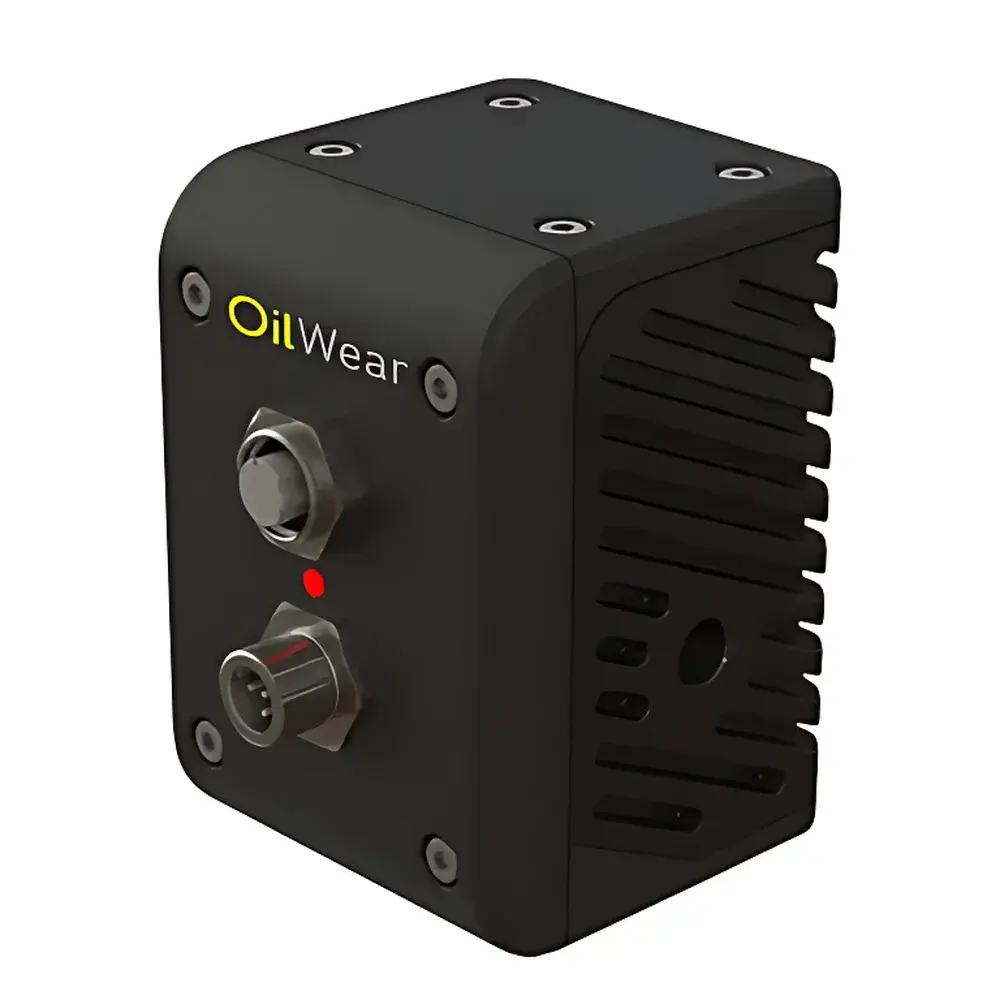
Atten2 OilWear S120 Online Oil Cleanliness Analyzer
| Brand | Atten2 |
|---|---|
| Origin | Spain |
| Manufacturer Type | Authorized Distributor |
| Origin Category | Imported |
| Model | S120 |
| Product Type | Online Instrument |
| Detection Parameter | Mechanical Contaminants (Particulate Matter) |
| Particle Detection Threshold | ≥4 µm |
| Compliance | ISO 4406, NAS 1638 |
| Data Transmission | Wired Ethernet Gateway / Wireless (Wi-Fi/4G) |
| Fluid Compatibility | Hydraulic Oil, Lubricating Oil, Fuel Oil, Mineral Oil, Synthetic Oil, Coolants, Cleaning Solutions, Cutting Fluids |
Overview
The Atten2 OilWear S120 Online Oil Cleanliness Analyzer is an AI-powered, real-time particulate monitoring system engineered for continuous in-situ assessment of lubricant and hydraulic fluid contamination. Unlike conventional offline particle counters relying solely on light extinction or pore-blockage principles, the S120 employs high-resolution digital imaging coupled with proprietary deep-learning algorithms to perform morphological analysis of suspended particles in flowing oil streams. It operates on the principle of automated microscopic image acquisition—capturing sequential video frames of oil flowing through a calibrated optical flow cell—and applies convolutional neural networks (CNNs) trained on over a decade of laboratory ferrographic data to classify particle morphology, size distribution, and spatial texture. This enables not only quantitative cleanliness grading per ISO 4406 and NAS 1638 standards but also root-cause attribution of wear mechanisms—including fatigue spalling, adhesive wear, cutting wear, and pitting—based on statistically validated shape signatures. The system is designed for permanent integration into pressurized or gravity-fed lubrication circuits without interrupting operational flow, delivering traceable, timestamped, and audit-ready data streams compliant with industrial condition monitoring frameworks.
Key Features
- Real-time, online particulate monitoring with ≥4 µm detection sensitivity under dynamic flow conditions
- AI-driven particle morphology classification trained on >500 commercially available lubricant base-oil models and validated against ferrographic reference datasets
- Simultaneous quantification of particle count, size distribution (binned per ISO 4406 code), and wear mode attribution (fatigue, abrasion, corrosion, etc.)
- Integrated colorimetric analysis for oxidation state estimation and additive depletion trend tracking
- Multi-fluid compatibility: certified for use with mineral oils, PAOs, ester-based synthetics, water-glycol hydraulics, aqueous coolants, and cutting fluids
- Modular mounting options: flanged inline installation (DN15–DN25), bypass loop configuration, or portable plug-and-play deployment
- Embedded edge processing unit with local data buffering, configurable alarm thresholds, and dual-mode communication (Ethernet/IP + optional 4G/Wi-Fi)
Sample Compatibility & Compliance
The OilWear S120 is validated for continuous operation across viscosity ranges from ISO VG 10 to VG 680 and operating temperatures from −20 °C to +80 °C. It meets mechanical and electrical safety requirements per IEC 61000-6-2 (EMC immunity) and IEC 60079-0 (non-hazardous area classification). All reported cleanliness metrics conform to ISO 4406:2017 (fluids) and NAS 1638 Class Code reporting conventions. The system supports GLP/GMP-aligned data integrity through immutable event logging, user-access controls, and full audit trail generation—including operator actions, calibration events, and firmware updates. While not FDA-certified as a medical device, its data architecture satisfies foundational elements of 21 CFR Part 11 for electronic records and signatures when deployed in regulated manufacturing environments requiring traceable maintenance history.
Software & Data Management
The OilWear Intelligence Suite provides browser-based visualization and analytics via secure HTTPS access. Dashboards display real-time ISO codes, cumulative particle histograms, wear mode heatmaps, and trend alerts based on statistical process control (SPC) limits. Raw image archives, metadata logs, and AI inference confidence scores are stored locally and synchronized to cloud repositories using TLS 1.2–encrypted protocols. Software modules support automated report generation (PDF/CSV), API integration with CMMS (e.g., IBM Maximo, SAP PM), and custom rule-based notifications (email/SMS/webhook). All analytical models are version-controlled; retraining pipelines accept customer-submitted ferrograph images for domain adaptation—enabling model expansion to proprietary lubricants or application-specific wear profiles upon request.
Applications
The S120 serves as a core sensor in predictive maintenance programs across energy, transportation, and heavy industry. In wind turbine gearboxes, it detects early-stage micropitting before vibration signatures emerge. In coal mining conveyor drives and shield tunneling machines, it correlates abrasive particle influx with cutterhead bearing degradation. Power generation facilities deploy it on turbine lube oil systems to reduce unplanned outages by >95%—eliminating reliance on weekly lab sampling. Rail operators monitor traction motor gear oil to preempt catastrophic failures during peak service cycles. Marine engine rooms use it for crankcase oil surveillance across diesel propulsion units, while aerospace MRO centers apply it to hydraulic fluid health verification prior to aircraft return-to-service. Its adaptability extends to R&D labs performing tribological benchmarking and OEMs validating new lubricant formulations under accelerated aging protocols.
FAQ
Does the S120 require oil sampling or system shutdown for installation?
No. It is designed for permanent inline or bypass-loop integration without interrupting fluid circulation or requiring offline sampling.
Can the AI distinguish between solid particles and entrained air bubbles?
Yes. The CNN model incorporates temporal coherence analysis across video frames to reject transient bubble artifacts and retain only morphologically stable particulates.
Is calibration traceable to national standards?
While the system does not require routine recalibration, its optical path and flow geometry are factory-verified against NIST-traceable particle size standards (PSL microspheres); certificate of conformance is supplied with each unit.
How is data security ensured during wireless transmission?
All wireless telemetry uses WPA3-Enterprise encryption and mutual TLS authentication; no credentials or raw images are stored on gateway devices.
Can the system be integrated into existing SCADA or IIoT platforms?
Yes. It supports Modbus TCP, OPC UA, and RESTful JSON APIs with documented schema and sample integration scripts for common industrial middleware.
Related Products






