
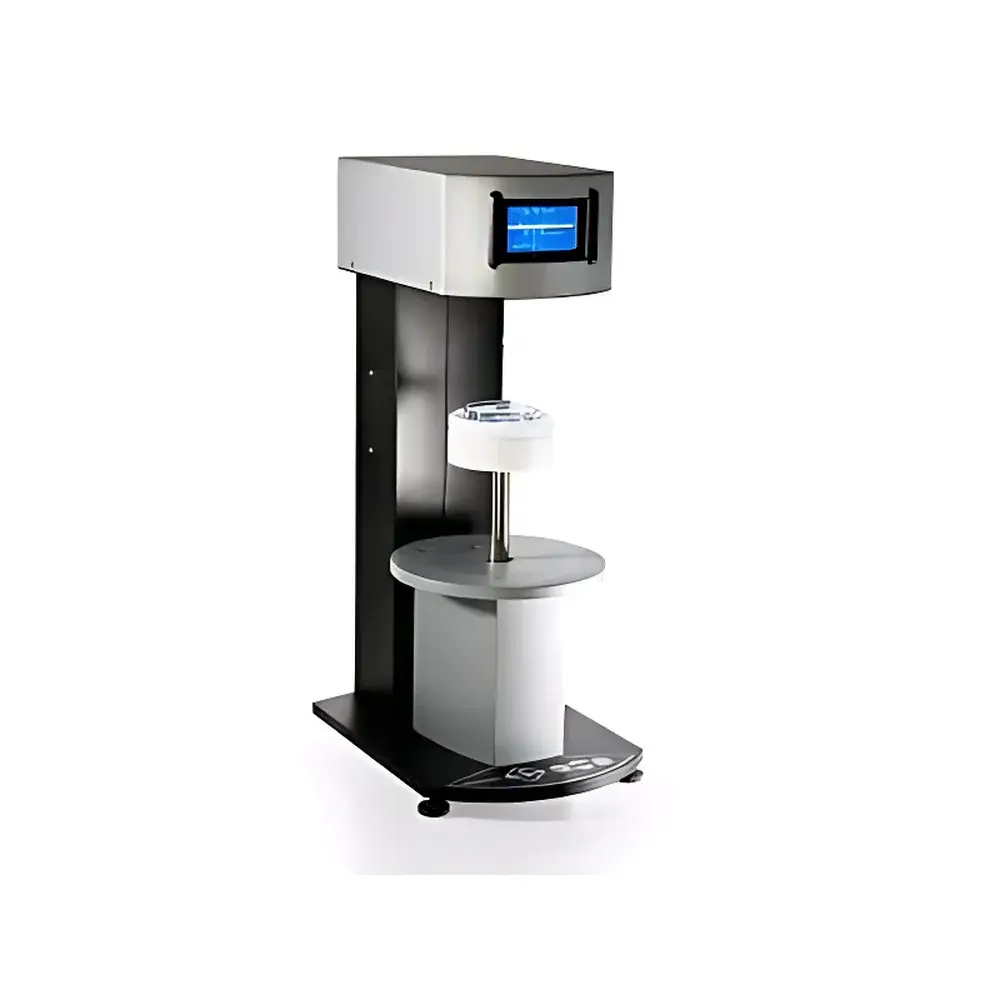
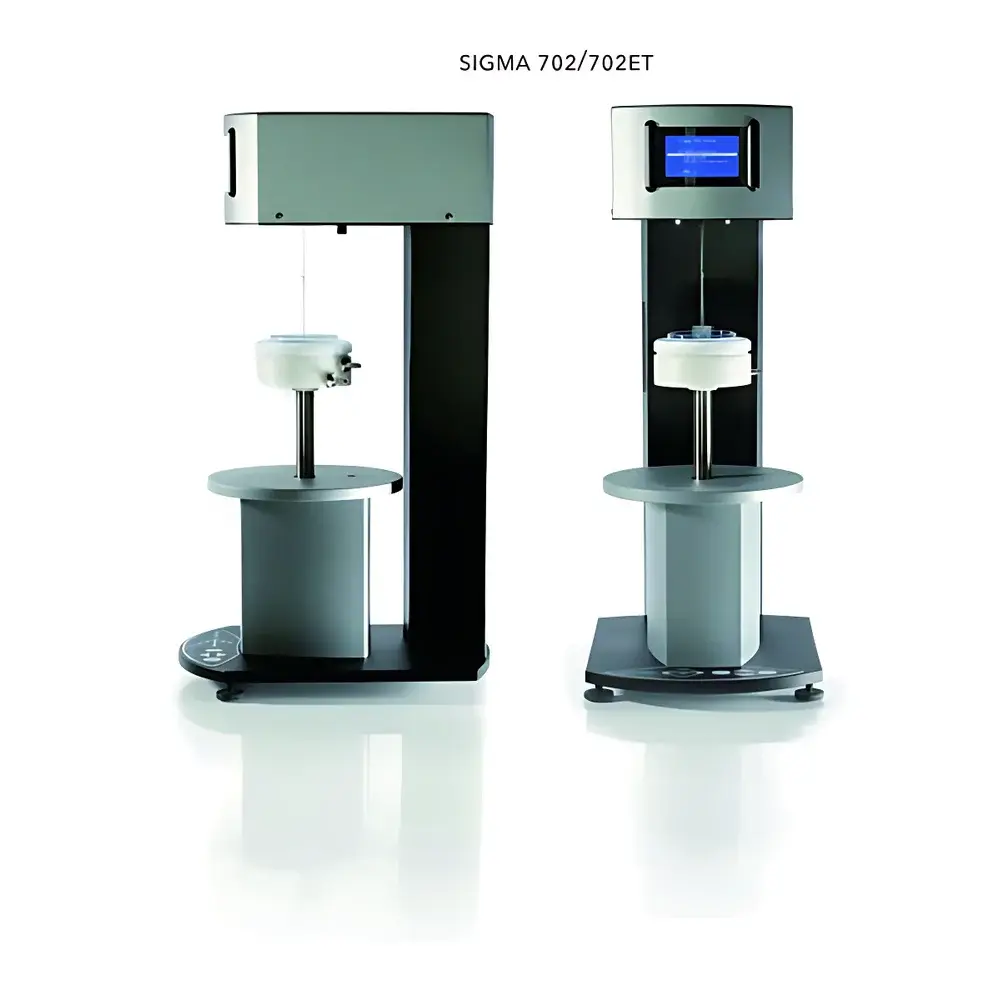
Attension Sigma 702ET Surface & Interfacial Tensiometer
| Brand | Attension |
|---|---|
| Origin | Finland |
| Model | Sigma 702ET |
| Measurement Principle | Wilhelmy Plate / Du Noüy Ring Method (Force-Based Gravimetric) |
| Compliance | ASTM D971 (Oil-Water Interfacial Tension), ISO 1409, ISO 6295, USP <1058> (for instrument qualification) |
| Temperature Control Options | Circulating bath jacket, integrated temperature probe, vapor-phase temperature control |
| Key Measurables | Surface Tension (mN/m), Interfacial Tension (mN/m), Critical Micelle Concentration (CMC), Dynamic Contact Angle (°), Solid Surface Free Energy (mJ/m²), Powder Wettability (via Washburn method), Sedimentation Rate (mg/s), Liquid Density (g/cm³) |
| Display | Integrated high-resolution LCD with real-time force and tension readout |
| Data Output | USB interface, optional direct thermal printer connection, bundled Attension OneTouch™ software for data logging, CMC curve fitting, and ASTM D971 report generation |
Overview
The Attension Sigma 702ET is a benchtop, stand-alone surface and interfacial tensiometer engineered for precision gravimetric measurement of interfacial phenomena at air–liquid, liquid–liquid, and solid–liquid boundaries. It operates on the fundamental principle of force transduction: a highly sensitive microbalance quantifies the vertical force exerted on a calibrated probe—typically a platinum plate (Wilhelmy method) or platinum ring (Du Noüy method)—as it interacts with the interface. This force is directly related to surface or interfacial tension via geometric and wetting corrections (e.g., Huh & Mason model for plate correction; Zuidema & Waters option available). Unlike optical systems, the Sigma 702ET delivers traceable, SI-traceable tension values independent of optical alignment, droplet shape assumptions, or image resolution limits. Its mechanical architecture ensures high reproducibility (< ±0.1 mN/m repeatability under controlled conditions) and long-term stability—critical for regulatory-compliant quality control in pharmaceutical, petrochemical, and formulation laboratories.
Key Features
- Self-contained operation: Integrated LCD display, intuitive front-panel controls, and onboard data visualization eliminate dependency on external PCs for routine measurements.
- ASTM D971–compliant oil–water interfacial tension testing: Preconfigured measurement protocol, dedicated calibration routines, and automated report templates meet mandatory requirements for transformer oil purity assessment per IEEE C57.106 and IEC 60296.
- Dual-probe versatility: Switch seamlessly between platinum plate (optimal for dynamic contact angle and surface free energy analysis) and platinum ring (ideal for high-viscosity or contaminated samples) using standardized, factory-calibrated probes.
- Modular temperature integration: Accepts circulating bath jackets (±0.1 °C stability), immersion temperature probes, and vapor-phase enclosures—enabling isothermal studies from 5 °C to 80 °C per ISO 1409 Annex A.
- Direct density determination: Uses a calibrated density sphere and buoyancy-based force measurement per ASTM D1298, eliminating separate pycnometer workflows.
- Regulatory-ready software: Attension OneTouch™ provides audit-trail-enabled data acquisition, electronic signatures (21 CFR Part 11 compliant configuration available), and GLP/GMP-aligned metadata tagging (operator ID, timestamp, environmental logs).
Sample Compatibility & Compliance
The Sigma 702ET accommodates diverse sample forms without modification: low- to medium-viscosity liquids (e.g., surfactant solutions, base oils, polymer melts), solid substrates (fibers, films, wafers, coated metals), and porous powders (pigments, catalysts, pharmaceutical excipients). For powder wettability, the Washburn capillary rise method is implemented via controlled immersion of packed powder beds into test liquids, with real-time mass gain recorded to derive contact angle and penetration kinetics. All measurement protocols align with internationally recognized standards: surface tension per ISO 1409 and ASTM D1331; interfacial tension per ISO 6295 and ASTM D971; contact angle hysteresis per ISO 19403-2; and solid surface energy calculation via Owens–Wendt–Rabel–Kaelble (OWRK) model. Instrument qualification documentation supports IQ/OQ/PQ execution per USP and GAMP 5 guidelines.
Software & Data Management
Attension OneTouch™ software serves as both acquisition engine and analytical platform. It captures raw force–time traces at up to 100 Hz, applies real-time baseline drift correction, and executes automated CMC detection using first-derivative inflection point analysis. Export formats include CSV (for LIMS integration), PDF (ASTM-formatted reports), and native .atd files retaining full metadata. The software enforces role-based access control, stores operator-defined SOPs with versioning, and maintains immutable audit trails—including parameter changes, calibration events, and manual data edits. Optional 21 CFR Part 11 compliance packages include electronic signatures, system validation templates, and secure user authentication (LDAP/Active Directory support).
Applications
- Transformer oil QC: Quantitative oil–water interfacial tension monitoring per ASTM D971 to detect oxidation byproducts, hydrolysis, or contamination—directly correlating with dielectric strength degradation.
- Surfactant R&D: High-precision CMC mapping across temperature gradients to optimize micellar solubilization efficiency in detergent, agrochemical, and biopharmaceutical formulations.
- Coating & ink development: Dynamic contact angle profiling on functionalized films to predict leveling, adhesion, and substrate wetting behavior during roll-to-roll processing.
- Powder processing: Washburn analysis of pigment dispersion kinetics in organic solvents to guide dispersant selection and minimize agglomeration in lithographic inks.
- Biomaterial characterization: Surface free energy determination of polymer scaffolds (e.g., PCL, PLA) to correlate with protein adsorption and cell attachment efficacy.
FAQ
What distinguishes the Sigma 702ET from optical tensiometers?
The Sigma 702ET uses direct force measurement, offering superior accuracy for opaque, viscous, or particle-laden samples where optical methods fail due to poor contrast or scattering.
Can the Sigma 702ET measure contact angles on rough or heterogeneous surfaces?
It requires geometrically uniform, homogeneous solids (e.g., polished wafers, monofilaments) for reliable Wilhelmy-based contact angle derivation; heterogeneous surfaces are better assessed via optical sessile drop.
Is temperature control mandatory for ASTM D971 testing?
Yes—ASTM D971 specifies 25.0 ± 0.1 °C; the Sigma 702ET achieves this via integrated bath jacket coupling with certified recirculating chillers.
How is calibration verified on the Sigma 702ET?
Using NIST-traceable reference liquids (e.g., ultrapure water at 20 °C: 72.75 mN/m; diiodomethane: 50.8 mN/m) and certified platinum probe geometry checks per ISO 1409 Annex B.
Does the system support Good Manufacturing Practice (GMP) environments?
With the 21 CFR Part 11 compliance package, it provides electronic signatures, audit trails, and validated software—fully supporting GMP documentation requirements for pharmaceutical QC labs.



