
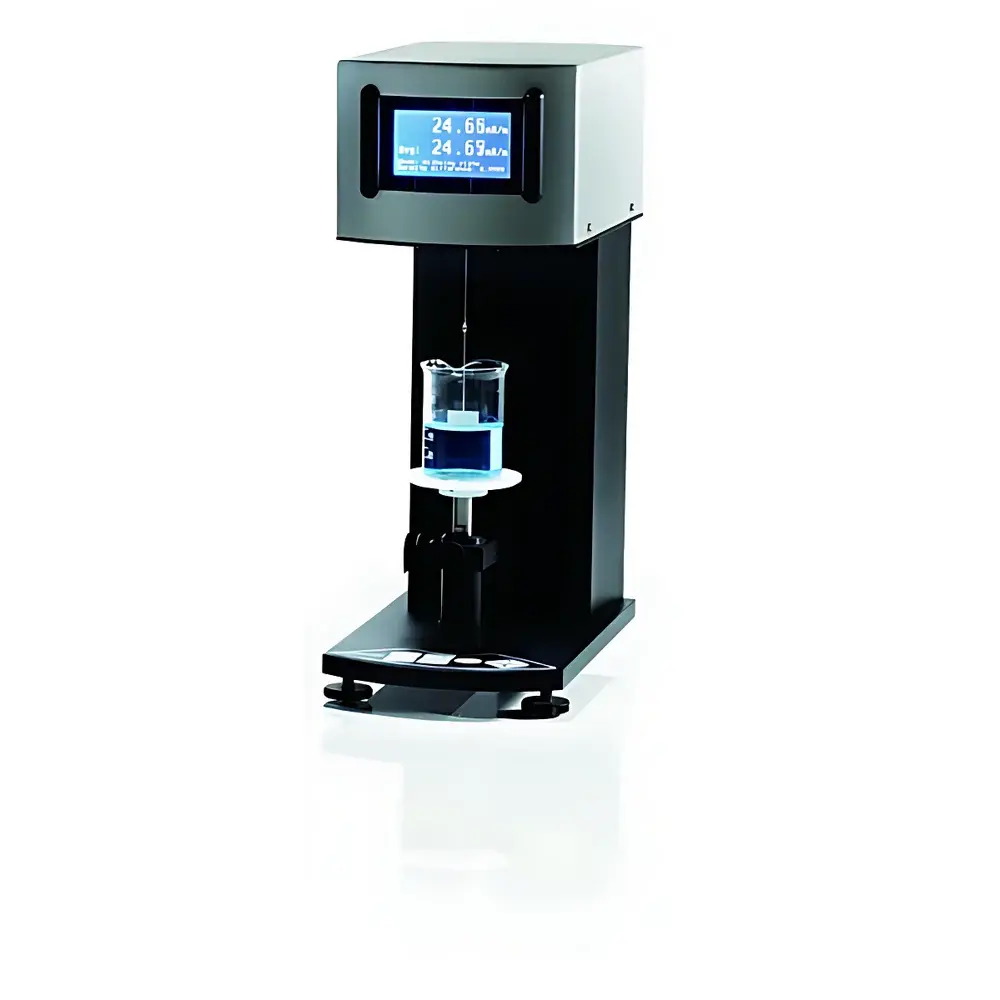
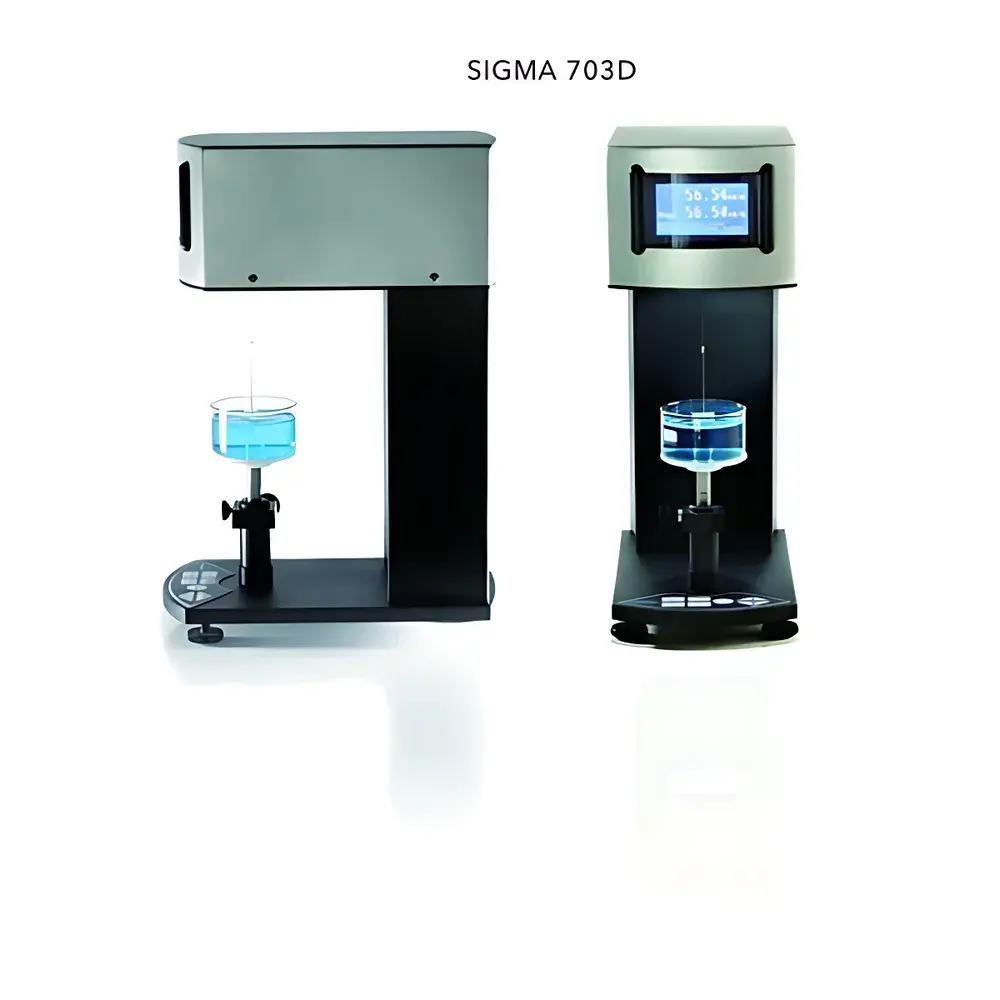
Attension Sigma 703D Force-Based Surface and Interfacial Tensiometer
| Brand | Attension |
|---|---|
| Origin | Finland |
| Model | 703D |
| Measurement Principle | Wilhelmy Plate/Ring Method (Force Balance) |
| Display | Integrated High-Resolution Digital Screen |
| Operation Mode | Standalone Manual Operation (PC Optional) |
| Temperature Control Support | Yes (via Jacketed Cell, Immersion Probe, Vapor Phase Chamber) |
| Compliance Standards | ASTM D971, ISO 1409, ISO 6295, USP <1046>, EN 14370 |
| Data Output | Real-time on-screen display, USB export, optional printer interface |
| Accessories Included | Platinum Plate, Platinum Ring, Density Sphere, Calibration Kit, Ring Correction Tool, Glass Beakers |
Overview
The Attension Sigma 703D is a benchtop, force-based surface and interfacial tensiometer engineered for precision measurement of thermodynamic and kinetic interfacial properties at gas–liquid, liquid–liquid, and solid–liquid interfaces. It operates on the fundamental principle of force balance: a calibrated platinum plate or ring is brought into contact with the interface, and the resulting wetting force—governed by surface tension (γ), contact angle (θ), and geometric parameters—is measured via a high-resolution microbalance (resolution ≤ 0.1 µN). This method adheres to internationally recognized standards including ASTM D971 (for insulating oil/water interfacial tension), ISO 1409 (plastics—determination of surface tension of plastics), and ISO 6295 (determination of interfacial tension between immiscible liquids). Unlike optical systems, the Sigma 703D delivers direct, absolute force-derived values without image analysis assumptions, making it particularly robust for opaque, turbid, or highly viscous samples common in formulation development and industrial QC.
Key Features
- Standalone operation with intuitive front-panel controls and integrated digital display—no external PC required for routine measurements
- Manual sample stage with micrometer-driven vertical positioning for precise immersion/retraction control during dynamic contact angle and CMC experiments
- Dual-probe capability: interchangeable platinum plate (for high-precision static/dynamic surface tension and contact angle) and platinum ring (for rapid screening and interfacial tension of low-energy systems)
- Comprehensive correction algorithms embedded—including Huh & Mason (default) and Zuidema & Waters models—for accurate plate-based surface tension calculation
- Integrated temperature monitoring interface supporting external Pt100 probes, liquid-jacketed cells (±0.1 °C stability), and vapor-phase thermal enclosures for isothermal interfacial studies
- Direct USB data export and optional parallel printer connectivity for GLP-compliant hardcopy generation
- Pre-calibrated density sphere module enabling liquid density determination per ASTM D1298 and ISO 3675 protocols
Sample Compatibility & Compliance
The Sigma 703D accommodates a broad range of sample types: clear or opaque aqueous/organic solutions, polymer melts, surfactant micellar systems, transformer oils, emulsions, suspensions, and functionalized solid substrates (films, fibers, powders). Powder wettability is assessed via Washburn capillary rise methodology using standardized cylindrical powder beds; sedimentation kinetics are quantified by gravimetric deposition on suspended probes. All measurement workflows support traceable calibration using certified reference liquids (e.g., ultrapure water, 2-ethylhexanol, diiodomethane). Instrument firmware and data handling comply with audit-trail requirements under FDA 21 CFR Part 11 when used with validated software extensions. Routine operation meets ISO/IEC 17025 documentation expectations for accredited testing laboratories performing surface energy, CMC, and interfacial stability assessments.
Software & Data Management
While fully functional as a standalone instrument, the Sigma 703D integrates seamlessly with Attension’s OneAttension software suite (Windows-based) for advanced data acquisition, multi-parameter curve fitting (e.g., Langmuir isotherms, Gibbs adsorption modeling), automated CMC detection via spline-differentiation, and batch report generation. Raw force–time datasets are stored in open CSV format with metadata timestamps, operator ID fields, and environmental parameter logging (temperature, ambient pressure if equipped). Software modules support statistical process control (SPC) charting for QC labs and export to LIMS-compatible formats (ASTM E1384, HL7). All measurement sequences can be saved as reusable methods with user-defined pass/fail criteria aligned with internal SOPs or regulatory specifications (e.g., USP for pharmaceutical excipient characterization).
Applications
- Surfactant R&D: Quantification of CMC, adsorption efficiency, and interfacial elasticity in anionic, cationic, nonionic, and zwitterionic systems
- Coating & Ink Formulation: Optimization of substrate wettability (dynamic advancing/receding contact angles), pigment dispersion stability, and film leveling behavior
- Electrical Insulating Fluids: Monitoring oxidation-induced degradation of transformer oils via ASTM D971-compliant oil/water interfacial tension trends
- Pharmaceutical Solid Dosage: Surface energy mapping of tablet excipients and active ingredients to predict compaction behavior and dissolution kinetics
- Food & Cosmetic Emulsions: Stability assessment of O/W and W/O systems through interfacial rheology proxies and droplet coalescence onset thresholds
- Materials Science: Surface free energy component analysis (Lifshitz–van der Waals, acid–base) of polymers, composites, and nanocoatings
FAQ
What measurement methods does the Sigma 703D support?
Wilhelmy plate (static/dynamic surface and interfacial tension, contact angle, solid surface energy), Du Noüy ring (interfacial tension screening), Washburn (powder wettability), density sphere (liquid density), and gravimetric sedimentation (particle settling kinetics).
Is temperature control mandatory for accurate measurements?
Not mandatory—but strongly recommended for reproducibility. Surface tension exhibits temperature dependence (~0.15 mN/m per °C for water); ISO and ASTM standards specify ±0.5 °C control for accredited work.
Can the Sigma 703D measure critical micelle concentration (CMC) automatically?
It supports manual CMC determination via sequential concentration measurements. Full automation requires OneAttension software with programmable dosing integration (not included with base 703D hardware).
Does the instrument meet regulatory requirements for GMP/GLP environments?
Yes—when operated with validated software, electronic signatures, and audit-trail enabled, it satisfies core elements of FDA 21 CFR Part 11 and EU Annex 11 for data integrity in regulated quality control labs.
What calibration standards are recommended for routine verification?
Ultrapure water (72.75 mN/m at 20 °C), 2-ethylhexanol (36.0 mN/m), and diiodomethane (50.8 mN/m) are traceable reference liquids specified in ISO 1409 and ASTM D1331 for daily system verification.



