
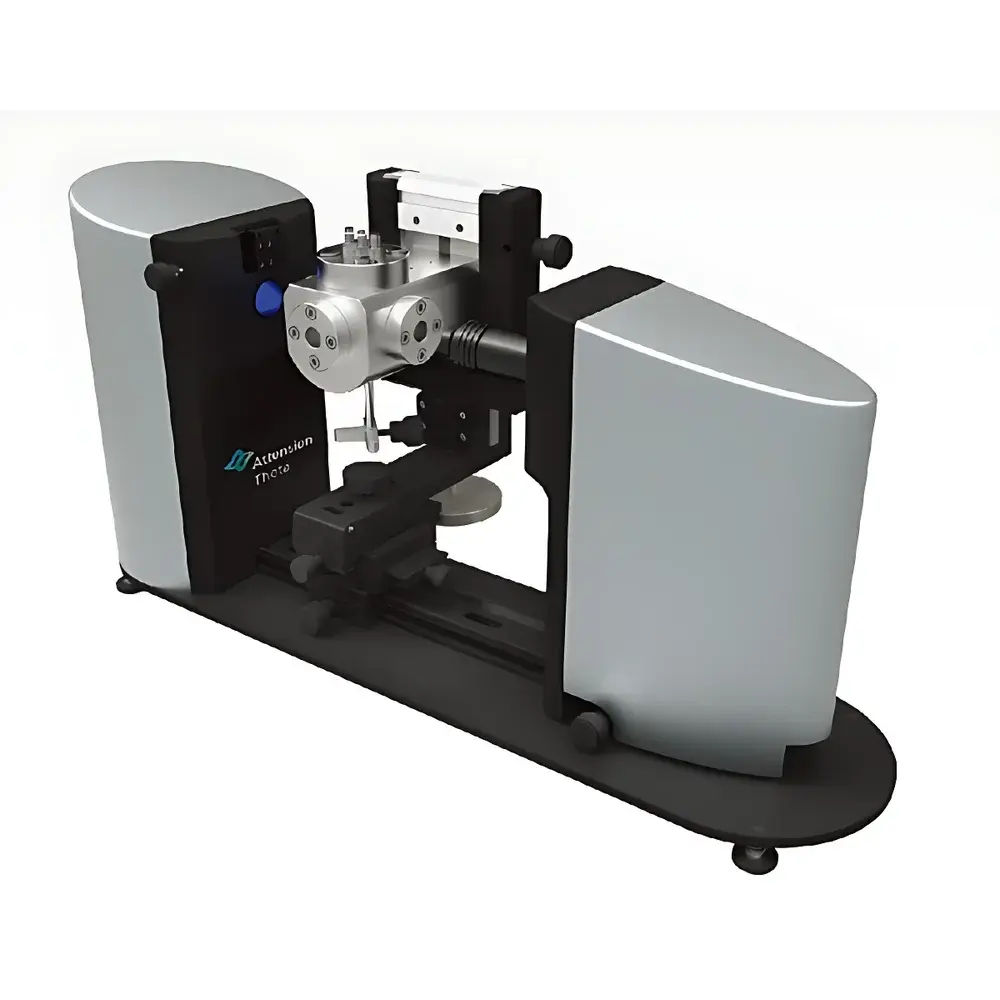
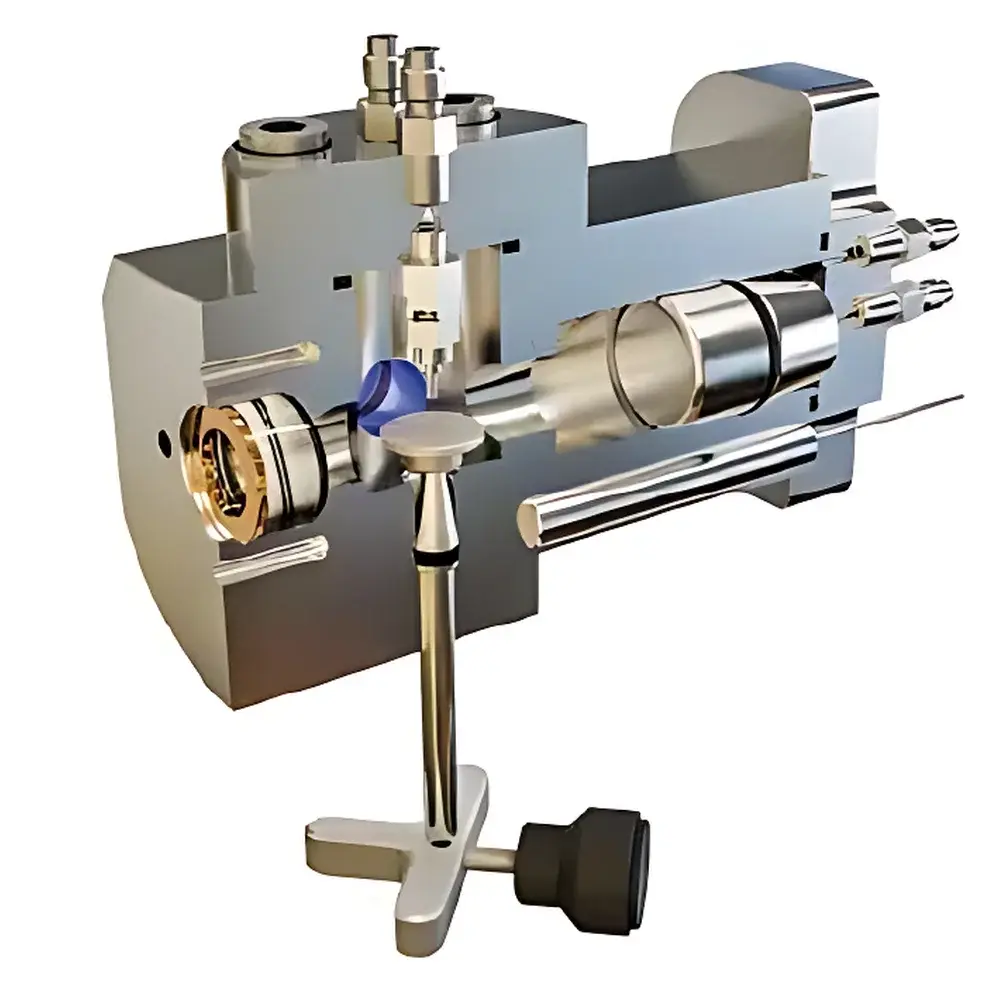
Attension Theta High-Pressure Chamber for High-Temperature and High-Pressure Surface & Interfacial Tension and Contact Angle Measurement
| Brand | Attension |
|---|---|
| Origin | Finland |
| Model | High Pressure Chamber |
| Instrument Type | Benchtop Laboratory System |
| Contact Angle Range | 0.1–179.9° |
| Contact Angle Accuracy | ±0.1° |
| Sample Stage Dimensions | 10 × 10 mm |
| Image Resolution | 782 × 582 pixels/mm |
| Surface/Interfacial Tension Range | 0.01–1000 mN/m |
| Max Operating Pressure | 400 bar |
| Temperature Range | 1–200 °C |
| Chamber Volume | 77 mL (without piston), 45 mL (with piston) |
| Pressure Control Method | Precision Piston Actuation or Gas/Liquid Injection |
| Construction Material | Certified Stainless Steel (CE Compliant) |
| Dimensions (Theta + Chamber) | 74 × 25 × 61 cm (L×W×H) |
| Weight | 16 kg |
| Power Supply | 100–240 V AC, 50–60 Hz |
Overview
The Attension Theta High-Pressure Chamber is an engineered extension module designed to integrate seamlessly with the Attension Theta optical tensiometer platform, enabling quantitative surface and interfacial property characterization under rigorously controlled high-temperature and high-pressure (HTHP) conditions. It operates on the principle of pendant drop, sessile drop, and captive bubble analysis—leveraging high-resolution imaging and advanced contour fitting algorithms—to determine contact angles, surface tension (γLV), and interfacial tension (γLV, γSL, γSV) in gas–liquid, liquid–liquid, and solid–liquid systems. Unlike conventional ambient-pressure instruments, this system maintains thermodynamic equilibrium across extreme process-relevant environments—up to 400 bar and 200 °C—making it indispensable for fundamental research and applied development in reservoir engineering, supercritical fluid processing, and advanced material formulation.
Key Features
- Integrated piston-driven pressure regulation ensures precise, stepless pressure control without introducing additional fluid volume—preserving surfactant concentration stability during dynamic experiments.
- CE-certified stainless steel construction guarantees structural integrity, corrosion resistance, and long-term repeatability in aggressive chemical environments (e.g., CO2-saturated brines, hydrocarbon mixtures).
- Dual-mode operation: supports both static pressure hold and dynamic ramping protocols for time-resolved interfacial aging studies under isothermal or isobaric conditions.
- Optimized optical path design minimizes refraction distortion at elevated pressures, enabling reliable image acquisition for automated contact angle calculation with ±0.1° accuracy.
- Benchtop footprint (74 × 25 × 61 cm) and modular architecture allow straightforward integration into existing Theta platforms without requiring facility modifications or auxiliary cooling systems.
- Thermally insulated chamber housing and PID-controlled heating ensure uniform temperature distribution and minimal thermal gradient-induced measurement drift.
Sample Compatibility & Compliance
The system accommodates solid substrates up to 10 × 10 mm, including polished metals, functionalized wafers, porous rock cores (e.g., Berea sandstone, carbonate plugs), and polymer films. Liquid phases include aqueous electrolytes, hydrocarbons (n-heptane, decane), supercritical CO2, and fluorinated solvents. All measurements adhere to ASTM D724, ISO 19403-2/-3, and USP guidelines for contact angle and interfacial tension determination. The piston mechanism and pressure vessel comply with PED 2014/68/EU and are certified for use in GLP-compliant laboratories. Data acquisition meets FDA 21 CFR Part 11 requirements when paired with Attension OneAttension software with audit trail and electronic signature functionality.
Software & Data Management
Controlled via Attension OneAttension v4.x software, the system delivers synchronized acquisition of pressure, temperature, video frames, and derived parameters—including dynamic contact angle hysteresis, interfacial relaxation kinetics, and Young–Dupré work of adhesion. Raw image sequences, metadata (timestamp, P/T setpoints, calibration IDs), and processed results are stored in vendor-neutral HDF5 format. Batch processing scripts support statistical evaluation across multiple pressure–temperature trajectories. Export options include CSV, MATLAB .mat, and PDF reports compliant with internal QA/QC workflows and regulatory submissions.
Applications
- Enhanced Oil Recovery (EOR) Research: Quantifies wettability reversal in reservoir rocks under simulated downhole conditions (e.g., 300 bar, 90 °C), directly informing surfactant selection and injection strategy optimization.
- Supercritical Fluid Processing: Characterizes CO2/water/oil interfacial behavior during SC-CO2 extraction, dry cleaning, and particle coating—critical for predicting phase distribution and mass transfer efficiency.
- Geological Carbon Storage: Evaluates caprock sealing integrity by measuring contact angles of CO2-brine systems on shale and clay minerals at representative storage depths.
- Pharmaceutical Formulation: Assesses surfactant adsorption kinetics at organic–aqueous interfaces under pressurized dissolution conditions relevant to hot-melt extrusion and spray drying.
- Electrolyte Development for Batteries: Measures wetting behavior of Li-ion battery electrolytes on separator membranes under elevated temperature and inert gas pressure.
FAQ
What pressure and temperature ranges are supported?
The chamber operates from 1 to 400 bar and 1 to 200 °C, with stable control within ±0.5 bar and ±0.3 °C during steady-state measurements.
Can the system measure liquid–liquid contact angles?
Yes—it supports captive bubble, pendant drop, and rotating cylinder methods for immiscible liquid–liquid systems, including hydrocarbon–water and polymer–solvent interfaces.
Is the piston mechanism compatible with corrosive fluids like H2S-saturated brines?
All wetted parts are constructed from ASTM A276 UNS S31603 stainless steel; optional Hastelloy C-276 seals are available for highly aggressive media.
How is calibration verified under high pressure?
Certified reference liquids (e.g., ultrapure water, diiodomethane) are measured at multiple pressure–temperature points; deviations from NIST-traceable literature values are logged for uncertainty propagation.
Does the system support automated long-term aging experiments?
Yes—scheduled acquisition intervals (1 min to 24 h) combined with environmental logging enable unattended interfacial evolution studies over 72+ hours.



