
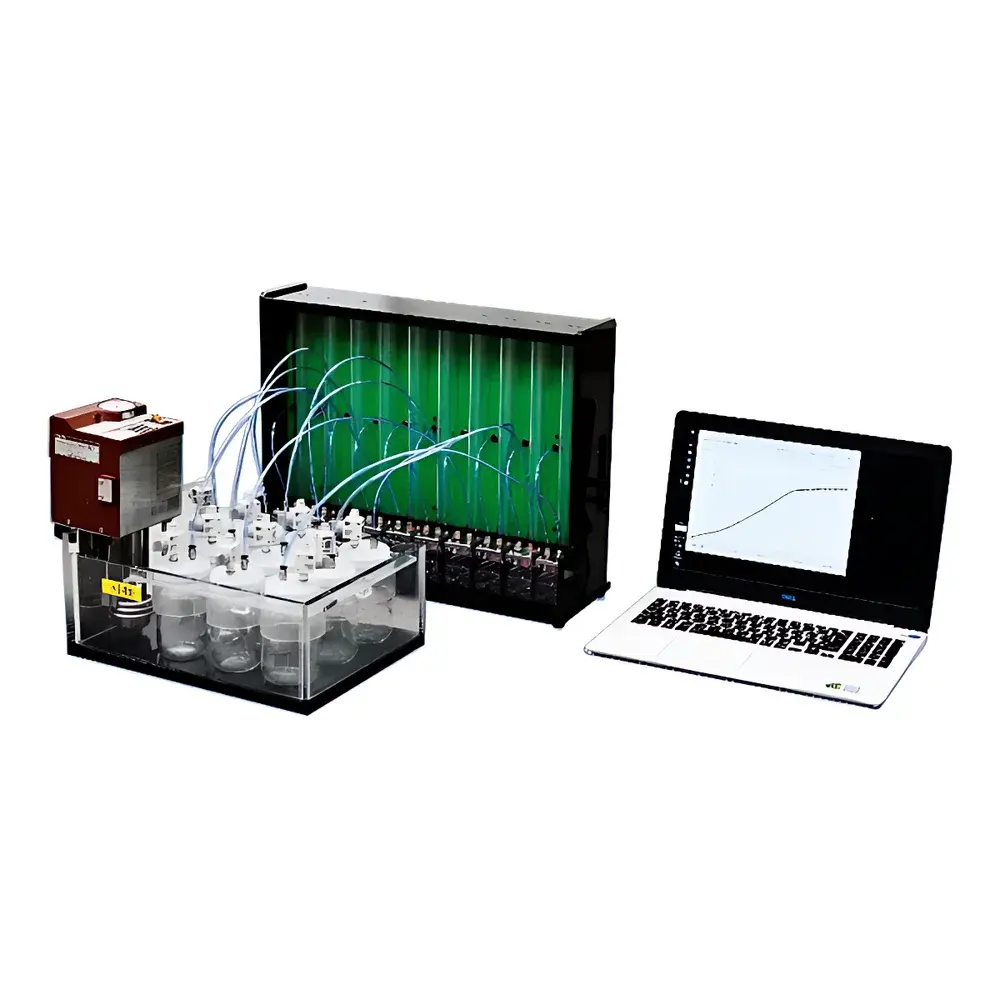
ATTO WSF-2000MH Series Fermentation Characterization Analyzer
| Origin | Japan |
|---|---|
| Manufacturer Type | Authorized Distributor |
| Origin Category | Imported Instrument |
| Model | WSF-2000MH Series |
| Pricing | Available Upon Request |
Overview
The ATTO WSF-2000MH Series Fermentation Characterization Analyzer is a precision-engineered, benchtop instrument designed for continuous, real-time quantification of gas evolution during microbial and chemical fermentation processes. It operates on the principle of liquid-displacement manometry: as gases (e.g., CO₂, H₂, CH₄) are generated by biological metabolism or chemical decomposition within sealed sample vessels, they displace water in a calibrated U-tube manometer column. A high-stability pressure transducer—temperature-compensated via an integrated PT100 sensor—converts the resulting hydrostatic pressure change into volumetric gas output, corrected to standard temperature and pressure (STP) using the ideal gas law. This gravimetric–volumetric hybrid methodology ensures traceable, NMIJ-aligned measurement accuracy across extended durations—from seconds to 90 days—making it suitable for kinetic profiling of yeast leavening, brewing kinetics, bioethanol production, and chemical blowing agent decomposition.
Key Features
- Parallel multi-sample analysis: WSF-2000MH-10W supports up to 10 independent sample channels; WSF-2000MH-20W expands capacity to 20 channels—all fully isolated to eliminate cross-talk and enable comparative experimental design.
- Independent channel control: Each vessel is equipped with dedicated pressure sensing, thermal monitoring, and valve actuation—allowing asynchronous start/stop, individual calibration, and discrete data logging without interference.
- Dual-unit gas reporting: Total evolved gas volume is reported in both milliliters (mL) at STP and grams (g), based on user-defined gas composition (e.g., CO₂, H₂, air-equivalent) for stoichiometric interpretation.
- Flexible time resolution: Data acquisition intervals configurable from 5 s to 120 s (for rapid early-stage kinetics) or 5 min to 120 min (for long-term stability studies); maximum duration: 23 h 59 min at second resolution, or 90 days at minute resolution.
- Modular sample vessel system: Standard 225 mL glass vials (optimized for ~20 g wheat flour dough); optional custom vial sizes (50–500 mL) accommodate micro-scale screening or high-volume industrial slurries.
- Automated sensor validation: Onboard self-calibration routines for both pressure and temperature sensors prior to each run—ensuring metrological integrity per ISO/IEC 17025 alignment practices.
- NMIJ-traceable gas flow metrology: All pressure transducers are certified to Japan’s National Metrology Institute of Japan (NMIJ) standards, supporting regulatory compliance in food safety and process validation contexts.
Sample Compatibility & Compliance
The analyzer accommodates diverse sample matrices including yeast-leavened doughs, wort and must fermentations, soy sauce mash, ethanol fermentation broths, anaerobic digestates, and chemical leavening systems (e.g., sodium bicarbonate–acid blends, azodicarbonamide). Its inert glass/viton wetted path ensures compatibility with acidic, alcoholic, and mildly corrosive media. The system meets functional requirements for GLP-compliant laboratories: full audit trail capability (user login, method parameters, raw sensor outputs), electronic signature support, and data immutability upon export. While not FDA 21 CFR Part 11–certified out-of-the-box, its CSV-based data architecture facilitates integration into validated LIMS or ELN platforms compliant with USP , ISO 17025, and ICH Q5C guidelines.
Software & Data Management
The proprietary ATTO Fermentation Analysis Software (v4.x) provides real-time visualization of cumulative gas volume, first-derivative gas evolution rate (dV/dt), and intra-dough gas retention index (calculated from post-fermentation headspace equilibration). All curves and tabular data—including timestamps, ambient temperature, barometric pressure, and sensor diagnostics—are automatically saved in native .afa format and exportable to industry-standard CSV for statistical analysis (e.g., JMP, Python pandas, R). Batch comparison tools enable overlay of ≥10 fermentation profiles with synchronized time-zero alignment. Exported files retain metadata required for regulatory submission, including instrument ID, calibration certificate numbers, and operator credentials.
Applications
- Food Science: Wheat flour strength evaluation (gas retention capacity), sourdough starter activity profiling, baking powder efficacy testing, and shelf-life prediction of fermented dairy products.
- Beverage Production: Yeast strain selection for lager vs. ale fermentation kinetics, wort attenuation monitoring, and CO₂ yield optimization in kombucha or kefir systems.
- Industrial Biotechnology: Anaerobic digestion efficiency assessment, hydrogen-producing bacterial consortia screening, and ethanol yield benchmarking under varying C/N ratios.
- Pharmaceutical & Chemical R&D: Decomposition kinetics of effervescent tablet excipients, foaming agent performance in topical formulations, and gas-release profiling of controlled-release drug carriers.
FAQ
What gases can the WSF-2000MH quantify?
It measures total gas volume irrespective of composition; users assign molar mass (e.g., 44 g/mol for CO₂, 2 g/mol for H₂) in software to convert volume to mass.
Is temperature control integrated into the instrument?
No—external incubators or climate chambers are required; the system includes high-accuracy internal temperature sensing for STP correction only.
Can data be exported directly to Excel or statistical software?
Yes—CSV export preserves all timestamps, channel identifiers, and derived metrics in comma-delimited format with UTF-8 encoding.
How often does the pressure sensor require recalibration?
NMIJ-certified transducers maintain ±0.25% FS accuracy for 12 months; annual third-party verification is recommended for GLP environments.
Are consumables required beyond standard glass vials and septa?
No—no pumps, membranes, or reagents are used; maintenance is limited to periodic water level checks and septum replacement.
Related Products





