
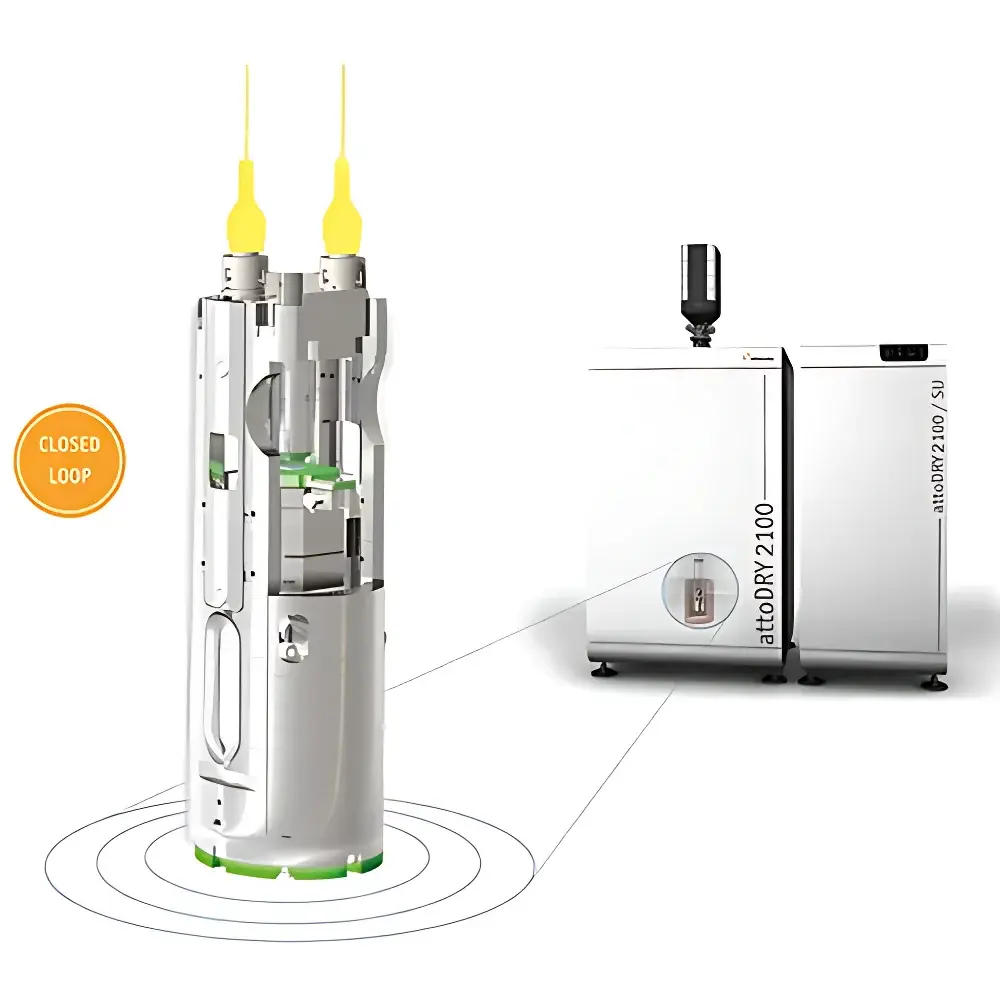
attoCFM I Cryogenic Confocal Microscope System by attocube — Liquid-Helium-Free, High-Magnetic-Field Compatible
| Brand | attocube |
|---|---|
| Origin | Germany |
| Model | attoCFM I |
| Instrument Type | Cryogenic Confocal Microscope for Quantum Materials Research |
| Positioning Noise | < 0.5 nm |
| Sample Size Capacity | Ø100 mm |
| Sample Stage Travel Range | 150 µm (fine scan) / 5 × 5 × 5 mm³ (coarse positioning) |
| Temperature Range | 1.8 K – 300 K |
| Magnetic Field | Up to 12 T (vector magnet optional) |
| Vacuum Operating Range | 1 × 10⁻⁶ mbar – 1 atm |
| Optical Resolution | ~550 nm (at 635 nm, NA = 0.82) |
| Scan Area | 30 × 30 µm² @ 4 K |
| Objective | Cryo-optimized Achromatic Objective, NA = 0.82, WD = 0.7 mm |
| Expandable Modules | AFM/MFM/PFM/KPFM/ct-AFM/cryo-Raman |
Overview
The attoCFM I is a fully integrated, liquid-helium-free cryogenic confocal microscope system engineered for high-resolution optical spectroscopy and nanoscale imaging of quantum materials under extreme conditions. Built upon attocube’s proprietary attoDRY® closed-cycle cryostat platform and ultra-low-vibration mechanical architecture, the system enables stable, long-duration measurements at base temperatures as low as 1.8 K while simultaneously applying magnetic fields up to 12 T. Its core measurement principle relies on diffraction-limited confocal excitation and detection—using spatial filtering to reject out-of-focus light—thereby delivering high signal-to-noise ratio photoluminescence (PL), electroluminescence (EL), photocurrent, Raman, and time-resolved optical spectra from nanoscale emitters such as quantum dots, 1D nanowires, graphene, and van der Waals heterostructures. Unlike conventional cryo-optical setups requiring liquid helium refills and suffering from thermal drift or mechanical instability, the attoCFM I achieves sub-nanometer positional stability (< 0.5 nm RMS noise) over hours, enabling reproducible single-emitter spectroscopy, polarization-resolved mapping, and magneto-optical studies under Faraday or Voigt geometry configurations.
Key Features
- Liquid-helium-free operation via attoDRY® 1000/2100 closed-cycle cryocooler, eliminating operational downtime and cryogen logistics
- Integrated high-stability XYZ sample stage with coarse travel (5 × 5 × 5 mm³) and piezo-driven fine scanning (30 × 30 µm² @ 4 K; 50 × 50 µm² @ 300 K)
- Cryogenic achromatic objective lens (NA = 0.82, WD = 0.7 mm) optimized for minimal chromatic aberration and focal shift below 4 K
- Modular optical head supporting up to three independent optical paths: one excitation, one detection, and one configurable auxiliary channel
- Compatibility with standard 1″ and 2″ bore magnets—including Quantum Design PPMS®—and vector magnet options for arbitrary field orientation
- Optical access via 25 mm diameter viewport; 36 electrical feedthroughs for in-situ transport or gating experiments
- External CCD camera (75 µm field of view) for real-time low-temperature sample alignment and coarse positioning
- Step resolution: 0.05–3 µm @ 300 K; 10–500 nm @ 4 K
Sample Compatibility & Compliance
The attoCFM I accommodates a broad class of solid-state quantum samples, including but not limited to semiconductor quantum dots, transition metal dichalcogenide (TMD) monolayers, hexagonal boron nitride (hBN) color centers, topological insulator surfaces, and superconducting heterostructures. Sample mounting follows standardized cryogenic protocols compatible with UHV-compatible holders and electrical wiring standards per ISO 14001 and ASTM F2797 for low-temperature instrumentation. The system supports full GLP-compliant experimental logging when paired with optional audit-trail-enabled control software. Vacuum integrity meets ISO 27472 Class 5 specifications (base pressure ≤ 1 × 10⁻⁶ mbar), ensuring minimal surface contamination during extended low-temperature optical characterization.
Software & Data Management
Control and automation are managed through attoCONTROL®, a deterministic real-time software suite running on Windows-based host systems. It provides synchronized coordination of temperature ramping, magnetic field sweeping, laser modulation, spectral acquisition (via external spectrometers or APDs), and piezo-stage raster scanning. All hardware parameters—including stage position, detector counts, filter wheel state, and temperature setpoints—are timestamped and stored in HDF5 format for traceability. Export modules support MATLAB, Python (h5py), and Igor Pro environments. Optional FDA 21 CFR Part 11 compliance packages include electronic signatures, user role management, and immutable audit trails for regulated research environments.
Applications
- Single-photon source characterization in quantum dot and defect-center systems under magnetic field
- Polarization-resolved photoluminescence mapping of valley polarization in TMD monolayers
- Magneto-Raman spectroscopy of phonon modes and spin-orbit coupling in 2D magnets
- Gate-tunable photocurrent imaging in van der Waals p–n junctions at milli-Kelvin temperatures
- Correlative cryo-confocal + AFM/MFM for simultaneous optical emission and nanoscale magnetic domain imaging
- Time-resolved PL decay analysis of exciton dynamics in perovskite nanocrystals under high magnetic fields
FAQ
Does the attoCFM I require liquid helium?
No—it operates exclusively with the attoDRY® closed-cycle cryocooler, achieving base temperatures down to 1.8 K without cryogen consumption.
Can the system be upgraded to include atomic force microscopy?
Yes—AFM, MFM, PFM, KPFM, conductive-AFM (ct-AFM), and cryo-Raman modules are factory-integrated or retrofittable as add-on kits.
What is the maximum magnetic field strength supported?
Standard configurations support up to 12 T; vector magnet variants allow independent control of Bx, By, and Bz components.
Is the optical path compatible with femtosecond pulsed lasers?
Yes—the modular optical head accepts free-space and fiber-coupled excitation sources across UV–NIR (250–1600 nm), including Ti:sapphire and OPO systems, with dispersion compensation options.
How is sample alignment performed at cryogenic temperatures?
An external CCD camera with 75 µm FOV and motorized focus enables real-time visual alignment prior to confocal engagement; all positioning is referenced to a calibrated coordinate system.




