
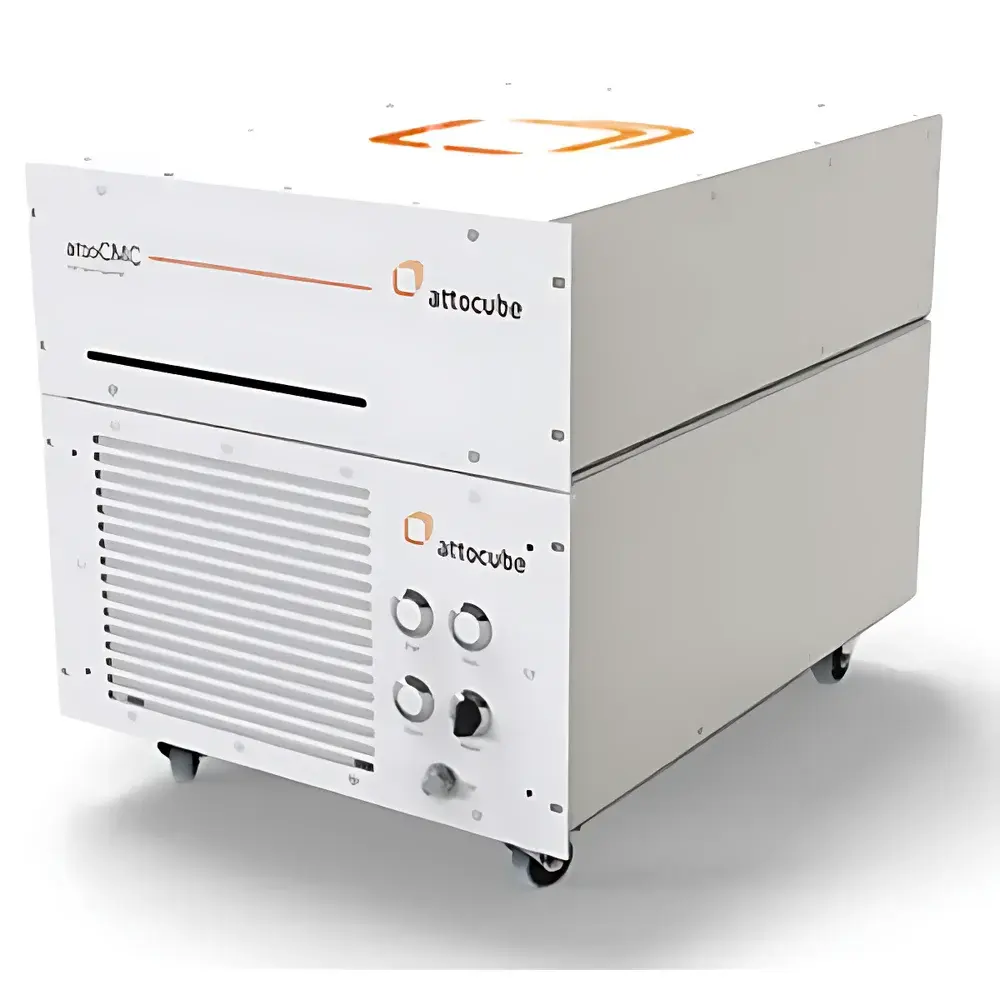
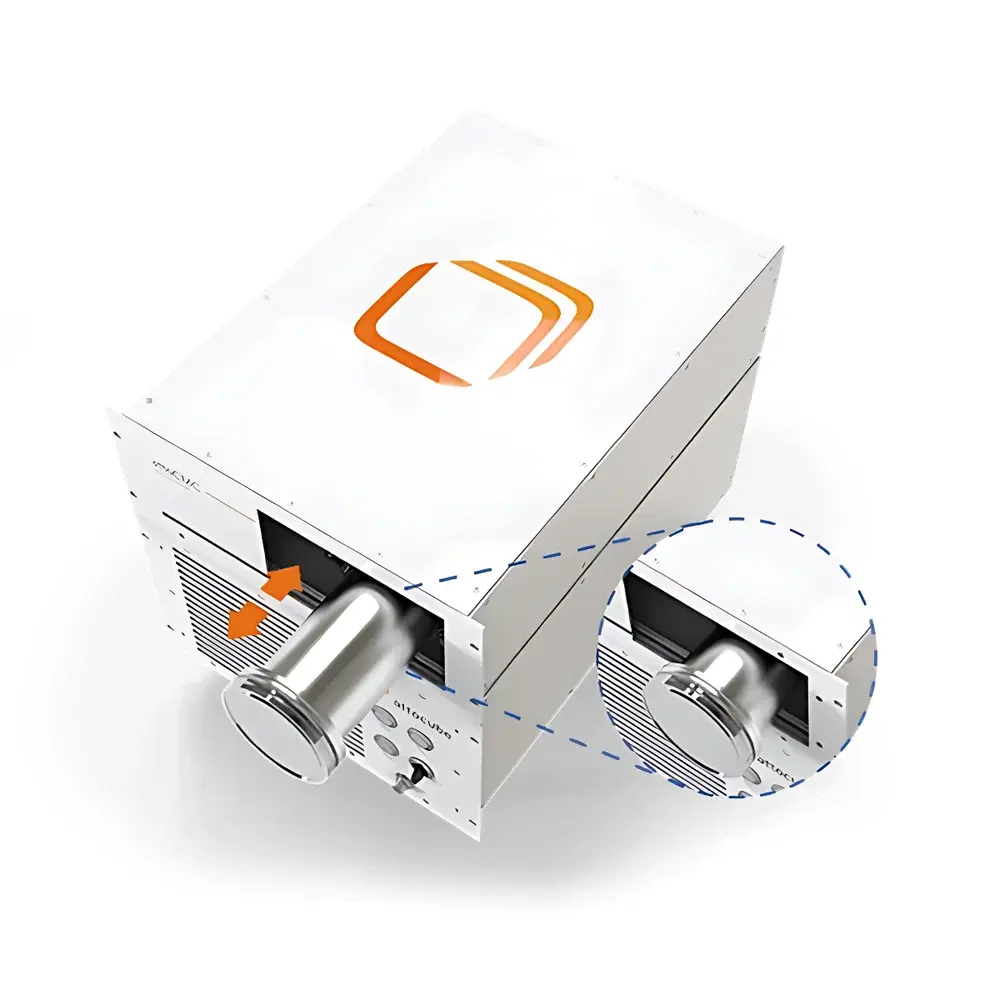
Attocube attoCMC Compact Cryogenic Thermostat for Single-Photon Detection
| Brand | Attocube Systems AG |
|---|---|
| Origin | Germany |
| Model | atto CMC |
| Instrument Type | Vertical |
| Base Temperature | 2.3 K |
| Vibration Stability | High |
| Dimensions | 446 × 266 × 641 mm³ |
| Cooling Method | Air-Cooled |
| Refrigeration Power | 50 mW @ 2.8 K |
| Cold Head Diameter | 45 mm |
| Electrical Feedthroughs | Standard 6, Optional 12 |
| Max. Electrical Power Consumption | 1.4 kW |
| IGLU Compressor Integration | Yes |
| Rack-Mountable | 19-inch compatible |
| Control | Remote via Ethernet/RS232 |
| Automation Level | Fully Automated Cool-Down & Operation |
Overview
The Attocube attoCMC is a vertically oriented, air-cooled compact cryogenic thermostat engineered specifically for single-photon detection applications in quantum information science. Operating down to a base temperature of 2.3 K, the system integrates Attocube’s proprietary IGLU® closed-cycle helium compressor technology with a high-stability, low-vibration cryostat platform. Unlike conventional liquid-helium-dependent or water-cooled dilution refrigerators, the attoCMC achieves sub-3 K operation without external cryogens or chilled-water infrastructure—enabling deployment in standard laboratory environments with only a single-phase 230 V AC power outlet. Its measurement principle relies on closed-cycle Joule–Thomson and adiabatic demagnetization cooling stages, optimized for thermal stability (±10 mK over 24 h) and mechanical quietness (< 5 nm RMS vibration amplitude at sample stage), critical for time-resolved photoluminescence, superconducting nanowire single-photon detector (SNSPD) characterization, and cavity quantum electrodynamics experiments.
Key Features
- Compact vertical footprint (446 × 266 × 641 mm³) designed for seamless integration into 19-inch rack systems or tabletop optical setups
- Air-cooled IGLU compressor with total system power draw ≤ 1.4 kW—no chiller, no water lines, no dedicated HVAC
- Fully automated cool-down sequence: from ambient to < 3 K in under 12 hours; repeatable thermal cycling with < 0.1 K hysteresis
- High mechanical stability: optimized cold head suspension and vacuum chamber design minimize microphonic coupling and thermal drift
- Modular electrical feedthrough architecture: standard 6-channel low-noise coaxial feedthroughs (DC–1 GHz); optional upgrade to 12 channels with customizable shielding and impedance matching
- Remote operation via Ethernet and RS232 interfaces; compatible with LabVIEW, Python (PyVISA), and MATLAB APIs for script-driven experiment control
Sample Compatibility & Compliance
The attoCMC accommodates samples up to Ø45 mm mounted on its copper cold finger, with thermal anchoring via indium or silver epoxy. It supports standard optical access configurations—including top-view windows (AR-coated fused silica, 5–25 mm clear aperture) and side ports for fiber coupling—and is routinely deployed with superconducting transition-edge sensors (TES), SNSPDs, quantum dot emitters, and NV-center diamond substrates. The system complies with CE marking requirements per EU Directive 2014/30/EU (EMC) and 2014/35/EU (LVD). All firmware and control software adhere to ISO/IEC 17025:2017 guidelines for calibration traceability, and audit logs meet GLP-compliant data integrity standards per FDA 21 CFR Part 11 when operated with optional secure authentication modules.
Software & Data Management
The attoCMC is controlled through Attocube’s proprietary CryoSoft™ v4.x suite, which provides real-time monitoring of temperature (PT100 and Cernox® sensors), pressure (capacitance manometer), compressor status, and cooling stage thermometry. Data logging is performed at configurable intervals (10 ms–10 s resolution) with timestamped binary output (.dat) and exportable CSV files. The software includes built-in PID tuning tools, alarm thresholds with email/SNMP notification, and encrypted local storage for ≥30 days of continuous operation data. For regulated environments, optional 21 CFR Part 11 compliance packages include electronic signatures, role-based access control, and immutable audit trails with SHA-256 hash verification.
Applications
- Characterization of superconducting nanowire single-photon detectors (SNSPDs) under bias sweep and photon flux variation
- Time-correlated single-photon counting (TCSPC) in solid-state quantum emitters (e.g., WSe₂ monolayers, SiV centers)
- Cryogenic photoluminescence mapping of quantum dots and perovskite nanocrystals
- Low-temperature microwave reflectometry of superconducting qubit readout resonators
- Integration with confocal microscopy platforms for sub-diffraction-limited quantum imaging
- Quantum key distribution (QKD) system validation under realistic operating temperatures and vibration profiles
FAQ
What is the minimum achievable base temperature, and how is it verified?
The attoCMC achieves a verified base temperature of 2.3 K, measured using calibrated Cernox® CX-1050 sensors traceable to NIST standards. Verification is performed during factory acceptance testing (FAT) under ISO 17025-accredited conditions.
Can the system operate continuously for extended periods (e.g., >1 month)?
Yes—the IGLU compressor and cold head are rated for uninterrupted operation up to 12 months between maintenance cycles, with automatic fault detection and graceful shutdown protocols.
Is vacuum maintenance required by the end user?
No. The attoCMC features a hermetically sealed, getter-pumped vacuum space with lifetime >10 years; no user-accessible vacuum pumps or gauges are needed.
How does the attoCMC compare to traditional wet cryostats in terms of experimental reproducibility?
With thermal stability better than ±10 mK over 24 h and vibration noise < 5 nm RMS, the attoCMC delivers reproducibility comparable to liquid-helium systems—without boil-off variability or manual refills.
Are custom optical or electrical feedthrough configurations available?
Yes. Attocube offers application-specific feedthrough modules including fiber-optic ferrules (FC/APC, SMA905), multi-pin RF connectors (SMPM, 1.0 mm), and filtered DC lines with EMI suppression—designed and validated per customer mechanical drawings.



