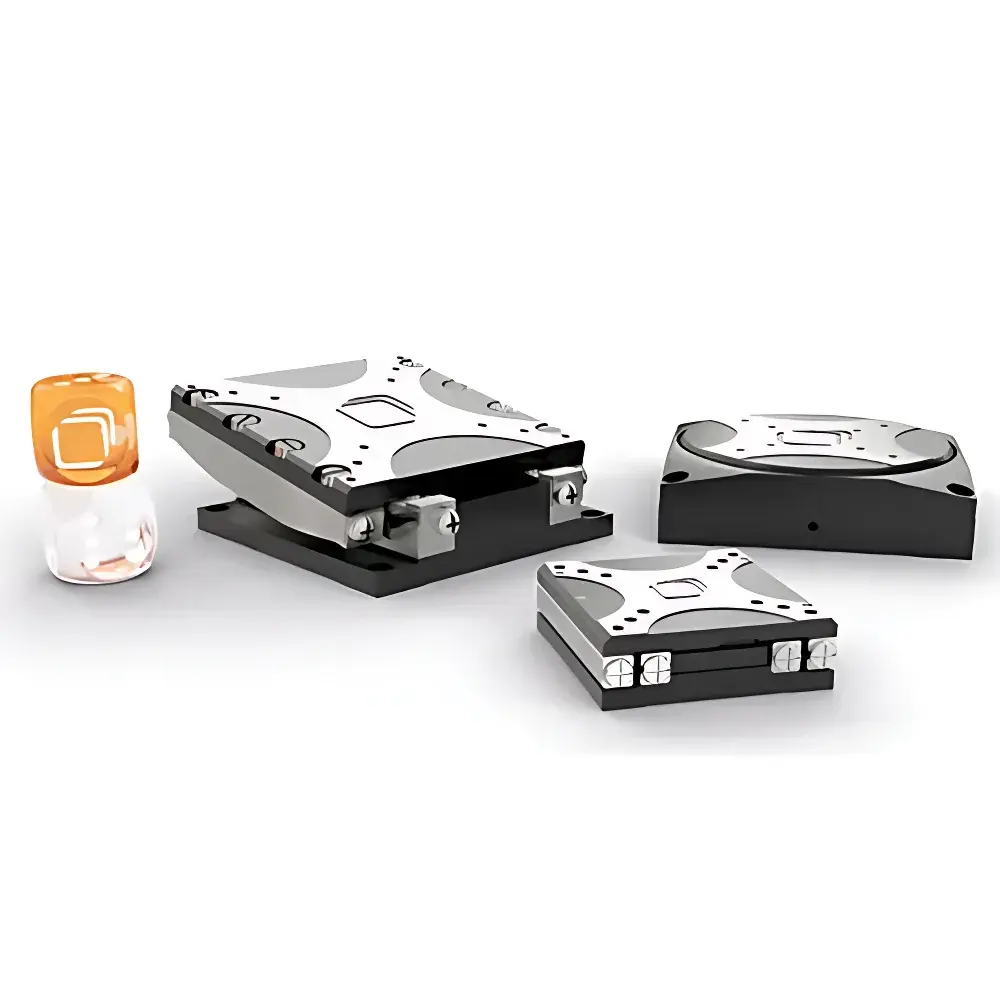
attoCube attoECS Series Room-Temperature Nanopositioning Translation Stage
| Brand | attocube Systems AG |
|---|---|
| Origin | Germany |
| Product Type | Motorized Translation Stage |
| Model | attoECS |
| Travel Range | up to 50 mm |
| Minimum Step Size | 50 nm (open-loop), 10 nm (closed-loop with optical encoder) |
| Repeatability | ±200 nm |
| Accuracy | <0.01% of full scale |
| Load Capacity | up to 240 N (24 kg) |
| Operating Environment | Ambient air, dry nitrogen, or ultra-high vacuum (UHV) compatible |
| Drive Voltage | <45 V |
| Encoder Resolution (optional) | 1 nm |
| Dimensions (min) | 30 × 30 × 9.5 mm³ |
| Compliance | ISO 9001 certified manufacturing |
Overview
The attoCube attoECS Series is a high-precision, room-temperature motorized translation stage engineered for sub-nanometer positioning stability and reproducibility in demanding optical, metrological, and quantum research environments. Based on piezoelectric inertia-driven actuation (so-called “stick-slip” principle), the attoECS achieves true nanoscale displacement control without continuous power consumption or thermal drift—enabling long-term positional hold with zero heat generation. Unlike traditional stepper-motor or voice-coil stages, the attoECS delivers atomic-scale resolution (down to 10 nm with integrated optical encoder feedback) over centimeter-scale travel ranges (up to 50 mm), while maintaining mechanical rigidity and minimal hysteresis. Its low-voltage operation (<45 V) eliminates the need for high-voltage shielding infrastructure, simplifying integration into cleanroom, UHV, or laser-interferometry setups. Designed for compatibility with ambient air, dry inert gas, and ultra-high vacuum (≤10⁻⁹ mbar), the stage employs non-outgassing materials—including precision-ground stainless steel bodies, sapphire bearings, and ceramic-insulated actuators—to ensure dimensional stability under thermal cycling and vacuum bakeout conditions.
Key Features
- Sub-10 nm closed-loop positioning accuracy with integrated optical encoder (attoECS/NUM variants)
- Open-loop step resolution of 50 nm; repeatable motion over >10⁶ cycles without wear-induced drift
- Zero-power static holding: position retained indefinitely without active voltage or current
- UHV-compatible construction (ISO-KF flange options available); no lubricants or polymers in vacuum path
- Modular multi-axis configurations: linear (ECSx), XY (ECSxy), Z (ECSz), rotation (ECR), and tilt (ECG) stages share common control architecture and mounting interfaces
- Low electromagnetic interference (EMI): fully passive actuation enables use near SQUIDs, cryogenic detectors, or single-photon sources
- Standard M4/M6 threaded mounting holes and kinematic alignment features for optical breadboard integration
Sample Compatibility & Compliance
The attoECS series meets stringent requirements for optical metrology and fundamental physics experiments. All structural components comply with ASTM F897 (standard specification for vacuum-compatible stainless steels) and ISO 14644-1 Class 5 cleanroom handling protocols. Surface finishes are electropolished to Ra < 0.2 µm to minimize particle shedding in UHV systems. The stages are routinely deployed in setups requiring GLP/GMP traceability—supporting audit-ready calibration logs when paired with attoDRY cryostats or interferometric verification tools. While not FDA-regulated, the system’s deterministic motion profile and hardware-enforced limit switches align with IEC 61508 functional safety principles for laboratory automation. Full material declarations (including EN 10204 3.1 mill certificates for base metals) are provided upon request for regulatory submissions.
Software & Data Management
Control is executed via attoCube’s proprietary ASC (AttoControl Software) suite, supporting Windows/Linux platforms and offering native Python, MATLAB, and LabVIEW APIs. ASC implements real-time motion profiling with configurable acceleration ramps, programmable dwell times, and synchronized trigger I/O (TTL, LVDS) for pump-probe or time-resolved measurements. Closed-loop variants log encoder data with timestamped metadata (UTC-synchronized via NTP), satisfying 21 CFR Part 11 requirements for electronic records when used with validated system configurations. Raw position traces are exported in HDF5 format, preserving bit-depth fidelity for post-acquisition analysis in tools such as Igor Pro or OriginLab. Firmware updates are digitally signed and verified during installation to prevent unauthorized modification—a requirement for ISO/IEC 17025 accredited calibration laboratories.
Applications
The attoECS platform serves as a foundational motion subsystem across multiple advanced research domains: high-resolution structured illumination microscopy (e.g., C-SIM systems achieving 580 nm lateral resolution in natural-color 3D insect imaging); beamline metrology at synchrotron facilities (sub-microradian angular stability for X-ray mirror alignment); quantum optics experiments requiring diffraction-limited spot positioning on superconducting nanowire single-photon detectors (SNSPDs); and semiconductor wafer inspection where nanoscale stage repeatability directly impacts overlay error budgets. Its UHV readiness also supports surface science applications—including scanning probe microscopy (SPM) tip positioning, molecular beam epitaxy (MBE) shutter synchronization, and cryo-electron microscopy (cryo-EM) sample grid translation in hybrid TEM/UHV chambers.
FAQ
Is the attoECS compatible with ultra-high vacuum environments?
Yes—stages are constructed from vacuum-rated stainless steel (1.4404/316L), feature metal-sealed electrical feedthroughs, and undergo helium-leak testing to ≤1×10⁻¹⁰ mbar·L/s prior to shipment.
What is the difference between open-loop and NUM-closed-loop variants?
Open-loop models rely on calibrated step response and offer 50 nm minimum step size; NUM variants integrate optical encoders for real-time position feedback, enabling 10 nm accuracy and automatic error correction.
Can multiple attoECS axes be synchronized?
Yes—ASC software supports hardware-timed multi-axis trajectories with sub-microsecond inter-axis jitter using shared clock distribution over PCIe or USB 3.0.
Does the stage require active cooling during operation?
No—piezoelectric inertia drives generate negligible heat; no heatsinks, fans, or water cooling are needed, even during continuous scanning.
Are calibration certificates included with shipment?
Each unit ships with a factory calibration report (traceable to PTB standards) documenting linearity error, bidirectional repeatability, and thermal drift over 20–30 °C range.