
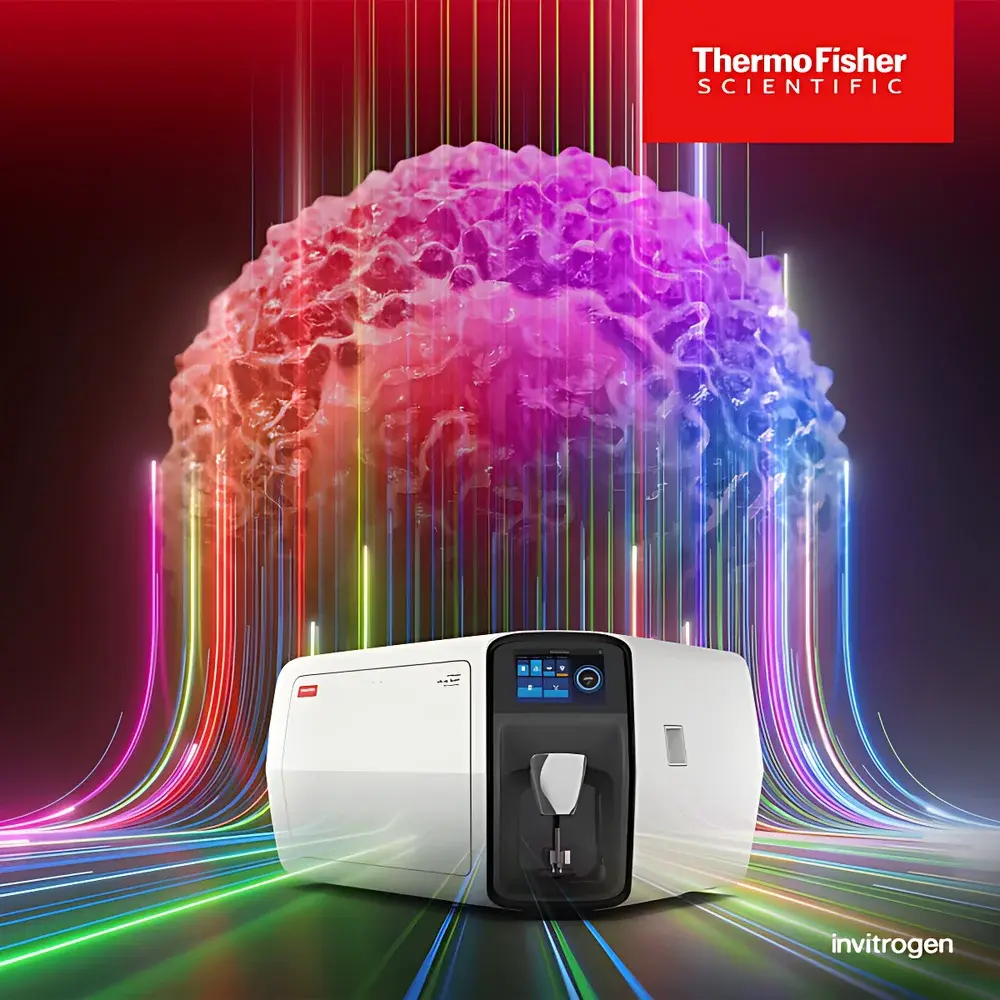
Attune Xenith Full-Spectrum Flow Cytometer
| Brand | Invitrogen |
|---|---|
| Origin | Singapore |
| Manufacturer Type | Original Equipment Manufacturer (OEM) |
| Import Status | Imported Instrument |
| Model | Attune Xenith |
| Technology Platform | Spectral Flow Cytometry |
| Product Category | Flow Cytometer |
| Primary Use Case | Research Applications |
| Lasers | 6 lasers (405 nm, 488 nm, 561 nm, 594 nm, 640 nm, 785 nm) |
| Detection Parameters | 57 parameters (51 fluorescence channels + 6 scatter channels) |
| Coefficient of Variation (CV) | <3% |
| Fluorescence Sensitivity | FITC ≤ 30 MESF, PE ≤ 10 MESF, APC ≤ 10 MESF |
| Acquisition Rate | >50,000 events/sec |
| Autosampler Compatibility | Yes, compatible with CytKick Max automated sample loader |
| Sample Flow Rate | 12.5–1000 µL/min |
| Compensation Method | Real-time spectral unmixing (automated and manual) |
| Voltage Adjustment Required | Yes |
Overview
The Attune Xenith Full-Spectrum Flow Cytometer is a high-parameter, research-grade spectral flow cytometer engineered for precision, reproducibility, and operational robustness in demanding life science laboratories. Unlike conventional filter-based flow cytometers, the Attune Xenith employs full-spectrum detection—capturing the complete emission spectrum of each fluorophore across all detectors using a high-resolution spectrometer array. This enables simultaneous deconvolution of highly overlapping fluorophore signatures without physical optical filters, significantly expanding panel design flexibility and minimizing spillover error. The system integrates patented acoustic focusing technology to hydrodynamically align cells in a single-file stream independent of sheath pressure or sample viscosity—ensuring stable signal acquisition even with challenging samples such as whole blood, tissue digests, or low-concentration suspensions. Designed for high-throughput discovery workflows, it delivers quantitative multicolor analysis at speeds exceeding 50,000 events per second while maintaining sub-3% CV for critical population discrimination.
Key Features
- Six-laser excitation platform covering UV to near-infrared wavelengths (405 nm, 488 nm, 561 nm, 594 nm, 640 nm, 785 nm), enabling optimal excitation of modern tandem dyes and rare-earth metal conjugates.
- 57-parameter detection capacity, including 51 fluorescence channels and 6 scatter channels (FSC-A/SSC-A/FSC-H/SSC-H/FSC-W/SSC-W), supporting deep immunophenotyping and functional profiling.
- Acoustic-assisted hydrodynamic focusing eliminates clogging risks associated with traditional nozzle-based systems, particularly during extended runs or with particulate-rich samples.
- Real-time spectral unmixing performed on-board via integrated GPU-accelerated processing, supporting both automated and user-adjustable unmixing matrices with traceable calibration standards.
- Variable flow rate control (12.5–1000 µL/min) allows optimization for sensitivity (low flow) or throughput (high flow), with automatic pressure compensation to maintain laminar flow integrity.
- Voltage tunability across all photomultiplier tubes (PMTs) and avalanche photodiodes (APDs), enabling precise gain calibration per experiment and longitudinal instrument stability tracking.
Sample Compatibility & Compliance
The Attune Xenith accommodates a broad range of biological specimens—including peripheral blood mononuclear cells (PBMCs), dissociated solid tissues, cultured cell lines, microbial suspensions, and microvesicles—without requiring centrifugation or pre-filtration in most cases. Its low-sample-consumption mode supports analysis of rare populations from limited clinical or preclinical sources (e.g., cerebrospinal fluid, fine-needle aspirates). The instrument complies with IEC 61010-1 safety standards for laboratory equipment and meets electromagnetic compatibility (EMC) requirements per EN 61326-1. Data acquisition and storage workflows support audit-trail-enabled operation under GLP and GMP-aligned environments when paired with validated software configurations and instrument qualification documentation.
Software & Data Management
Controlled via Attune Cytometric Software v4.x, the system provides intuitive experimental setup, real-time visualization, and comprehensive post-acquisition analysis. The software includes built-in tools for batch compensation, dimensionality reduction (t-SNE, UMAP), automated gating (FlowSOM), and statistical comparison across sample cohorts. Raw spectral data (.fcs and proprietary .attune formats) are stored with embedded metadata (laser power, PMT voltage, threshold settings, calibration bead IDs) to ensure full traceability. Export options include CSV, HDF5, and FCS 3.1-compliant files for integration with third-party analysis platforms such as FlowJo, Cytobank, or custom Python/R pipelines. For regulated environments, optional 21 CFR Part 11-compliant modules provide electronic signature support, role-based access control, and immutable audit logs.
Applications
- High-dimensional immune monitoring in oncology, autoimmunity, and infectious disease studies.
- Single-cell phenotyping and functional characterization of stem/progenitor cell populations.
- Comprehensive TCR/BCR repertoire analysis using oligonucleotide-conjugated antibodies.
- Multi-parametric viability and apoptosis assays incorporating DNA dyes, caspase sensors, and mitochondrial probes.
- Exosome and extracellular vesicle characterization via high-sensitivity scatter and fluorochrome labeling strategies.
- Longitudinal biomarker validation requiring inter-laboratory reproducibility and cross-platform harmonization.
FAQ
Does the Attune Xenith require daily optical alignment?
No—its fixed optical path and factory-calibrated spectral detector array eliminate routine alignment procedures. System performance verification is conducted via daily QC with Rainbow Calibration Particles and CS&T beads.
Can compensation be applied retrospectively to acquired spectral data?
Yes—raw spectral files retain full wavelength-resolved intensity information, allowing re-analysis with updated unmixing matrices without re-acquisition.
Is the CytKick Max autosampler compatible with non-standard tube formats?
It supports standard 12×75 mm, 15 mL conical, and 96-well plate formats; custom adapters are available for specialized containers upon request.
What maintenance is required beyond routine cleaning?
Annual preventive maintenance includes fluidic line inspection, laser output verification, spectrometer dark-current calibration, and PMT gain validation—all documented in the service log.
How does the system handle autofluorescence in primary tissue samples?
The spectral unmixing algorithm incorporates reference autofluorescence profiles (e.g., from unstained controls or spectral libraries) to subtract background contributions prior to population identification.




