
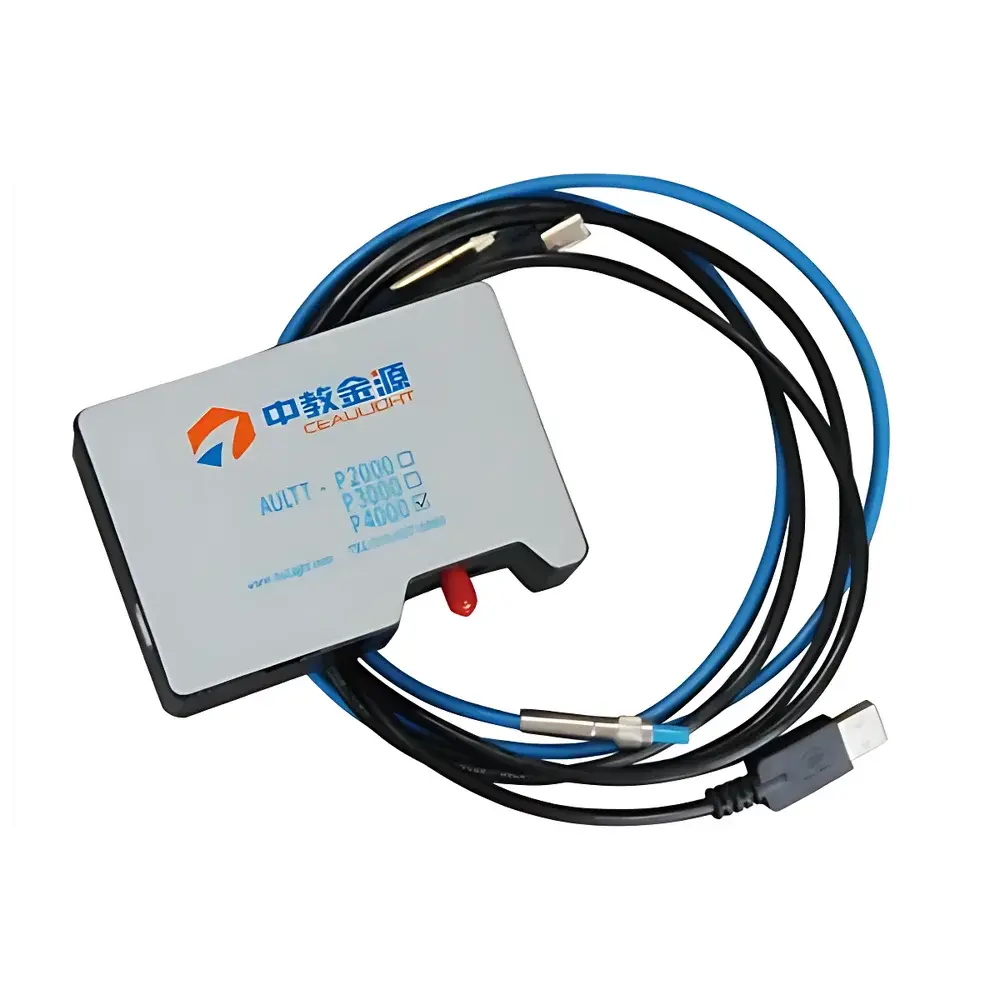
AULTT-P4000 Fiber-Optic Spectrometer
| Brand | AULTT |
|---|---|
| Model | P4000 |
| Detector | 3648-pixel linear silicon CCD |
| Wavelength Range | 185–1100 nm |
| Optical Resolution (FWHM) | ≤0.03 nm |
| Wavelength Repeatability | < ±0.3 nm |
| Slit Width | 30 µm |
| Grating | 600 lines/mm, blazed at 250 nm |
| Interface | USB 2.0, bus-powered |
| Software Compatibility | Windows 7 and later |
| Compliance | CE-marked optical instrumentation, compliant with IEC 61326-1 for EMC in laboratory environments |
Overview
The AULTT-P4000 is a high-performance, compact fiber-optic spectrometer engineered for precision spectral analysis across the deep ultraviolet (UV), visible (VIS), near-infrared (NIR), and short-wave infrared (SWIR) regions—from 185 nm to 1100 nm. Based on Czerny–Turner optical architecture with a fixed grating and optimized collimating/focusing optics, it delivers robust wavelength calibration stability and high signal-to-noise ratio (SNR) under ambient laboratory conditions. Its core measurement principle relies on dispersed light detection via a 3648-element linear silicon CCD array, enabling simultaneous acquisition of spectral intensity distribution with sub-nanometer wavelength fidelity. Designed for integration into optical test benches, OEM systems, and quality control workflows, the P4000 supports both absolute radiometric and relative photometric measurements when paired with NIST-traceable calibration standards.
Key Features
- Ultra-broad spectral coverage spanning 185–1100 nm—enabling unified characterization of UV-emitting LEDs, solar simulators, deuterium and mercury lamps, and broadband halogen sources
- Optical resolution down to 0.03 nm (FWHM), achieved through a high-efficiency 600 lines/mm holographic grating blazed at 250 nm and a precision 30 µm entrance slit
- Integrated USB 2.0 interface with bus-powered operation—eliminates external power supplies and simplifies deployment in portable or space-constrained setups
- High wavelength repeatability (< ±0.3 nm) ensured by thermally stable mechanical housing and factory-applied non-linear pixel-to-wavelength mapping correction
- Standard SMA905 fiber coupling compatible with industry-standard 200 µm, 400 µm, and 600 µm core diameter fibers
- Modular accessory ecosystem including calibrated tungsten-halogen, deuterium, and LED-based broadband sources; integrating spheres; cuvette holders; and polarization optics
Sample Compatibility & Compliance
The AULTT-P4000 accommodates diverse sample types—including transmitted/reflectance measurements of optical filters, thin-film coatings, semiconductor wafers, liquid solutions (via cuvette adapters), and solid-state emitters—when used with appropriate fiber probes or free-space input optics. It meets electromagnetic compatibility requirements per IEC 61326-1 for laboratory use and conforms to RoHS Directive 2011/65/EU. While not inherently GLP/GMP-certified, its software supports audit-ready data logging (timestamped spectra, user ID tagging, instrument configuration snapshots) suitable for ISO/IEC 17025-accredited laboratories when deployed with documented calibration protocols.
Software & Data Management
The bundled SpectraView Pro software provides native support for Windows 7 through Windows 11 and enables plug-and-play recognition of multiple connected spectrometers. It implements real-time spectral acquisition, intelligent auto-exposure control, and synchronized spectral video recording (up to 30 fps at full resolution). Analytical modules include absorbance calculation (using reference/background subtraction), CIE 1931 chromaticity coordinate mapping (x,y and u’,v’), correlated color temperature (CCT), and dominant wavelength determination. Export options include CSV, TXT, PDF, BMP, and PNG formats; spectral datasets can be directly imported into Excel or MATLAB for advanced modeling. All raw spectral files are saved in vendor-neutral ASCII format with embedded metadata (integration time, grating ID, slit width, calibration date).
Applications
- LED and OLED spectral characterization for binning, CCT verification, and peak wavelength validation per IES LM-79 and ENERGY STAR SSL requirements
- UV-Vis-NIR absorbance spectroscopy of dyes, nanoparticles, and biological macromolecules in cuvette-based or microfluidic configurations
- Calibration and validation of solar simulators against AM1.5G reference spectra (ASTM E927-22)
- Plasma emission monitoring in semiconductor process tools (e.g., endpoint detection in etch chambers)
- Thin-film thickness and refractive index estimation via interference fringe analysis in reflectance mode
- Educational labs requiring versatile, low-maintenance spectral instrumentation for undergraduate optics and materials science curricula
FAQ
Is the AULTT-P4000 spectrometer calibrated traceable to NIST standards?
Yes—each unit ships with a factory calibration certificate referencing NIST-traceable tungsten-halogen and mercury-argon line sources. Optional recalibration services are available annually.
Can the device operate in continuous acquisition mode for kinetic studies?
Yes—the software supports triggered and free-running acquisition modes with user-defined interval timing (down to 10 ms between spectra) and ring-buffer memory management.
What is the typical dark noise level and dynamic range at 10 ms integration time?
At 10 ms exposure, RMS dark noise is ≤15 digital units (16-bit ADC), yielding a system dynamic range exceeding 4,500:1 (typical).
Does the spectrometer support third-party API integration (e.g., LabVIEW, Python)?
Yes—DLL-based SDKs for C/C++, .NET, and Python (via ctypes) are provided, enabling full remote control and spectral data streaming without GUI dependency.
How is stray light performance characterized in the UV region below 220 nm?
Stray light is suppressed to <0.05% at 200 nm using order-sorting filters and internal blackened baffles; performance is verified per ISO 17123-7 Annex B protocols.




