
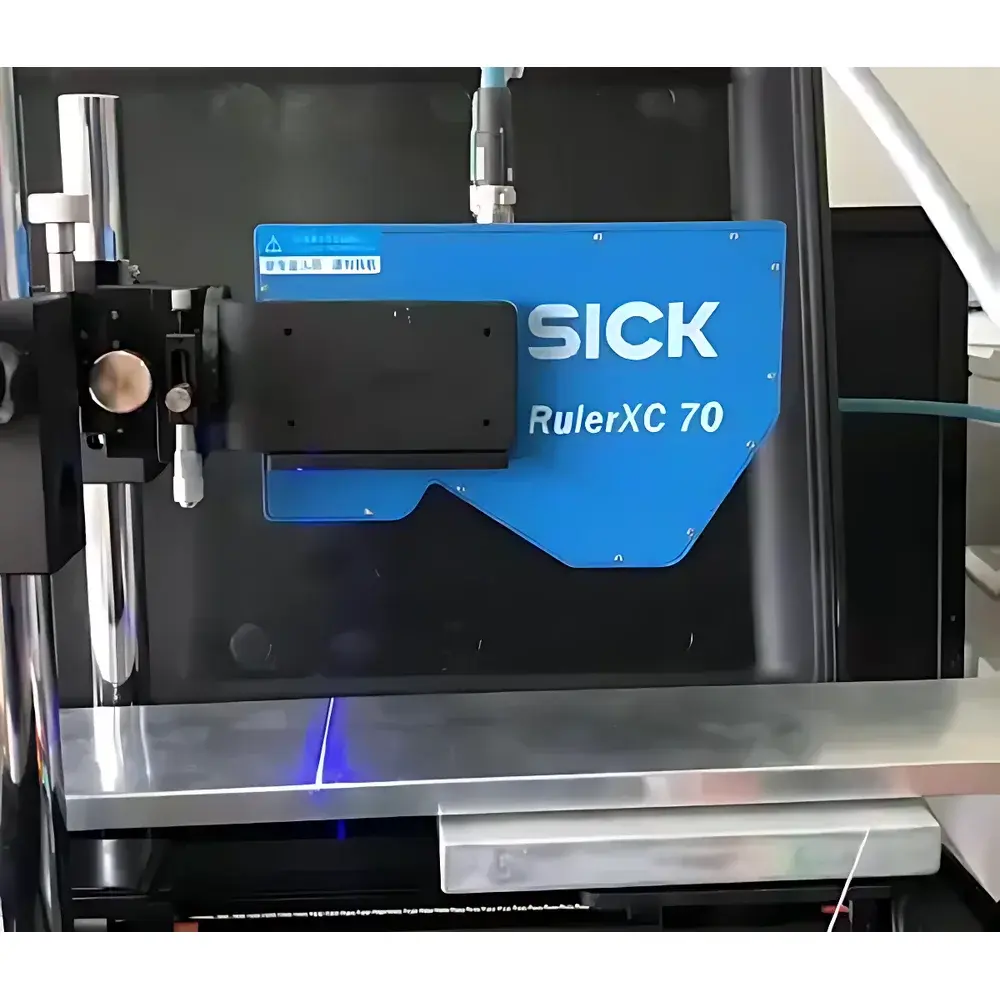
Auniontech 3D Machine Vision System for Automotive Lithium Battery Manufacturing
| Brand | Auniontech |
|---|---|
| Origin | Germany |
| Manufacturer Type | Authorized Distributor |
| Origin Category | Imported |
| Model | 3D Machine Vision System |
| Price Range | USD 14,000 – 70,000 (FOB Hamburg) |
| Effective Pixels | Not Applicable (Structured Light / Laser Triangulation Based) |
| Pixel Size | Not Applicable (System-Level Metrology Parameter) |
Overview
The Auniontech 3D Machine Vision System for Automotive Lithium Battery Manufacturing is an industrial-grade optical metrology platform engineered for non-contact, high-precision 3D surface profiling and geometric inspection in high-throughput battery production environments. Unlike conventional 2D imaging systems, this solution integrates calibrated laser triangulation or structured light projection with synchronized high-speed CCD/CMOS image acquisition and real-time point-cloud reconstruction—enabling sub-micron depth resolution and µm-level lateral repeatability across dynamic production lines. Designed specifically for the stringent dimensional and surface integrity requirements of automotive-grade lithium-ion batteries, the system supports inline, at-line, and offline quality assurance workflows—from electrode foil handling to cell assembly, module stacking, and pack integration.
Key Features
- Industrial-grade 3D sensing architecture based on active optical triangulation with temperature-stabilized laser diodes and telecentric optics, ensuring consistent measurement fidelity under ambient factory lighting and thermal fluctuations.
- Real-time 3D point cloud generation at up to 120 fps (configurable), enabling seamless integration with PLC-controlled conveyor systems and robotic pick-and-place stations.
- Multi-sensor calibration framework compliant with ISO 10360-8 (coordinate measuring machines) and VDI/VDE 2634 Part 2 (optical 3D measuring systems), supporting traceable uncertainty budgets per measurement task.
- Ruggedized IP65-rated housing with ESD-safe construction, qualified for operation in Class 10,000 cleanroom environments typical of cathode/anode coating and cell assembly zones.
- Embedded GPU-accelerated algorithms for weld seam topology analysis, including bead height, penetration depth, undercut quantification, and porosity mapping—aligned with ISO 13919-1 for laser welding of aluminum alloys.
Sample Compatibility & Compliance
The system accommodates a broad range of battery components: prismatic aluminum casings (10–200 mm width), cylindrical jelly-roll assemblies (up to Ø80 mm), pouch cell laminates, and blade-type cells (up to 600 mm length). Surface reflectivity variations—from matte graphite-coated anodes to highly specular aluminum housings—are compensated via adaptive exposure control and multi-angle illumination sequencing. All hardware and firmware comply with CE marking directives (EMC 2014/30/EU, Machinery Directive 2006/42/EC), and software modules support audit-ready data logging per FDA 21 CFR Part 11 (electronic records/signatures) and ISO 13485-aligned quality management systems.
Software & Data Management
Powered by Auniontech’s VisionLink™ Suite—a modular, Windows-based application platform supporting both GUI-driven setup and API-driven automation (C++, Python, OPC UA). The software includes pre-validated inspection templates for common battery QA tasks: weld geometry verification (per DIN EN ISO 15614-11), planarity assessment of busbar mounting surfaces (per ISO 1101), and cavity depth measurement for sealing grooves (per IATF 16949 clause 8.5.1.5). All measurement data—including raw point clouds, statistical process control (SPC) charts, and defect classification logs—are stored in SQLite or SQL Server databases with configurable retention policies and role-based access control. Full GLP/GMP audit trails are maintained for all user actions, parameter modifications, and calibration events.
Applications
- Electrode foil thickness uniformity mapping (±0.3 µm repeatability over 300 mm scan width)
- Laser weld seam inspection on aluminum battery casings: convexity/concavity, crater formation, and micro-crack detection via surface gradient analysis
- Cell body flatness and perpendicularity verification (reference plane deviation < 5 µm over 150 × 150 mm area)
- Busbar and terminal post coplanarity assessment prior to ultrasonic welding
- Sealing groove depth and width validation for lid-to-can crimping processes
- Dimensional stability monitoring of stacked modules during thermal cycling tests
FAQ
What measurement principles does this system use?
It employs calibrated laser triangulation or fringe projection, depending on model configuration—both methods deliver absolute 3D coordinates without reliance on photogrammetric referencing.
Is the system compatible with existing MES/SCADA infrastructure?
Yes—via native OPC UA server implementation, Modbus TCP, or RESTful API endpoints for bidirectional data exchange with Siemens SIMATIC, Rockwell FactoryTalk, or custom manufacturing execution platforms.
Can it operate in humid or temperature-variable production environments?
The optical head is rated IP65 and thermally compensated for stable performance between 15–40 °C; optional climate-controlled enclosures extend operational range to 5–50 °C.
Does it support automated pass/fail decision logic?
Yes—customizable tolerance bands, GD&T callouts (e.g., flatness, concentricity), and machine learning–augmented anomaly detection (optional add-on) enable fully autonomous go/no-go output to PLCs.
What documentation is provided for regulatory compliance?
Factory calibration certificates (traceable to PTB or NIST), IQ/OQ protocols, risk analysis reports (ISO 14971), and software validation summaries (per GAMP 5) are included with each system shipment.



