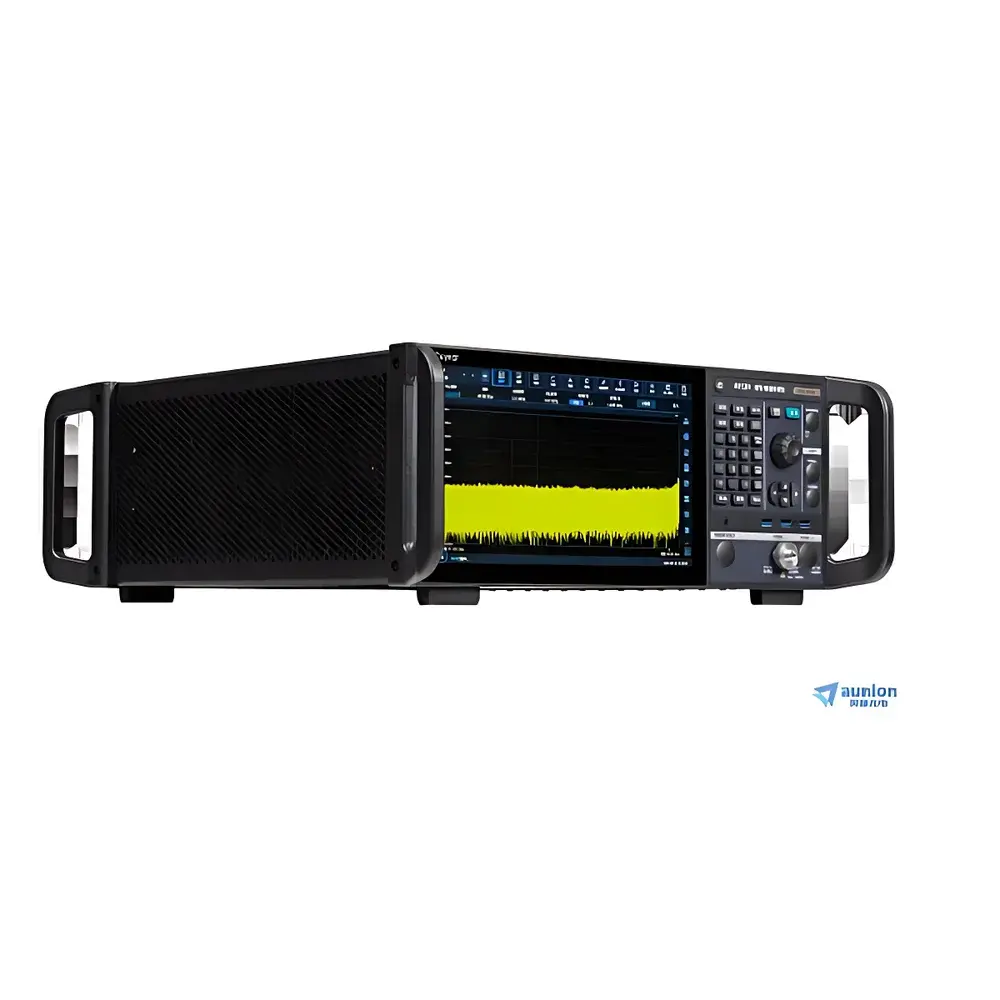
Auniontech 4052 Multi-Function Universal Signal & Spectrum Analyzer
| Brand | Auniontech |
|---|---|
| Model | 4052 |
| Frequency Range | 2 Hz to 50 GHz |
| Analysis Bandwidth | 10 MHz to 1.2 GHz (6 selectable options) |
| Phase Noise | < –122 dBc/Hz @ 10 kHz offset, 1 GHz carrier |
| DANL | –154 dBm/Hz (typ.) @ 1 GHz, –172 dBm/Hz with noise cancellation enabled |
| Amplitude Accuracy | ±0.4 dB (typ.) up to 8 GHz |
| Spurious-Free Dynamic Range | –75 dBc @ 200 MHz BW, –65 dBc @ 1.2 GHz BW |
| Real-Time Analysis Bandwidth | 400 MHz |
| 100% Probability of Intercept (POI) | < 0.6 µs |
| Spectral Processing Rate | 1.95 million FFTs/s |
| Interface | 10 Gigabit Ethernet (10GbE), analog/digital I/O for system integration |
| Compliance | Designed for ISO/IEC 17025-aligned test environments |
Overview
The Auniontech 4052 Multi-Function Universal Signal & Spectrum Analyzer is a high-performance, modular instrumentation platform engineered for precision RF and microwave signal characterization across research, development, and production environments. Based on superheterodyne architecture with dual-conversion synthesis and real-time digital IF processing, the 4052 delivers coherent wideband acquisition and multi-domain analysis capabilities — spanning spectral, time, modulation, and transient domains — within a single instrument chassis. Its 2 Hz to 50 GHz frequency coverage (with eight factory-configurable band modules) enables end-to-end validation of low-frequency sensor interfaces, sub-6 GHz cellular transceivers, mmWave 5G FR2 components, LEO satellite uplink/downlink chains, and ultra-wideband IoT waveforms. The analyzer’s architecture integrates a 1.2 GHz instantaneous bandwidth ADC front-end, low-phase-noise local oscillators, and FPGA-accelerated signal processing pipelines — ensuring deterministic latency, traceable amplitude linearity, and phase-coherent multi-channel synchronization when deployed in automated test systems.
Key Features
- Ultra-wide frequency range: 2 Hz – 50 GHz, configurable via eight interchangeable RF input modules (including low-noise preamplifier and harmonic mixing options)
- Real-time spectrum analysis with 400 MHz instantaneous bandwidth, 100% POI < 0.6 µs, and spectral update rate up to 1.95 million FFTs per second
- Six user-selectable analysis bandwidths: 10 MHz, 40 MHz, 200 MHz, 400 MHz, 600 MHz, and 1.2 GHz — optimized for standards-compliant testing of 5G NR, WLAN 6E/7, UWB, and satellite DVB-S2X signals
- Phase noise performance ≤ –122 dBc/Hz @ 10 kHz offset (1 GHz carrier), enabling accurate EVM measurement of high-order QAM constellations
- Display average noise level (DANL) of –154 dBm/Hz (typ.) @ 1 GHz; enhanced to –172 dBm/Hz with noise cancellation algorithm active
- Amplitude accuracy of ±0.4 dB (typ.) up to 8 GHz, traceable to NIST-traceable calibration sources
- 10 Gigabit Ethernet interface supporting full-bandwidth IQ streaming at sustained rates > 9.6 Gbps, compatible with MATLAB, Python (NumPy/SciPy), and LabVIEW real-time frameworks
- Open API (SCPI-compliant over TCP/IP and USB-TMC) and SDK support for custom application development and ATE integration
Sample Compatibility & Compliance
The 4052 is designed for direct connection to RF devices under test (DUTs) ranging from crystal oscillators and VCOs to GaN power amplifiers and phased-array antenna modules. It supports standard 50 Ω coaxial interfaces (SMA, 2.92 mm, 1.85 mm) and optional external harmonic mixers for extended millimeter-wave coverage. All internal calibration routines — including receiver gain flatness, IF response, and phase tracking — are performed using factory-characterized reference paths and stored in non-volatile memory with timestamped metadata. The instrument complies with electromagnetic compatibility (EMC) requirements per CISPR 16-2-3 and safety standards per IEC 61010-1. For regulated industries, its firmware implements secure boot, role-based access control, and audit-trail-enabled configuration logging — aligning with FDA 21 CFR Part 11 principles for electronic records and signatures in quality-critical workflows.
Software & Data Management
The native SignalStudio software suite provides intuitive graphical workflow construction for spectrum monitoring, vector signal analysis (VSA), pulse parameter extraction, and audio domain evaluation. All measurements generate IEEE-compliant .mat or .csv files containing time-synchronized I/Q samples, metadata headers (frequency, RBW, attenuation, calibration state), and measurement descriptors. Optional add-ons include 5G NR Release 17 conformance test packages (TS 38.141-1/2), LTE Layer 1 physical layer validation, and satellite signal demodulation (DVB-S2X, CCSDS). Data export supports HDF5 format for long-duration recording (>1 TB/hour at 1.2 GHz BW), with built-in checksum verification and SHA-256 hash generation for integrity assurance. Remote operation is fully scriptable via Python bindings and RESTful HTTP endpoints — enabling seamless integration into CI/CD pipelines for automated regression testing.
Applications
- 5G NR base station transmitter validation: ACLR, EVM, spectral emission mask, and time-gated burst analysis
- Automotive radar development: FMCW chirp characterization, Doppler resolution, and angle-of-arrival estimation using IQ stream replay
- LEO satellite ground terminal testing: L-band to Ka-band downlink signal demodulation, timing jitter analysis, and Doppler shift compensation
- IoT device certification: NB-IoT, LoRa, and Bluetooth LE PHY layer compliance testing per ETSI EN 300 328 and FCC Part 15
- R&D lab use: Wideband EMI pre-compliance scanning, oscillator phase noise mapping, and RFIC behavioral modeling with stimulus-response capture
- Defense electronics: Electronic warfare (EW) signal intelligence (SIGINT) recording, pulse descriptor word (PDW) generation, and threat library correlation
FAQ
What calibration standards does the 4052 support?
The instrument includes factory-performed amplitude, frequency, and phase calibration traceable to national metrology institutes (NIM, China); optional accredited calibration certificates (ISO/IEC 17025) are available upon request.
Can the 4052 perform simultaneous spectrum and vector signal analysis?
Yes — dual-path acquisition architecture allows concurrent real-time spectral monitoring and full-bandwidth IQ capture for post-processing modulation analysis without signal reacquisition.
Is remote programming supported over 10GbE?
Yes — SCPI commands, binary waveform transfers, and asynchronous event notifications are fully supported over TCP/IP with guaranteed packet ordering and low-latency buffering.
Does the instrument support third-party demodulation libraries?
Yes — raw IQ data is exported in industry-standard formats (complex64, complex128) compatible with GNU Radio, SigMF, and commercial SDR toolchains.
How is firmware updated and version controlled?
Firmware updates are delivered as signed packages with SHA-256 verification; rollback capability and version history logging are embedded in the system management controller.
Related Products