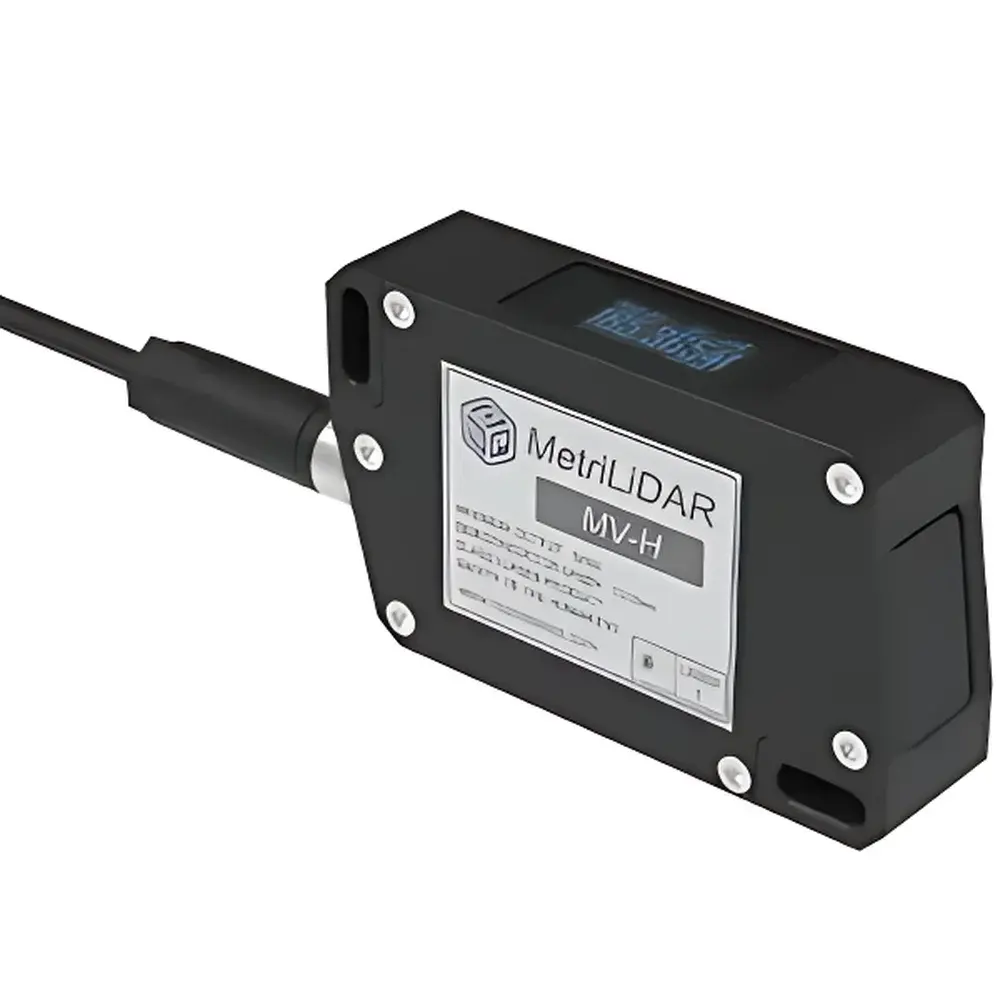
Auniontech AUM-LSV1310 Miniature Laser Vibrometer / Integrated Optical Laser Vibration Sensor
| Brand | Auniontech |
|---|---|
| Origin | Imported |
| Manufacturer Type | Authorized Distributor |
| Model | AUM-LSV1310 |
| Optical Wavelength | 1310 nm |
| Laser Safety Class | Class I (IEC 60825-1) |
| Output Power | <5 mW |
| Frequency Range | DC to 2.5 MHz |
| Displacement Noise Density | 5 pm/√Hz |
| Displacement Resolution | 1.28 nm |
| Maximum Velocity Range | 4.5 m/s |
| Velocity Resolution | <1 µm/s (at 1 kHz) |
| Displacement Repeatability (>10 Hz) | ±1 nm |
| Displacement Repeatability (<10 Hz) | ±10 nm |
| Vibration Frequency Accuracy | ±0.02% |
| Dynamic Velocity Range | 20 m/s (peak) |
| Sampling Rate | 5 MS/s (real-time digital acquisition) |
| Signal Output | Ethernet (TCP/IP, UDP), Digital TTL sync |
| Power Supply | 12–24 V DC |
| Power Consumption | <4 W |
| Operating Temperature | 0–50 °C |
| Relative Humidity | 35–85% RH (non-condensing) |
| Housing Material | Anodized Aluminum Alloy |
| Dimensions | 83.7 × 50 × 22 mm |
| Weight | 180 g |
Overview
The Auniontech AUM-LSV1310 is a miniature, fully integrated laser vibrometer engineered for high-fidelity non-contact vibration metrology in constrained environments and high-frequency applications. Unlike conventional laser Doppler vibrometers (LDVs) relying on bulk-optic interferometric assemblies, the AUM-LSV1310 implements a monolithic photonic integrated circuit (PIC) platform operating on frequency-modulated continuous-wave (FMCW) coherent detection principles. This architecture embeds the laser source, phase modulator, balanced photodetector array, and interferometric delay lines onto a single silicon-based optical chip—enabling sub-millimeter optical path stability, intrinsic immunity to thermal drift, and robust phase-locking performance. The sensor operates at 1310 nm (Class I eye-safe), delivering real-time displacement, velocity, and acceleration waveforms with DC-coupled response up to 2.5 MHz—making it particularly suited for ultrasonic transducer characterization, MEMS device validation, piezoelectric actuator testing, and micro-acoustic component analysis where spatial resolution, bandwidth, and installation flexibility are critical.
Key Features
- Fully Integrated Photonic Architecture: All core optical functions—including laser emission, interferometric signal generation, and coherent demodulation—are implemented on a single planar lightwave circuit (PLC), eliminating alignment sensitivity and mechanical hysteresis typical of free-space LDVs.
- True Plug-and-Measure Operation: No external controller, amplifier, or signal conditioning unit required; full measurement capability resides within the 180 g sensor head, enabling deployment in embedded systems, robotic end-effectors, or confined test fixtures.
- High-Fidelity FMCW Coherent Detection: Leverages linear frequency sweep modulation over a 100 MHz bandwidth to achieve sub-picometer displacement noise floor (5 pm/√Hz) and 1.28 nm RMS displacement resolution—validated per ISO 18431-1 and ASTM E1876 standards for dynamic mechanical analysis.
- Wide Dynamic Range & Bandwidth: Supports peak velocities up to 20 m/s and captures spectral content from DC to 2.5 MHz using a synchronized 5 MS/s ADC, satisfying requirements for ultrasonic NDT, resonant mode mapping, and broadband modal analysis.
- Environmental Robustness: Immune to surface reflectivity, color, roughness, and ambient illumination (>60,000 lux tolerance); maintains calibration stability across temperature gradients (0–50 °C) without active thermal compensation.
Sample Compatibility & Compliance
The AUM-LSV1310 is compatible with reflective or diffusely scattering surfaces—including polished metals, ceramic substrates, polymer films, and anodized aluminum—without requiring retroreflective tape or surface preparation. Its 1310 nm wavelength minimizes speckle noise on rough surfaces and avoids interference from visible-light sources common in industrial labs. The sensor conforms to IEC 60825-1:2014 (Class I laser safety), CE marking (EMC Directive 2014/30/EU, RoHS 2011/65/EU), and supports traceable calibration via NIST-traceable reference shakers (e.g., Brüel & Kjær Type 4809). When used with validated mounting hardware and environmental enclosures, the system meets GLP-compliant data acquisition requirements under FDA 21 CFR Part 11 when paired with audit-trail-enabled software.
Software & Data Management
The AUM-LSV1310 interfaces natively via Gigabit Ethernet using TCP/IP and UDP protocols, supporting real-time streaming of raw quadrature I/Q data at full 5 MS/s rate or decimated time-series outputs (velocity, displacement, acceleration) at user-defined sample rates. ASDK (Auniontech Sensor Development Kit) provides C/C++, Python, and MATLAB APIs for custom integration into LabVIEW, Python-based test automation frameworks (e.g., PyVISA), or real-time control systems (e.g., dSPACE SCALEXIO). Optional VibroView™ software includes FFT-based spectrum analysis, waterfall plots, coherence estimation, modal parameter extraction (via PolyMAX), and automated report generation compliant with ISO 10816-3 machinery vibration severity standards. All acquired datasets include embedded metadata (timestamp, gain setting, lens configuration, temperature) to support ALCOA+ data integrity principles.
Applications
- Ultrasonic transducer development and quality control (e.g., medical imaging arrays, cleaning transducers, sonar projectors)
- MEMS resonator characterization and failure mode analysis (Q-factor, motional impedance, nonlinear distortion)
- Piezoelectric actuator linearity and hysteresis evaluation under closed-loop feedback
- Micro-speaker diaphragm vibration mapping and breakup mode identification
- Non-destructive evaluation of adhesive bond integrity in aerospace composites
- In-situ monitoring of precision machining tool vibrations during high-speed milling
- Research-grade acoustic metamaterial characterization and bandgap verification
FAQ
Does the AUM-LSV1310 require external optics or alignment tools?
No—the integrated optical chip and collimating lens are factory-aligned and sealed; no user alignment or recalibration is necessary.
Can it measure through transparent media such as glass or water?
Yes, provided the laser beam path is unobstructed and the target surface behind the medium remains optically accessible; refractive index mismatch must be accounted for in displacement interpretation.
Is the output signal compatible with third-party DAQ systems?
Yes—raw I/Q data streams over Ethernet are protocol-agnostic; users may implement custom demodulation or feed directly into FPGA-based processing platforms.
What is the minimum measurable displacement at 1 Hz?
At 1 Hz, displacement noise density integrates to ~50 pm RMS over 1 Hz bandwidth; practical low-frequency resolution is limited by mechanical isolation and air currents—not sensor electronics.
How is traceability maintained for regulatory submissions?
Calibration certificates include uncertainty budgets per ISO/IEC 17025, referencing NIST-traceable primary standards; software audit logs record all parameter changes with user ID and timestamp.