
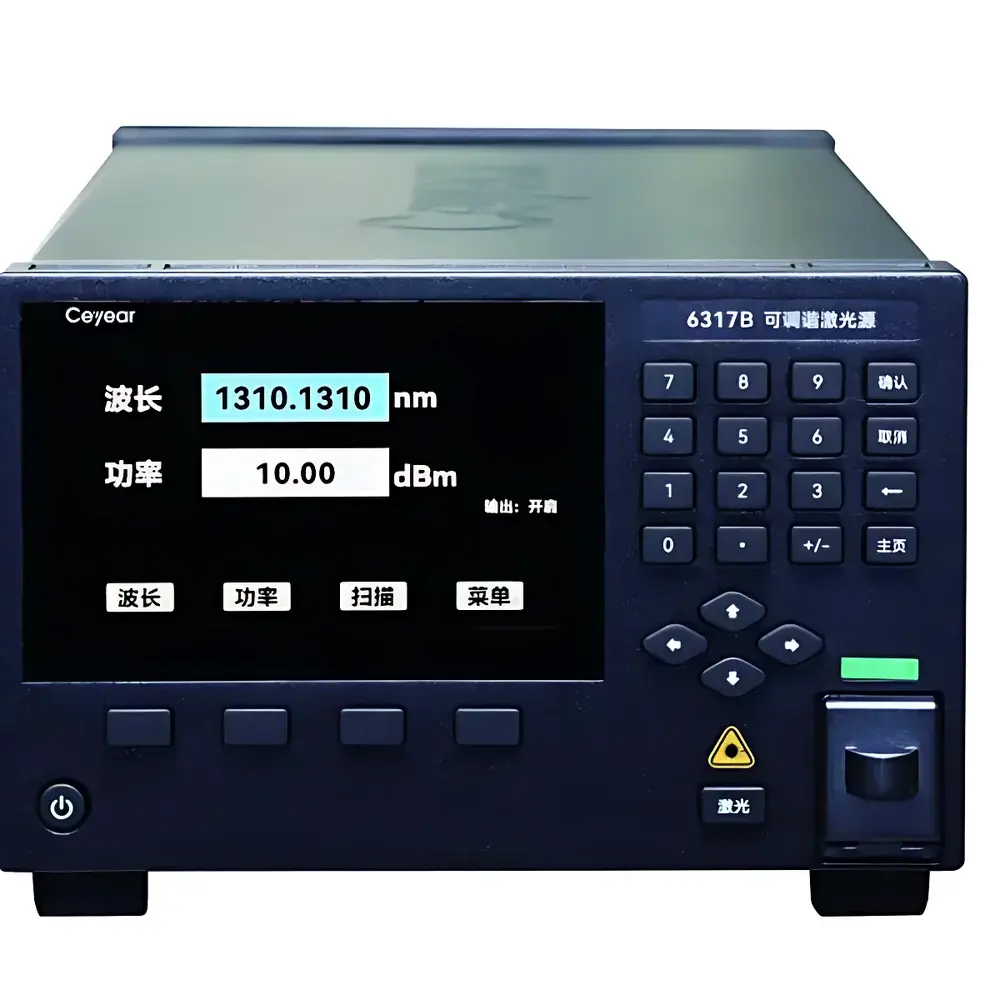
Auniontech O-Band High-Precision Tunable Laser Source (1260–1360 nm)
| Brand | Auniontech |
|---|---|
| Origin | Shanghai, China |
| Manufacturer Type | Authorized Distributor |
| Product Category | Continuous-Wave Tunable Semiconductor Laser |
| Wavelength Range | 1260–1360 nm |
| Wavelength Resolution | 0.1 pm |
| Absolute Wavelength Accuracy | ±20 pm |
| Wavelength Repeatability | ±5 pm |
| Wavelength Stability | ±5 pm / 10 min |
| Scan Speed | 1–200 nm/s |
| Output Power | ≥13 dBm |
| Power Stability | ±0.02 dB / 10 min |
| Linewidth | ≤100 kHz |
| SMSR | ≥45 dB |
| RIN | ≤−145 dB/Hz |
| ASE Noise Floor | ≥50 dB/nm |
| Optical Interface | FC/APC |
| Dimensions (W×H×D) | 213 × 133 × 451 mm |
| Weight | ≤8 kg |
| Input Power | 220 VAC ±10%, 50 Hz ±5% |
| Operating Temperature | 15–35 °C |
| Relative Humidity | ≤80% RH (non-condensing) |
Overview
The Auniontech O-Band High-Precision Tunable Laser Source (1260–1360 nm) is a benchtop-grade, continuous-wave (CW) semiconductor-based tunable laser engineered for metrology-grade optical testing in fiber-optic communication and photonic component development. Operating within the O-band—the original low-loss window of standard single-mode fiber (SMF-28)—this instrument leverages monolithic external cavity diode laser (ECDL) architecture with integrated piezoelectric actuation and high-finesse interferometric wavelength monitoring. Its core measurement principle relies on precise cavity-length modulation combined with real-time wavelength feedback from an on-board wavemeter module, enabling sub-picometer resolution and mode-hop-free tuning across the full 100 nm range. Unlike fixed-wavelength or coarse-tuning lasers, this source delivers traceable, repeatable, and spectrally pure output essential for characterizing wavelength-dependent parameters such as insertion loss, polarization-dependent loss (PDL), group delay, and chromatic dispersion in passive and active photonic devices.
Key Features
- Mode-hop-free continuous wavelength scanning across 1260–1360 nm with ≤0.1 pm wavelength setting resolution and ±5 pm repeatability over repeated sweeps;
- Ultra-narrow intrinsic linewidth of ≤100 kHz, optimized for coherent applications including heterodyne detection, optical coherence tomography (OCT), and high-resolution spectroscopy;
- High spectral purity with side-mode suppression ratio (SMSR) ≥45 dB and amplified spontaneous emission (ASE) noise floor ≥50 dB/nm, ensuring minimal background interference during sensitive measurements;
- Programmable scan speed from 1 nm/s to 200 nm/s, supporting both rapid broadband characterization and high-resolution narrowband interrogation;
- Integrated optical trigger output synchronized to wavelength position, enabling precise time-aligned data acquisition with optical spectrum analyzers (OSAs), vector network analyzers (VNAs), or photodetector arrays;
- Compact 2U rack-mountable chassis (213 × 133 × 451 mm) with FC/APC fiber output, designed for integration into automated test systems and production line environments;
- Stable optical output power ≥13 dBm with ±0.02 dB/10 min power stability, minimizing calibration drift during extended measurement cycles.
Sample Compatibility & Compliance
This laser source is compatible with industry-standard single-mode and polarization-maintaining fibers (SMF-28, PM1550), as well as planar lightwave circuit (PLC) devices, arrayed waveguide gratings (AWGs), thin-film filters (TFFs), and micro-ring resonators. It supports full characterization of O-band components including DFB lasers, VCSELs, Fabry–Pérot (FP) emitters, electro-absorption modulators (EAMs), and TOSA/BOSA subassemblies. The system complies with IEC 61300-3-29 (fiber optic connector durability), Telcordia GR-1209-CORE (reliability of optoelectronic devices), and meets electromagnetic compatibility (EMC) requirements per EN 55032 Class B. All firmware and control logic are structured to support audit-ready operation under GLP and GMP frameworks, with optional timestamped logging for FDA 21 CFR Part 11–compliant environments when used with validated host software.
Software & Data Management
The laser is controlled via USB 2.0 or Ethernet (TCP/IP) using a cross-platform SDK (C/C++, Python, LabVIEW, MATLAB). The native GUI provides intuitive sweep configuration, real-time wavelength/power monitoring, and CSV-based export of calibrated wavelength–power datasets. All internal calibration coefficients—including grating angle vs. wavelength mapping, thermal drift compensation, and power normalization curves—are stored in non-volatile memory and automatically applied during boot-up. Firmware updates preserve user-defined calibration offsets and maintain traceability to factory NIST-traceable reference standards. For automated test systems, SCPI command compliance enables seamless integration with Keysight, Viavi, or EXFO platforms, while TTL-compatible trigger I/O supports synchronization with oscilloscopes, lock-in amplifiers, or multi-channel digitizers.
Applications
- Characterization of O-band passive components: WDM filters, isolators, circulators, couplers, and variable optical attenuators (VOAs);
- Active device testing: Threshold current, slope efficiency, and spectral narrowing behavior of DFB/DBR lasers and SOAs;
- Modulator transfer function analysis: Electro-optic response of Mach–Zehnder and ring modulators at O-band wavelengths;
- Optical time-domain reflectometry (OTDR) source calibration and dispersion map generation;
- Photonic integrated circuit (PIC) wafer-level probing and post-packaging validation;
- Fiber Bragg grating (FBG) sensor interrogation and multiplexed strain/temperature sensing;
- Reference source for calibrating optical spectrum analyzers and wavelength meters in metrology labs.
FAQ
What is the typical warm-up time required to achieve specified wavelength and power stability?
The unit achieves thermal equilibrium and full specification compliance within 30 minutes of power-on under ambient conditions (23 ±2 °C). A built-in thermal stabilization loop actively maintains cavity temperature to ±0.02 °C.
Is the output polarization state controlled or stabilized?
The standard configuration delivers free-running polarization; however, optional integrated polarization controllers or polarization-maintaining (PM) fiber pigtails are available upon request for polarization-sensitive measurements.
Can this laser be used for coherent transmission system testing?
Yes—its ≤100 kHz linewidth, phase noise performance suitable for QPSK/QAM modulation formats, and low RIN (<−145 dB/Hz) make it suitable as a local oscillator (LO) or signal source in coherent receiver characterization setups.
Does the system support remote programming in automated manufacturing test environments?
Yes—full SCPI command set, deterministic latency (<5 ms per command), and hardware-triggered sweep start/stop enable integration into ATE platforms compliant with SEMI E122 and SECS/GEM protocols.
How is wavelength accuracy verified and maintained over time?
Each unit undergoes factory calibration against a NIST-traceable high-accuracy wavemeter (±0.3 pm uncertainty). Field recalibration is supported via the included reference gas cell option (acetylene absorption lines near 1300 nm) or external metrology-grade OSA.




