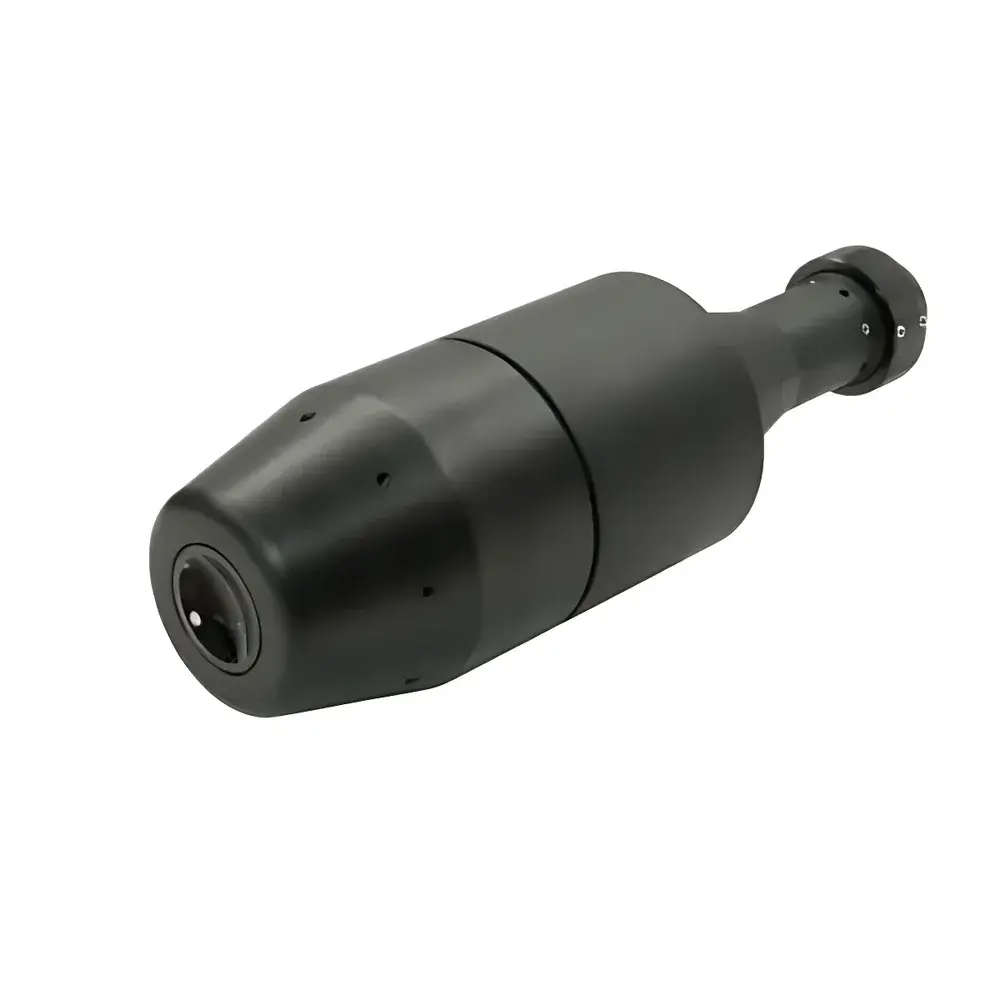
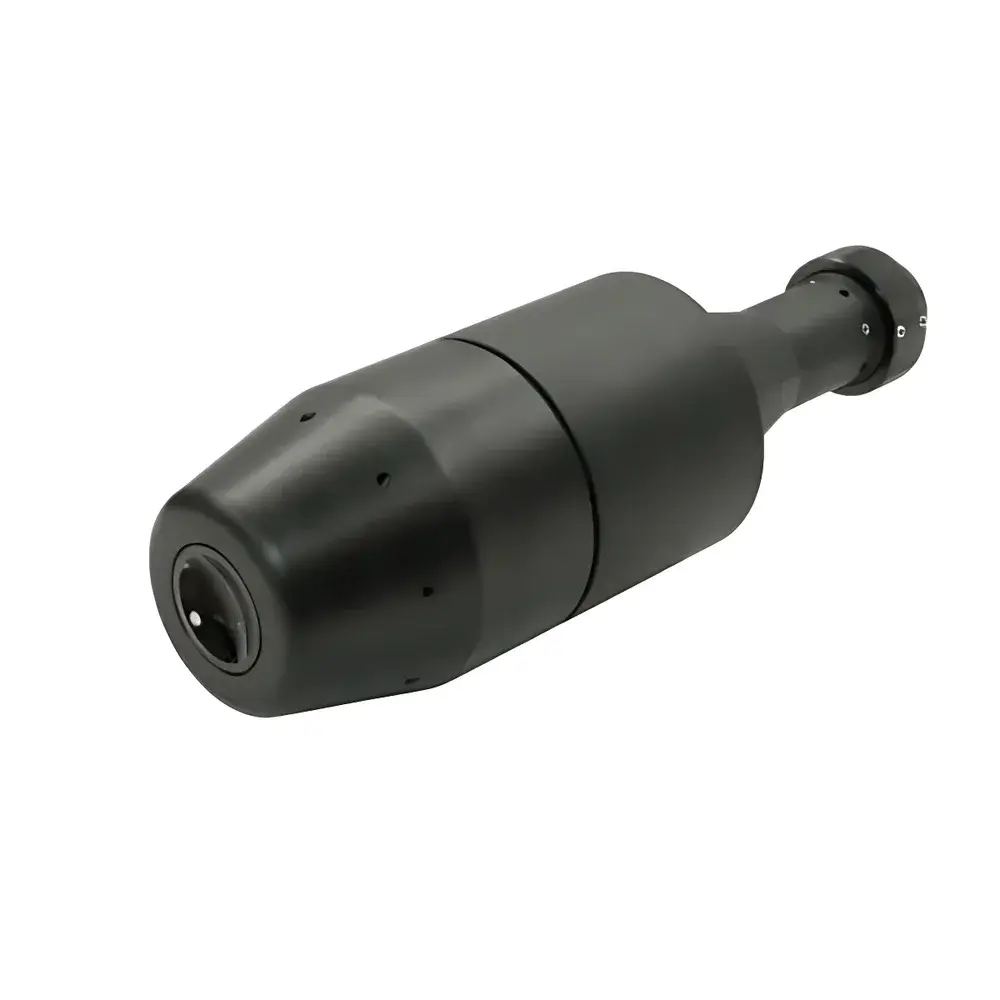
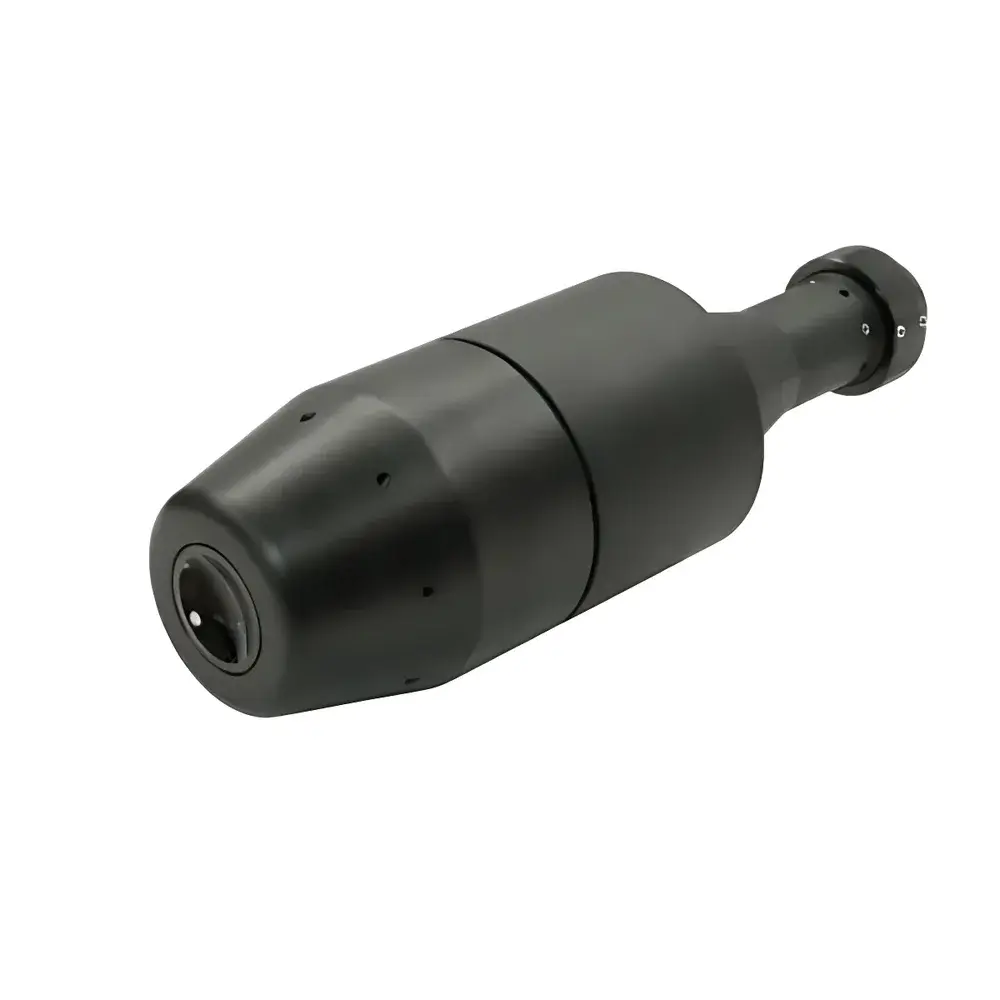
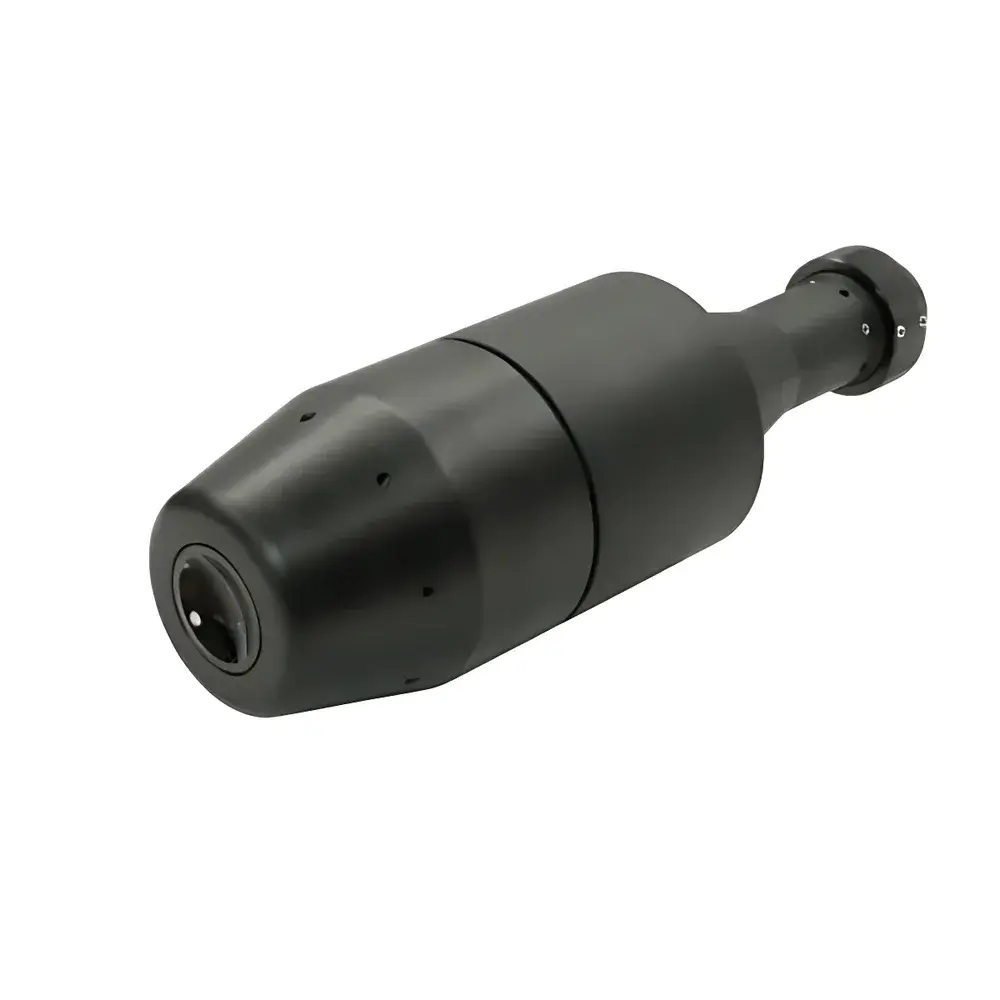
Auniontech Cono60°XR Full-Field Conoscopic Lens for Angular Light Distribution Measurement
| Brand | Auniontech |
|---|---|
| Origin | Shanghai, China |
| Model | Cono60°XR |
| Acceptance Angle | ±60° |
| Angular Resolution | 0.1° |
| Distortion | <2% |
| Chief Ray Angle (CRA) Control | <3° |
| Relative Illumination | Uniform, No Vignetting |
| Sample Size Compatibility | Point Sources <1.5 mm, External Displays >4.3 mm |
| Object Distance | Infinity |
| Working Distance | 5 mm |
| Image Circle Diameter | 8.6 mm |
| Peak Wavelength | 540 nm |
| Spectral Range | 405–780 nm |
| Interface | C-Mount |
| Recommended Sensor | Sony IMX183 (2.3 MP) |
| Length × Outer Diameter | 225 mm × 65 mm |
| Weight | 850 g (lens only) |
Overview
The Auniontech Cono60°XR is a precision-engineered full-field conoscopic lens designed for quantitative angular light distribution characterization of small-area emitters and flat-panel displays (FPDs). Operating on the principle of Fourier-transform imaging, the lens maps incident ray angles linearly onto a planar image sensor—where each pixel position corresponds directly to a specific emission angle relative to the optical axis. This enables single-shot acquisition of luminance and chromaticity data across a total field-of-view exceeding ±60° (i.e., 120° full cone), eliminating mechanical scanning and significantly accelerating photometric and goniophotometric analysis. The system leverages a two-stage optical architecture: a front objective functioning as an f-theta or Fourier-transform lens, projecting collimated rays from the source pupil onto an intermediate Fourier plane; and a rear reimaging group that scales and relays this angular map onto a standard CMOS/CCD sensor with optimized f-number and telecentricity control. Its extended spectral response (405–780 nm) supports both visible-light LED, OLED, and micro-LED characterization under photopic and scotopic conditions, making it suitable for R&D labs, display manufacturing QA, and lighting design validation.
Key Features
- Full-cone angular capture up to ±60° in a single frame—enabling rapid, non-scanning measurement of luminous intensity distribution (LID) and color uniformity
- Linear angle-to-position mapping with <2% geometric distortion and <3° chief ray angle deviation, ensuring high spatial fidelity in angular domain reconstruction
- Optimized for 2.3 MP sensors (e.g., Sony IMX183), delivering 0.1° angular resolution at ±60° FOV—calibrated per pixel via NIST-traceable angular calibration targets
- Extended visible spectrum coverage (405–780 nm) with peak transmission at 540 nm, supporting photobiological safety assessments and colorimetric compliance testing
- Fixed working distance of 5 mm and infinity-conjugate object plane—compatible with automated stage integration and inline production metrology setups
- C-mount interface and modular mechanical design allow seamless integration with industrial machine vision systems, spectroradiometers, or custom optical benches
Sample Compatibility & Compliance
The Cono60°XR is validated for use with point-like or sub-millimeter-area sources—including micro-LEDs, VCSEL arrays, OLED pixels, and miniature backlit indicators—with physical source dimensions 4.3 mm diagonal), external placement beyond the lens’s near-field zone ensures accurate far-field angular sampling. The system supports ISO/CIE-standard photometric geometry (Type A goniophotometer configuration) and complies with key international measurement protocols including CIE S 025/E:2015 (LED measurement), IEC 62385 (LED modules), and ASTM E308-22 (computing tristimulus values). When integrated into GLP- or GMP-regulated environments, the lens may be deployed with audit-trail-capable software platforms compliant with FDA 21 CFR Part 11 requirements for electronic records and signatures.
Software & Data Management
While the Cono60°XR is a hardware-only optical module, it is fully interoperable with industry-standard machine vision SDKs (e.g., GenICam, HALCON, OpenCV) and photometric analysis suites such as LumiCam, LightTools, or custom Python-based pipelines. Raw angular intensity maps are acquired as 16-bit TIFF or HDF5 files, preserving full dynamic range for downstream processing—including Lambertian/non-Lambertian fitting, viewing-angle-dependent chromaticity extraction (u’v’ or x,y), and radiant intensity vector summation. Calibration data (angular lookup tables, vignetting correction matrices, spectral responsivity curves) are stored in vendor-neutral JSON metadata format and can be embedded directly into image headers. For traceable metrology workflows, users may apply ISO/IEC 17025-aligned calibration certificates issued by accredited third-party laboratories—validating angular accuracy, linearity, and repeatability over temperature (15–25°C) and humidity (30–60% RH).
Applications
- Angular-resolved luminance and chromaticity mapping of emissive microdisplays in AR/VR headset development
- Fast binning and sorting of wafer-level micro-LED dies based on viewing-angle-dependent color shift (e.g., Δu’v’ vs. θ)
- Verification of anti-glare, anti-reflection, and brightness enhancement film (BEF) performance on LCD/OLED modules
- Goniophotometric validation of automotive interior lighting (e.g., instrument cluster LEDs) per UNECE R128 and SAE J1383
- Research-grade characterization of metasurface-emitter coupling efficiency and directional scattering profiles
- Education and training in Fourier optics, radiometry, and display metrology laboratories
FAQ
What is the maximum usable source size for accurate angular measurement?
For optimal angular fidelity and minimal spatial averaging error, the Cono60°XR is specified for sources with physical dimensions ≤1.5 mm. Larger sources require careful defocusing or external collimation to maintain pupil-plane conjugacy.
Can the lens be used with monochrome or scientific CMOS cameras?
Yes—the optical design is achromatic across 405–780 nm and does not rely on Bayer filtering. Monochrome sensors (e.g., IMX535, IMX455) yield higher SNR and simplify radiometric calibration.
Is thermal drift compensated in the optical design?
The lens housing uses low-CTE aluminum alloy and cemented air-spaced elements to minimize focus shift; however, active thermal stabilization of the camera sensor is recommended for sub-0.05° repeatability over extended acquisitions.
How is angular calibration performed?
Calibration employs a motorized collimator stage with NIST-traceable angular encoders, generating pixel-wise angular lookup tables (LUTs) that account for residual distortion, f-theta deviation, and sensor tilt—delivered with each unit.
Does the lens support polarization-sensitive measurements?
The standard Cono60°XR is unpolarized; however, optional wire-grid polarizers or liquid-crystal variable retarders can be mounted at the entrance pupil for Stokes parameter acquisition when paired with rotating analyzer techniques.