
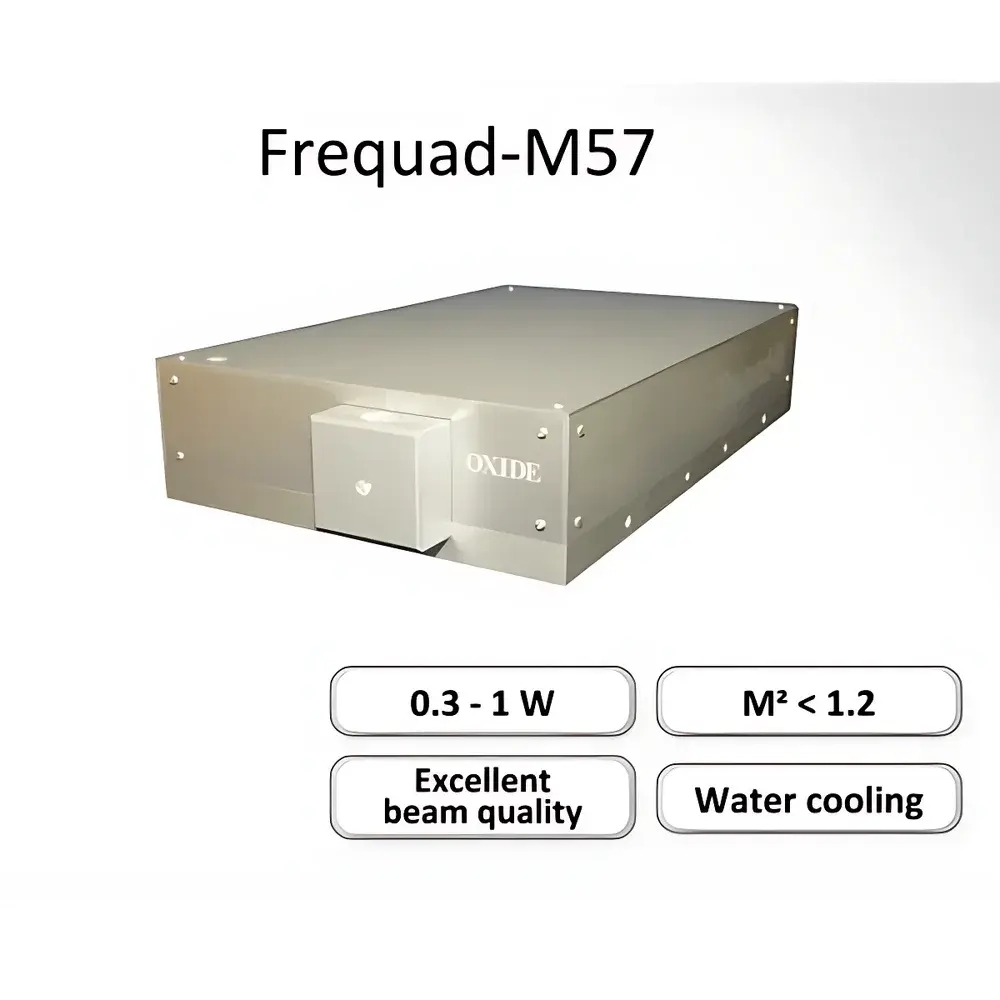
Auniontech Frequad-M57 Single-Frequency Deep-UV Continuous-Wave Laser System
| Brand | Auniontech |
|---|---|
| Wavelength | 257.5 nm |
| Output Power Options | 0.3 W / 0.5 W / 0.7 W / 1.0 W |
| Linewidth | < 0.01 pm |
| Polarization | Vertical, Linear |
| Extinction Ratio | > 100:1 |
| Beam Quality | TEM₀₀, M² < 1.3 |
| Power Supply | 100–240 V AC, 50/60 Hz |
| Power Consumption | < 340 W |
| Cooling | Water-cooled |
| Dimensions | 350 × 590 × 124 mm |
| Origin | Shanghai, China |
Overview
The Auniontech Frequad-M57 is a high-stability, continuous-wave (CW), single-frequency deep-ultraviolet (DUV) laser system engineered for precision photonic applications requiring exceptional spectral purity and spatial coherence. Operating at a fixed wavelength of 257.5 nm, the system leverages OXIDE’s proprietary nonlinear wavelength conversion technology—based on critically phase-matched beta-barium borate (BBO) or cesium lithium borate (CLBO) crystals—to generate narrow-linewidth DUV light from near-infrared pump sources via fourth-harmonic generation (FHG). Its fundamental architecture ensures strict longitudinal mode selection (single longitudinal mode, SLM), achieving an intrinsic linewidth of less than 0.01 pm (≈1.5 MHz), corresponding to a coherence length exceeding 30 m. This level of spectral resolution supports demanding interferometric, spectroscopic, and lithographic tasks where sub-picometer stability and minimal phase noise are non-negotiable.
Key Features
- Single-frequency operation with guaranteed TEM₀₀ spatial profile and M² < 1.3 — enabling diffraction-limited focusing and high-intensity spot formation in tight optical configurations.
- Ultra-narrow linewidth (< 0.01 pm) maintained over 8-hour continuous operation, verified by delayed self-heterodyne interferometry and stabilized against thermal drift via active cavity-length control.
- Output power scalability across four calibrated levels: 0.3 W, 0.5 W, 0.7 W, and up to 1.0 W — each delivered with RMS power stability better than ±0.7% over 4 hours (measured with NIST-traceable thermal power sensor).
- High polarization extinction ratio (>100:1) with vertically oriented linear polarization — optimized for integration into polarized-optics-based metrology tools and photoelectron spectrometers.
- Water-cooled thermal management architecture ensuring long-term power stability and minimizing thermal lensing effects in high-repetition-rate or sustained-duty applications.
- Compact industrial chassis (350 × 590 × 124 mm) designed for OEM integration into semiconductor inspection platforms, ultrafast pump-probe systems, and vacuum-compatible UHV spectroscopy endstations.
Sample Compatibility & Compliance
The Frequad-M57 is compatible with standard fused silica, calcium fluoride (CaF₂), and magnesium fluoride (MgF₂) optical components rated for deep-UV transmission below 260 nm. All beam delivery paths must exclude polymer-based optics and conventional BK7 glass due to strong absorption and solarization effects at 257.5 nm. The system complies with IEC 60825-1:2014 Class 4 laser safety requirements and includes integrated interlock circuitry for external shutter control and emergency stop signaling. For regulated environments—including GMP-compliant semiconductor fab metrology labs and FDA-audited biophotonics R&D facilities—the laser supports optional 21 CFR Part 11–compliant audit trail logging when paired with Auniontech’s certified control software suite.
Software & Data Management
Control is executed via Ethernet-connected GUI application running on Windows 10/11 (64-bit), supporting real-time monitoring of output power, head temperature, coolant flow rate, and cavity lock status. All operational parameters—including setpoint history, error logs, and calibration timestamps—are stored in encrypted SQLite databases with SHA-256 hashing for integrity verification. Remote API access (TCP/IP + RESTful endpoints) enables seamless integration into LabVIEW, Python (PyVISA), MATLAB, and SCADA-based factory automation systems. Firmware updates are performed via signed binary packages validated against embedded public-key certificates, satisfying ISO/IEC 17025 traceability requirements for metrological instruments.
Applications
- Semiconductor mask inspection and photomask defect review systems requiring high-resolution DUV illumination with minimal chromatic aberration.
- Deep-UV resonance Raman spectroscopy for characterizing wide-bandgap semiconductors (e.g., GaN, SiC, AlN) and 2D materials such as hexagonal boron nitride (h-BN).
- Angle-resolved photoemission spectroscopy (ARPES) light sources, where narrow linewidth and high brightness enable improved momentum-space resolution.
- Fabrication of Type-II fiber Bragg gratings in radiation-hardened photosensitive fibers using two-photon absorption processes.
- Time-resolved photoluminescence (TRPL) imaging of perovskite thin films and quantum dot monolayers under sub-10-ps excitation pulses derived via optical parametric amplification seeding.
- UV-induced crosslinking and surface functionalization in microfluidic biochip manufacturing, leveraging precise photon dose control.
FAQ
Is the 257.5 nm output wavelength tunable?
No — the Frequad-M57 is a fixed-wavelength source optimized for maximum efficiency and stability at 257.5 nm. Tunability is not supported; alternative models with discrete DUV lines (e.g., 266 nm, 213 nm) are available upon request.
What cooling water specifications are required?
Deionized water with resistivity > 1 MΩ·cm, flow rate ≥ 2.5 L/min, inlet temperature 18–22 °C, and pressure 2–4 bar. Chiller units meeting ASTM F2627-18 standards are recommended for lab-scale deployment.
Can this laser be operated in vacuum environments?
The laser head is not vacuum-rated; however, it may feed into UHV chambers via differential pumping stages using CaF₂ vacuum viewports and kinematic mounts. External beam path purging with dry nitrogen or argon is strongly advised to prevent ozone accumulation and optical degradation.
Does the system include beam diagnostics?
Yes — optional add-ons include a calibrated DUV photodiode power monitor (NIST-traceable), CCD-based beam profiler with MgF₂ lenses, and a compact wavemeter capable of ±0.002 pm absolute accuracy at 257 nm.
What is the expected lifetime of the nonlinear crystal module?
Under specified operating conditions (clean coolant, stable ambient temperature, no mechanical shock), the BBO/CLBO crystal assembly maintains > 95% initial conversion efficiency for ≥ 15,000 hours, consistent with Telcordia GR-468-CORE reliability testing protocols.



