
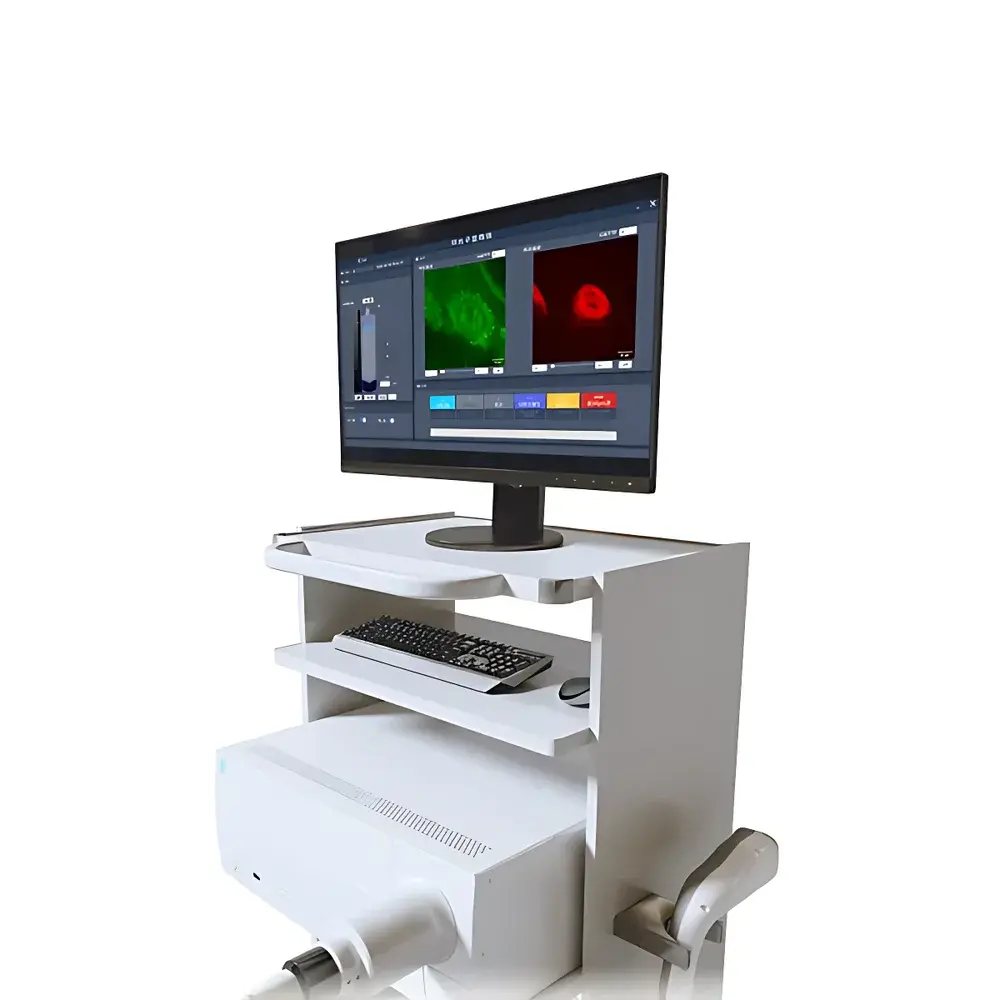
Auniontech Handheld Two-Photon Skin Imaging System
| Brand | Auniontech |
|---|---|
| Origin | Shanghai, China |
| Model | Bio-Micro Imaging System |
| Form Factor | Miniaturized Handheld Two-Photon Microscope |
| Axial Resolution | ≤2 µm |
| Lateral Resolution | ≤0.65 µm |
| Pulse Width | ≤200 fs |
| Repetition Rate | 80 MHz ±10% |
| Excitation Wavelength | 780 nm ±10 nm |
| Output Power | 50 mW ±10% |
| Field of View | ≥125 µm × 125 µm |
| Imaging Depth | ≥200 µm |
| Image Resolution | 512 × 512 pixels |
| Frame Rate | ≥8 fps |
| Probe Mass | 2.2 g |
| Fiber Type | Specialty Ultra-Flexible Photonic Crystal Fiber |
Overview
The Auniontech Handheld Two-Photon Skin Imaging System is a miniaturized, portable in vivo imaging platform engineered for label-free, non-invasive, subcellular-resolution visualization of human skin tissue at the epidermal and upper dermal layers. It operates on the physical principles of two-photon excitation fluorescence (2PEF) and second-harmonic generation (SHG), both nonlinear optical processes requiring ultrafast femtosecond laser illumination. Unlike conventional confocal or widefield microscopy, this system leverages near-infrared (NIR) excitation at 780 nm to achieve deeper photon penetration with reduced scattering and minimal photodamage—critical for longitudinal clinical monitoring. Endogenous fluorophores—including NAD(P)H, FAD, melanin, and keratin—and non-centrosymmetric structural proteins such as collagen type I and III serve as intrinsic contrast agents, eliminating the need for exogenous dyes or genetic labeling. The simultaneous acquisition of 2PEF and SHG signals enables concurrent mapping of cellular metabolism (via NAD(P)H/FAD redox ratio) and extracellular matrix architecture (via collagen fiber orientation and density), providing a quantitative, multi-parametric biomarker framework for dermatological assessment.
Key Features
- Ultra-lightweight handheld probe (2.2 g) with ergonomic, clinician-grade ergonomics for extended use during bedside or field-based examinations
- Integrated dispersion-compensated femtosecond fiber laser (780 nm, ≤200 fs pulse width, 80 MHz repetition rate, 50 mW average power) optimized for safe, high-efficiency 2PEF/SHG excitation
- Submicron lateral resolution (≤0.65 µm) and axial resolution (≤2 µm) validated per ISO 19012-1 standards for optical sectioning performance
- Real-time dual-channel detection: spectrally separated 2PEF (400–550 nm) and SHG (390 nm) emission pathways with high-transmission dielectric filter sets
- High-fidelity signal transmission via specialty ultra-flexible photonic crystal fiber, preserving spatial coherence and pulse integrity over >1.5 m length
- Onboard galvanometric scanning engine supporting ≥8 fps at 512 × 512 pixel resolution, enabling dynamic observation of keratinocyte migration, capillary flow, and collagen remodeling
- Ruggedized aerospace-grade mechanical housing compliant with IP54 environmental rating for clinical mobility and repeated sterilization cycles
Sample Compatibility & Compliance
The system is validated for direct, contact-based imaging of human volar forearm, cheek, and dorsal hand skin under ambient lighting conditions. No coupling gel or vacuum interface is required; gentle mechanical contact ensures stable optical alignment while maintaining epidermal integrity. All optical components comply with IEC 60825-1:2014 Class 1 laser safety requirements when operated within specified power and exposure limits. Data acquisition workflows support audit-trail logging and user-access controls aligned with GLP-compliant documentation practices. While not FDA-cleared or CE-marked as an IVD device, the system adheres to ISO 13485 design control principles for research-use-only (RUO) instrumentation and is routinely deployed in IRB-approved clinical studies investigating skin aging, diabetic dermopathy, and post-procedural wound healing.
Software & Data Management
The proprietary AunionTech SkinView™ software suite provides real-time image rendering, spectral unmixing, and quantitative morphometric analysis. Built on a modular Qt/C++ architecture, it supports DICOM-SR export for integration into hospital PACS environments and HDF5-based long-term storage compliant with NIH BRAIN Initiative data standards. Key analytical modules include: (1) Collagen Fiber Orientation Index (CFOI) calculation using FFT-based directional filtering; (2) Epidermal Thickness Mapping via automated stratum corneum–basal lamina segmentation; (3) Metabolic Activity Ratio (MAR) derived from NAD(P)H/FAD intensity quotienting; and (4) SHG-to-2PEF Signal Ratio (SSR) for fibroblast quiescence assessment. All processing pipelines are scriptable via Python API and support 21 CFR Part 11–compatible electronic signatures when deployed on validated Windows 10 LTSB platforms.
Applications
- Cosmetic Efficacy Evaluation: Quantitative tracking of stratum corneum compaction, epidermal thickening, and keratinocyte nucleation patterns following topical intervention (e.g., retinoids, peptides, ceramide formulations)
- Aesthetic Medicine Monitoring: Objective assessment of microneedling-induced microtrauma depth, collagen neosynthesis kinetics, and elastin regeneration post-radiofrequency treatment
- Dermatological Diagnostics: Differentiation of psoriatic plaques (aberrant keratinocyte proliferation + disrupted SHG collagen patterning) from atopic eczema (intact collagen architecture but elevated 2PEF in spongiosis zones)
- Metabolic Disease Screening: Detection of advanced glycation end-products (AGEs) in diabetic skin via altered NAD(P)H lifetime signatures and collagen cross-linking–induced SHG attenuation
- Transplant Viability Assessment: Real-time evaluation of graft bed revascularization and dermal-epidermal junction restoration in split-thickness skin grafts
FAQ
Is this system suitable for regulatory submission in clinical trials?
Yes—when used within its validated operational envelope (skin surface contact, ambient temperature/humidity, ≤10 min/session), raw image datasets and derived metrics meet ALCOA+ (Attributable, Legible, Contemporaneous, Original, Accurate, Complete, Consistent, Enduring, Available) data integrity criteria required by FDA and EMA for exploratory endpoint qualification.
Can the system image through tattoos or pigmented lesions?
Melanin absorption at 780 nm is moderate; imaging is feasible in lightly to moderately pigmented skin. For heavily melanized regions (e.g., nevi), signal-to-noise ratio decreases above 100 µm depth, though superficial epidermal morphology remains resolvable.
What maintenance is required for long-term stability?
Annual recalibration of laser power output and spatial resolution verification using NIST-traceable USAF 1951 target is recommended. No consumables or alignment tools are required beyond standard optical cleaning protocols.
Does the system support time-lapse or Z-stack acquisition?
Yes—software-controlled motorized focus adjustment enables automated Z-series collection up to 200 µm depth with 1 µm step resolution; time-lapse mode supports programmable intervals from 30 sec to 24 hr.
How is data security managed in multi-user clinical environments?
Role-based access control (RBAC), encrypted local database storage, and optional LDAP/Active Directory integration ensure HIPAA-compliant data governance without reliance on cloud infrastructure.



