
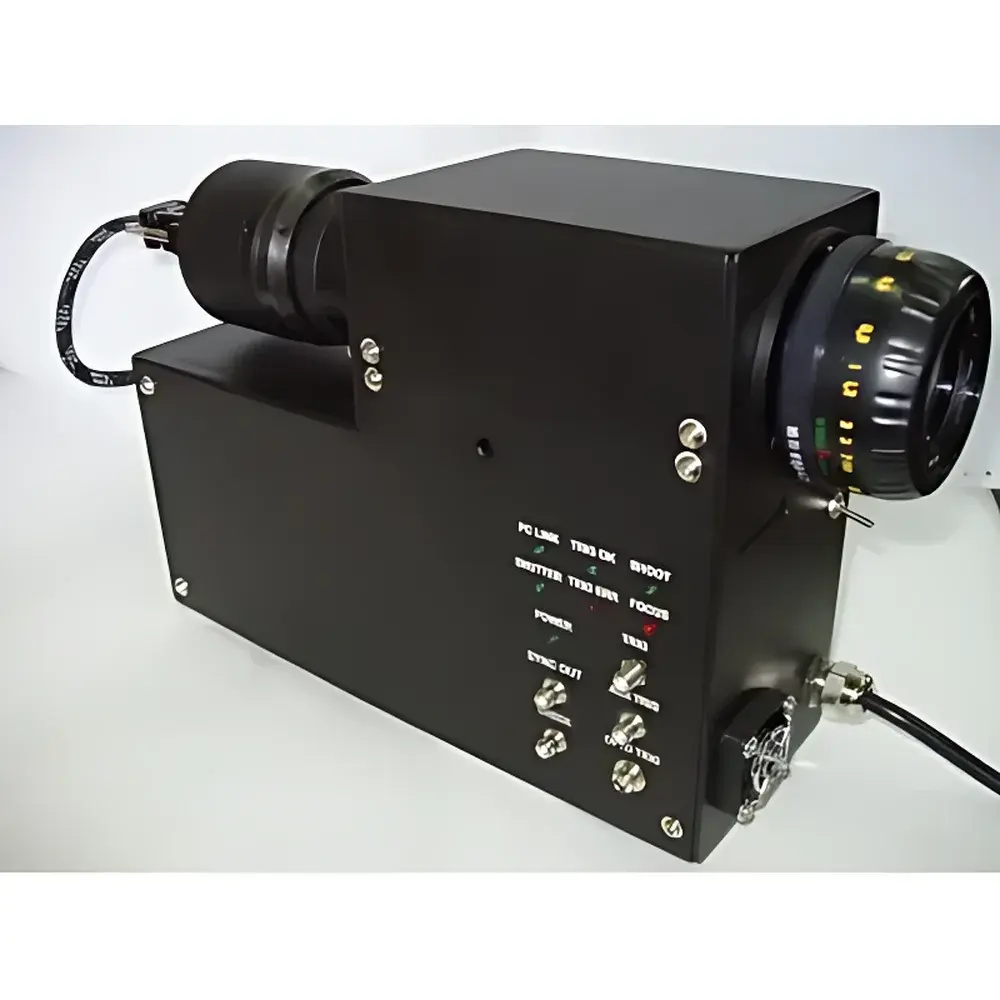
Auniontech PS-40 Picosecond Streak Camera
| Brand | Auniontech |
|---|---|
| Model | PS-40 |
| Type | Picosecond-Resolution Streak Camera |
| Spectral Range | 380–830 nm |
| Temporal Resolution | 40 ps |
| Photocathode Active Area | 15.2 × 12.8 mm |
| Overall Dimensions | 280 × 110 × 200 mm |
| Scan Range (SU-1) | 2 ns – 200 ns |
| Scan Range (SU-2) | 0.6 µs – 600 µs |
| Scan Nonuniformity | <5% |
| Trigger Input Voltage | 0.3–30 V |
| Software-Controlled Delay Step | 10 ns |
| Maximum Gain | 5000 |
| Data Export Formats | TIFF, BMP, HDF5, ASCII |
Overview
The Auniontech PS-40 Picosecond Streak Camera is a high-performance electro-optical diagnostic instrument engineered for ultrafast temporal imaging in the visible to near-UV spectral range (380–830 nm). Based on the principle of photoelectron deflection in a vacuum streak tube, the system converts time-varying optical signals into spatially resolved intensity distributions on a phosphor screen, which are then digitized by a high-sensitivity CCD sensor. This enables direct, single-shot measurement of transient light phenomena with 40 ps temporal resolution—making it suitable for applications requiring precise timing characterization of pulsed lasers, plasma emission dynamics, fluorescence lifetime mapping, and pump-probe spectroscopy. The PS-40 supports both continuous streak mode and gated single-frame acquisition, offering flexibility for both time-resolved waveform capture and snapshot imaging of ultrafast events.
Key Features
- 40 ps intrinsic temporal resolution, verified under standard calibration conditions using synchronized femtosecond laser excitation
- Dual-scan module architecture: SU-1 for nanosecond-scale sweeps (2–200 ns), SU-2 for microsecond-range acquisition (0.6–600 µs)
- Photocathode with high quantum efficiency across 380–830 nm, optimized for broadband visible/NIR detection
- Fully software-controlled operation including real-time adjustment of sweep speed, delay, gain, and trigger threshold
- Multiple synchronization options: optical triggering (via fiber-coupled photodiode input), electrical TTL/CMOS, and external clock reference
- Programmable delay generator with 10 ns step resolution for precise pump-probe alignment
- Integrated SDK (C/C++, Python, MATLAB APIs) enabling custom automation, integration into OEM systems, and third-party control environments
- Compliant with standard laboratory data formats: TIFF, BMP, HDF5, and ASCII export for post-processing in Igor Pro, Origin, or Python-based analysis pipelines
Sample Compatibility & Compliance
The PS-40 accepts free-space or fiber-coupled optical inputs via an adjustable C-mount interface. Its photocathode is compatible with collimated or focused beams up to Ø12 mm diameter. No sample preparation is required—operation is non-contact and non-destructive. The instrument meets CE marking requirements for electromagnetic compatibility (EMC Directive 2014/30/EU) and low-voltage safety (LVD Directive 2014/35/EU). While not certified for medical or industrial process control use out-of-the-box, its architecture supports traceable calibration per ISO/IEC 17025 when operated within accredited metrology laboratories. All firmware and software logs maintain timestamped audit trails compliant with GLP and basic GMP documentation practices.
Software & Data Management
The bundled acquisition software provides full GUI-based control of all hardware parameters, including sweep linearity correction, background subtraction, and multi-channel averaging. Real-time preview and histogram-based intensity normalization ensure optimal signal-to-noise ratio during setup. Raw streak images retain full bit-depth (16-bit) and metadata (exposure time, delay, sweep rate, gain setting) embedded in EXIF-compatible headers. Data export modules support batch processing and scripting-driven workflows. For regulated environments, optional configuration packages provide 21 CFR Part 11-compliant user access controls, electronic signatures, and immutable audit logs—available upon request for pharmaceutical or defense R&D deployments.
Applications
- Ultrafast laser pulse diagnostics: FWHM measurement, chirp analysis, and temporal contrast evaluation of Ti:sapphire, Yb-fiber, and optical parametric amplifiers
- Plasma physics: Time-resolved emission spectroscopy of laser-induced breakdown (LIBS), spark discharge evolution, and fusion target implosion dynamics
- Time-resolved fluorescence: Lifetime mapping of organic dyes, quantum dots, and biological fluorophores in confocal or widefield configurations
- Pump-probe microscopy: Sub-100 ps temporal gating for coherent anti-Stokes Raman scattering (CARS) and transient absorption imaging
- Photonics device testing: Characterization of modulator rise/fall times, photodetector impulse response, and integrated waveguide dispersion
- Ballistics and shockwave imaging: Single-shot visualization of detonation fronts and hypervelocity impact luminescence
FAQ
What is the minimum detectable pulse width supported by the PS-40?
The system achieves 40 ps full-width-at-half-maximum (FWHM) temporal resolution under optimal signal-to-noise conditions; effective measurable pulse widths begin at ~100 ps for reliable amplitude reconstruction.
Can the PS-40 be synchronized with femtosecond laser oscillators?
Yes—via optical triggering with sub-10 ps jitter using the integrated fiber-coupled photodiode input; external clock locking is also supported for phase-locked acquisition.
Is vacuum maintenance required for routine operation?
No—the streak tube is permanently sealed and factory-evacuated; no user-accessible vacuum ports or pumping systems are present.
Does the system support real-time data streaming to external DAQ systems?
Yes—through TCP/IP socket interface and shared memory buffers enabled via the provided SDK; frame rates up to 10 Hz sustained in single-frame mode.
Are NIST-traceable calibration certificates available?
Yes—optional factory calibration reports with uncertainty budgets (k=2) are available upon order, covering temporal linearity, spectral responsivity, and gain stability.



