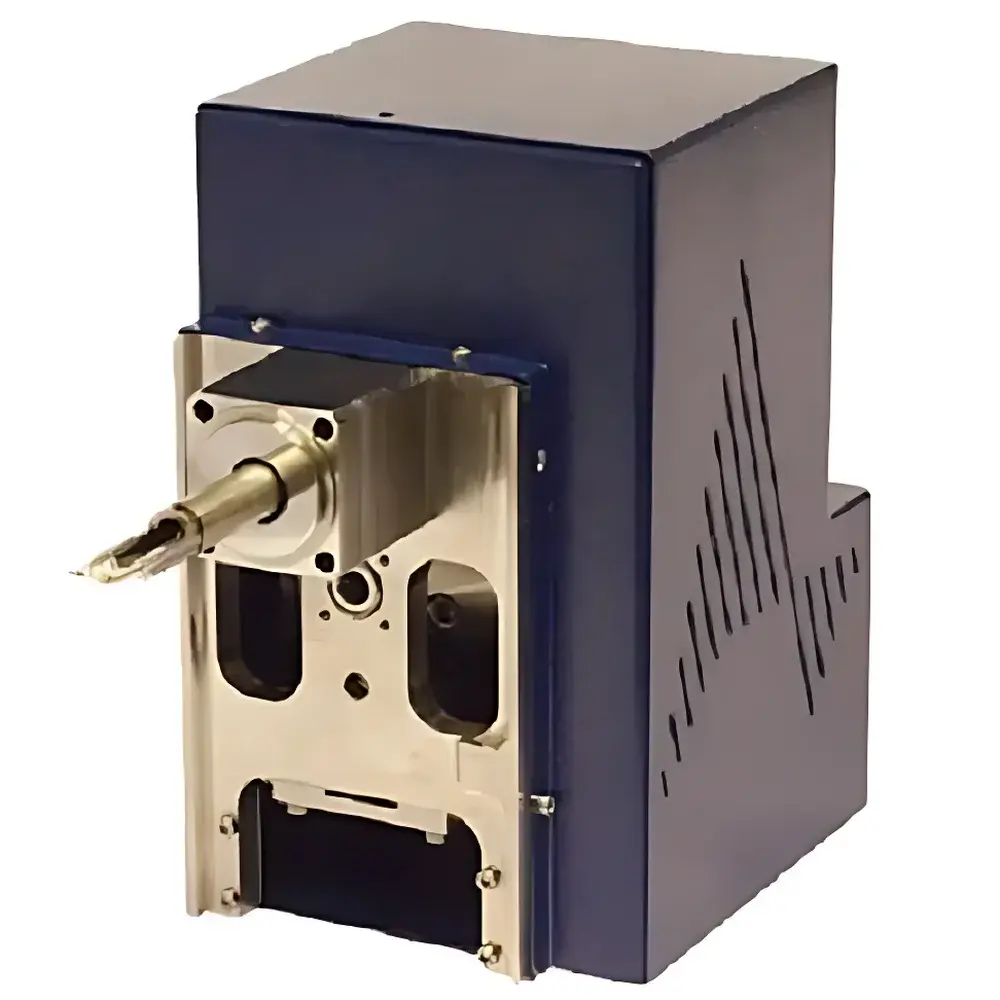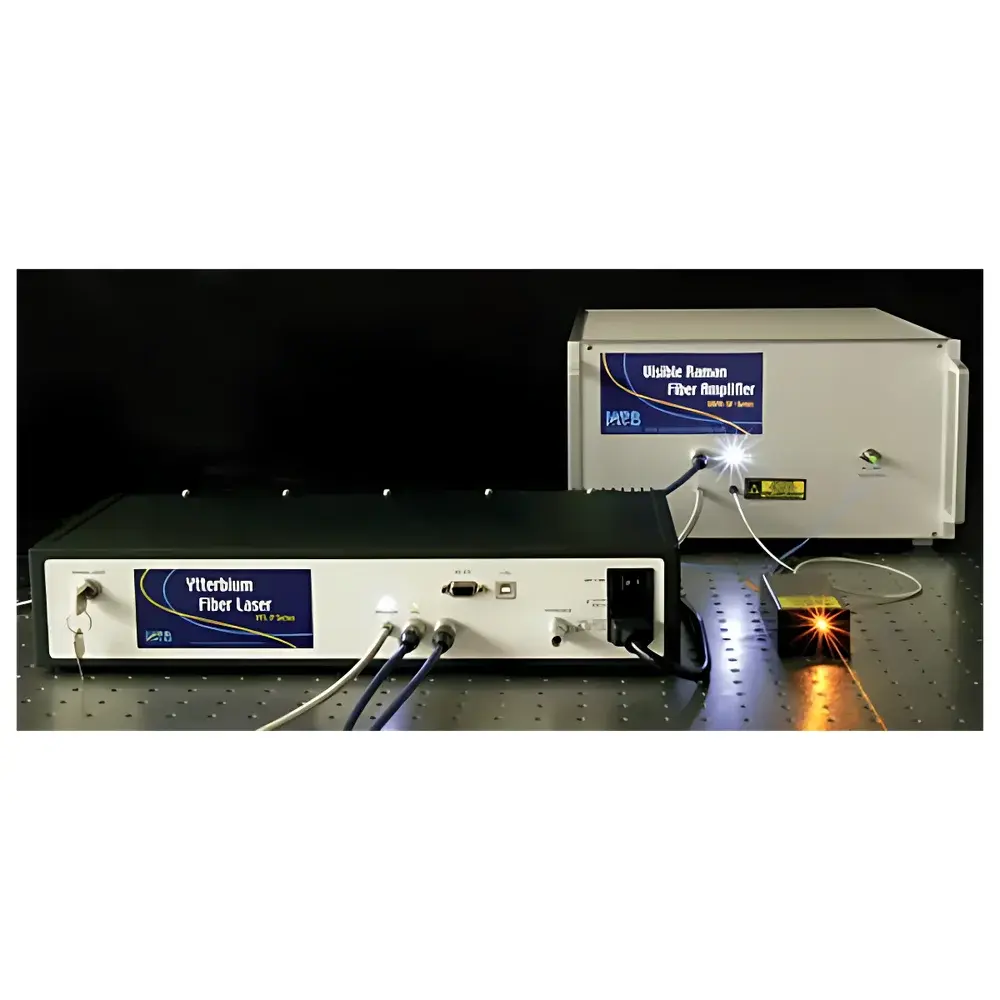
Auniontech RFA-SF Series Single-Frequency Raman Fiber Amplifier
| Brand | Auniontech |
|---|---|
| Origin | Shanghai, China |
| Type | Single-Frequency, Single-Longitudinal-Mode Raman Fiber Amplifier |
| Cooling | Air-Cooled (up to 15 W) / Water-Cooled (up to 20 W NIR output) |
| Output Wavelength Range (NIR) | 1100–1520 nm |
| Output Power (NIR, water-cooled) | ≤20 W |
| Polarization | Linear, slow-axis aligned |
| PER | ≥98% |
| Power Stability (APC, after 30-min warm-up) | ±2% / hour |
| Transverse Mode | TEM₀₀ |
| Beam Quality (M²) | ≤1.1 |
| Optional SHG Module | Output Wavelength 550–760 nm |
| Visible Output Power | Up to 4 W |
| Beam Pointing Stability | <5 µrad/°C |
| Noise Performance | Low intensity & phase noise, negligible spectral broadening |
Overview
The Auniontech RFA-SF Series Single-Frequency Raman Fiber Amplifier is a high-stability, narrow-linewidth optical amplifier engineered for demanding scientific and industrial applications requiring diffraction-limited beam quality, ultra-low phase and intensity noise, and exceptional spectral fidelity. Unlike conventional rare-earth-doped fiber amplifiers, this system leverages stimulated Raman scattering in polarization-maintaining single-mode fiber to achieve amplification without introducing significant spectral broadening or mode instability. The amplifier accepts a narrowband, linearly polarized seed laser—typically from a distributed feedback (DFB) or external cavity diode laser—and delivers high-power, single-frequency output across the near-infrared (NIR) band (1100–1520 nm). Its all-fiber, fusion-spliced architecture eliminates free-space alignment, ensuring long-term robustness and environmental insensitivity. Two thermal management configurations are available: air-cooled for compact integration (≤15 W output) and water-cooled for maximum power scalability (≤20 W NIR output).
Key Features
- True diffraction-limited beam quality with M² ≤ 1.1 and TEM₀₀ transverse mode profile
- Ultra-low intensity and phase noise—critical for interferometry, holography, and coherent detection
- Negligible spectral broadening (<100 kHz linewidth preservation typical under standard operating conditions)
- High polarization extinction ratio (>98%) with stable slow-axis alignment
- Active power control (APC) circuitry ensures ±2% power stability per hour after 30-minute thermal equilibration
- Beam pointing stability <5 µrad/°C—enabling integration into adaptive optics and space-based platforms
- Turnkey, maintenance-free operation with fully fused fiber train and hermetically sealed housing
- Low power consumption and compact footprint suitable for OEM integration and laboratory rack-mount deployment
Sample Compatibility & Compliance
The RFA-SF is designed to interface seamlessly with industry-standard single-frequency seed sources operating within the 1100–1520 nm range, including DFB lasers, fiber lasers, and external cavity diode lasers (ECDLs) with linewidths <1 MHz. All optical components—including pump combiners, Raman gain fiber, and polarization-maintaining delivery fiber—are qualified to Telcordia GR-1221-CORE reliability standards. The system complies with IEC 60825-1:2014 Class 4 laser safety requirements when operated at full power. For regulated environments, the APC loop supports analog voltage input (0–5 V) and RS-232/USB digital interface, enabling traceable power logging compatible with GLP/GMP audit trails. While not certified to FDA 21 CFR Part 11 out-of-the-box, the firmware architecture supports secure user authentication and immutable event logging upon customer-requested configuration.
Software & Data Management
Operation is managed via Auniontech’s RFA-Control Suite—a cross-platform application (Windows/macOS/Linux) providing real-time monitoring of output power, pump current, case temperature, and APC error signal. Data streams are timestamped and exportable in CSV or HDF5 format for post-acquisition analysis. The software implements configurable alarm thresholds (e.g., temperature excursion >45°C, power deviation >±3%), automatic shutdown on interlock breach, and firmware update capability over USB or Ethernet. For system-level integration, a documented SCPI-compatible command set enables scripting in Python, LabVIEW, or MATLAB. All communication channels support TLS 1.2 encryption where networked operation is deployed.
Applications
- Laser guide star generation for astronomical adaptive optics systems (e.g., sodium-layer excitation at 589 nm via SHG)
- Atom cooling and trapping—especially in magneto-optical traps (MOTs) requiring sub-MHz linewidth and high beam stability
- Coherent anti-Stokes Raman scattering (CARS) and stimulated Raman scattering (SRS) microscopy
- High-precision interferometry (e.g., gravitational wave detector auxiliary lasers, metrology reference sources)
- Holographic data storage and optical trapping requiring low-noise, high-M²-stability illumination
- Biophotonics applications including optogenetics stimulation and photoacoustic imaging pump sources
- Quantum optics experiments requiring indistinguishable photon pairs and phase-stable local oscillators
FAQ
What seed laser specifications are required for optimal performance?
A linearly polarized, single-longitudinal-mode seed with linewidth <1 MHz, power 10–100 mW, and polarization aligned to the slow axis of the PM input fiber is recommended. Wavelength must fall within 1100–1520 nm.
Can the RFA-SF be integrated with third-party SHG modules?
Yes—the NIR output is fully compatible with commercial PPLN- or MgO:PPLN-based SHG modules; however, Auniontech’s integrated SHG option guarantees optimized phase-matching, thermal management, and polarization coupling.
Is remote monitoring supported over Ethernet?
Yes—Ethernet connectivity (10/100BASE-T) is standard on water-cooled units and optional on air-cooled models. Full SCPI command access and web-based status dashboard are included.
Does the system support analog modulation of output power?
The APC loop accepts 0–5 V analog input for closed-loop power modulation up to 10 kHz bandwidth (small-signal, -3 dB point).
What is the typical warm-up time to reach specified stability?
30 minutes at ambient temperature (20–25°C); thermal stabilization time increases by ~5 min per 5°C ambient deviation below 20°C.