
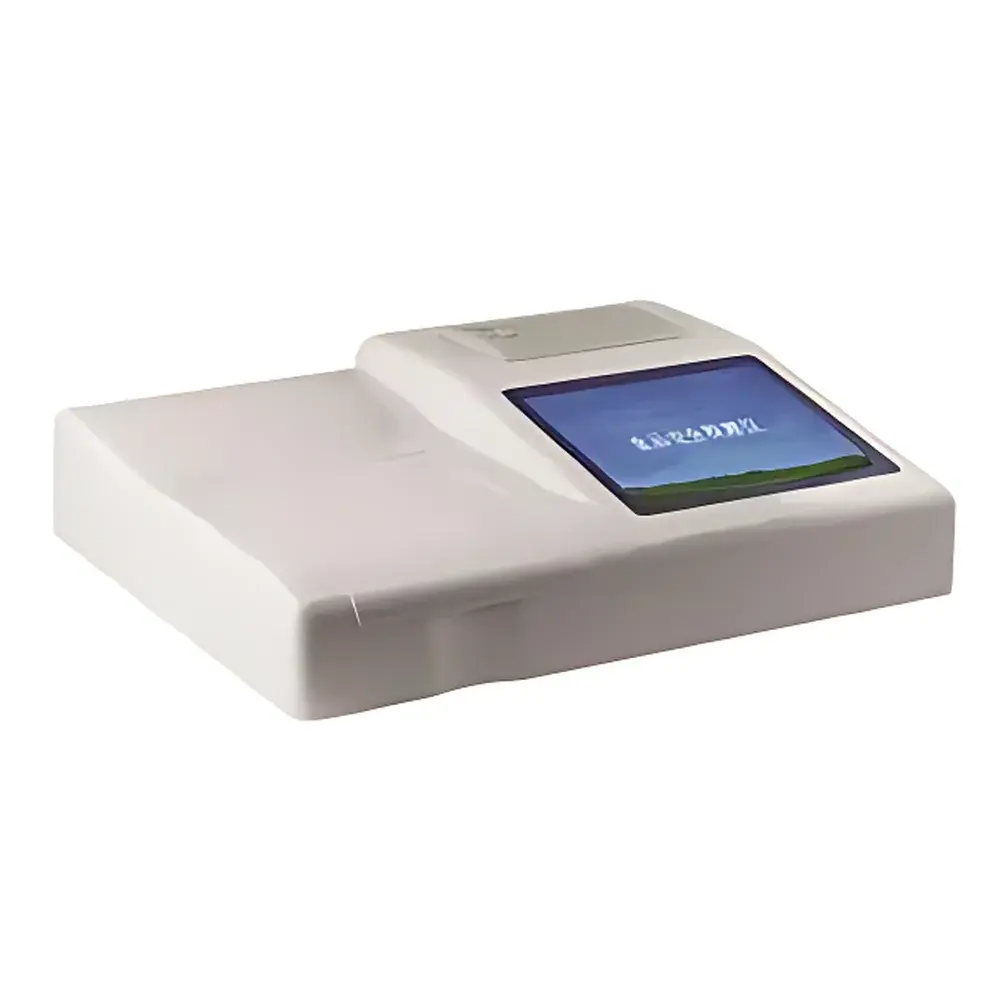
HJ FX-S120 Multi-Parameter Food Safety Analyzer
| Brand | HJ (Hujing Purification) |
|---|---|
| Origin | Shanghai, China |
| Manufacturer Type | Direct Manufacturer |
| Country of Origin | China |
| Model | FX-S120 |
| Price | USD 3,650 (approx.) |
| Function Type | Multi-analyte Detection Platform |
| Sample Compatibility | Universal for Liquid, Extracted, and Homogenized Food Matrices |
| Wavelength Range | 380–680 nm |
| Maximum Detection Time per Sample | ≤3 minutes |
| Photometric Repeatability (CV) | ≤0.2% |
| Optical Channels | 12 independent photometric channels |
| Display | 7-inch TFT-LCD touchscreen (800 × 400 resolution) |
| Data Storage Capacity | ≥15,000 records with timestamp/ID indexing |
| Integrated Thermal Printer | Embedded, auto/manual print mode |
| Light Source | Imported solid-state LED array (no thermal drift, >50,000 hr lifetime), real-time AD-value monitoring |
| User Access Control | Password-protected operator levels |
| Compliance Support | Pre-loaded Chinese National Standards (GB), industry standards (SB/T), and customizable limit thresholds per analyte |
Overview
The HJ FX-S120 Multi-Parameter Food Safety Analyzer is a benchtop photometric detection platform engineered for rapid, on-site screening of chemical contaminants and quality indicators in food matrices. It operates on the principle of absorbance-based colorimetric analysis—measuring changes in optical density at defined wavelengths (380–680 nm) following standardized enzymatic, chromogenic, or redox reactions. Unlike single-analyte immunoassay devices, the FX-S120 supports concurrent quantification across up to 12 samples using wavelength-specific LED sources, enabling parallel assessment of diverse analytes without cross-channel interference. Its architecture integrates optical path stability control, real-time source health monitoring (via AD-value feedback), and temperature-compensated signal processing—critical for maintaining measurement fidelity in non-climate-controlled field laboratories or QC environments. Designed for routine use in food processing plants, regulatory inspection units, and third-party testing labs, the instrument complies with methodological frameworks referenced in GB 5009 series standards and aligns with Good Laboratory Practice (GLP) documentation requirements.
Key Features
- 12 independent optical detection channels with programmable wavelength selection across 380–680 nm, supporting simultaneous multi-analyte assays
- Pre-calibrated standard curves for 50+ food safety parameters—including organophosphate pesticide residues (via acetylcholinesterase inhibition), formaldehyde, SO₂, nitrite, melamine, borax, Rhodamine B, Sudan dyes I–IV, benzoic peroxide, saccharin sodium, and aluminum in flour
- Real-time photometric repeatability ≤0.2% CV under controlled ambient conditions (20–25°C, RH <70%)
- Integrated 7-inch capacitive touchscreen interface (800 × 400 resolution) with bilingual (English/Chinese) UI navigation and audible step guidance
- Embedded thermal printer supporting both manual trigger and automatic result output upon assay completion
- Secure user management system with role-based access control, password enforcement, and audit-ready operation logging
- Onboard data storage capacity exceeding 15,000 test records, searchable by timestamp, sample ID, or assay type
- Dedicated cuvette tray design accommodating standard 10-mm pathlength cells; optimized for minimal reagent carryover and rapid turnover
Sample Compatibility & Compliance
The FX-S120 accepts homogenized extracts, clarified supernatants, and aqueous eluates derived from raw produce, processed meats, dairy products, edible oils, cereals, condiments, and aquatic commodities. Sample preparation follows GB/T 5009.x and SN/T protocols—e.g., QuEChERS extraction for pesticides, acid hydrolysis for nitrite, or iodometric titration derivatives for peroxide value. All onboard methods are traceable to Chinese national standards (GB), commercial industry specifications (SB/T), and AOAC Official Methods where applicable. The system supports user-defined threshold configuration aligned with GB 2763 (pesticide MRLs), GB 2762 (contaminant limits), and GB 2760 (food additive usage levels). Data export formats (CSV, PDF) meet basic traceability needs for internal QA review; optional USB export enables integration into LIMS environments requiring ISO/IEC 17025-compliant reporting workflows.
Software & Data Management
Firmware v3.2 includes embedded assay sequencing logic, dynamic curve fitting (linear, quadratic, log-log), and automated pass/fail classification against configured regulatory limits. Each result displays: sample identifier, analyte name, measured concentration, unit, reference standard (e.g., “GB 5009.199-2022”), uncertainty estimate (±X%), and interpretive status (“Compliant”, “Non-compliant”, “Inconclusive”). Audit trails record operator ID, timestamp, calibration events, and parameter modifications—retained for ≥180 days unless manually purged. Data backup is supported via USB mass storage; no cloud connectivity or remote telemetry is implemented, preserving data sovereignty per GB/T 35273 privacy guidelines. Software updates are distributed as signed firmware packages validated via SHA-256 checksum.
Applications
- Routine surveillance of pesticide residues in fruits, vegetables, and tea leaves using cholinesterase inhibition kinetics
- Quantitative determination of acid value and peroxide value in edible oils per GB 5009.229 and GB 5009.227
- Screening for illegal adulterants: borax in rice noodles, formaldehyde in seafood, Rhodamine B in chili powder, Sudan dyes in sauces
- Verification of preservative compliance: sulfites in dried fruits, nitrites in cured meats, benzoates in beverages
- Quality control of flour additives: aluminum content (GB 5009.182), protein content (Kjeldahl-equivalent colorimetric proxy)
- Field-deployable verification for HACCP critical control points in cold-chain distribution hubs
FAQ
Does the FX-S120 support ASTM or ISO standard methods?
The instrument implements reaction chemistries and calibration protocols consistent with selected Chinese national standards (GB); it does not natively execute ASTM D7212 or ISO 15141-1 workflows, though comparative validation studies may be conducted using user-supplied reference materials.
Can custom calibration curves be imported from external spectrophotometers?
Yes—curves may be uploaded via USB in CSV format containing wavelength, concentration, and absorbance columns; the system validates point spacing and fits using least-squares regression.
Is the device compliant with FDA 21 CFR Part 11 for electronic records?
It maintains operator-authenticated audit logs and immutable result timestamps but lacks digital signature capability, electronic signature workflows, or system-level validation documentation required for full Part 11 adherence.
What maintenance is required for the solid-state light source?
No periodic replacement is needed; the LED array includes real-time AD-value diagnostics displayed on-screen to confirm operational stability before each assay batch.
How is cross-contamination prevented between sequential assays?
The cuvette tray incorporates physical channel isolation and a wipe-clean stainless-steel surface; users are instructed to rinse cells with deionized water and dry prior to reuse—validated per GB/T 27404 protocol requirements.




