
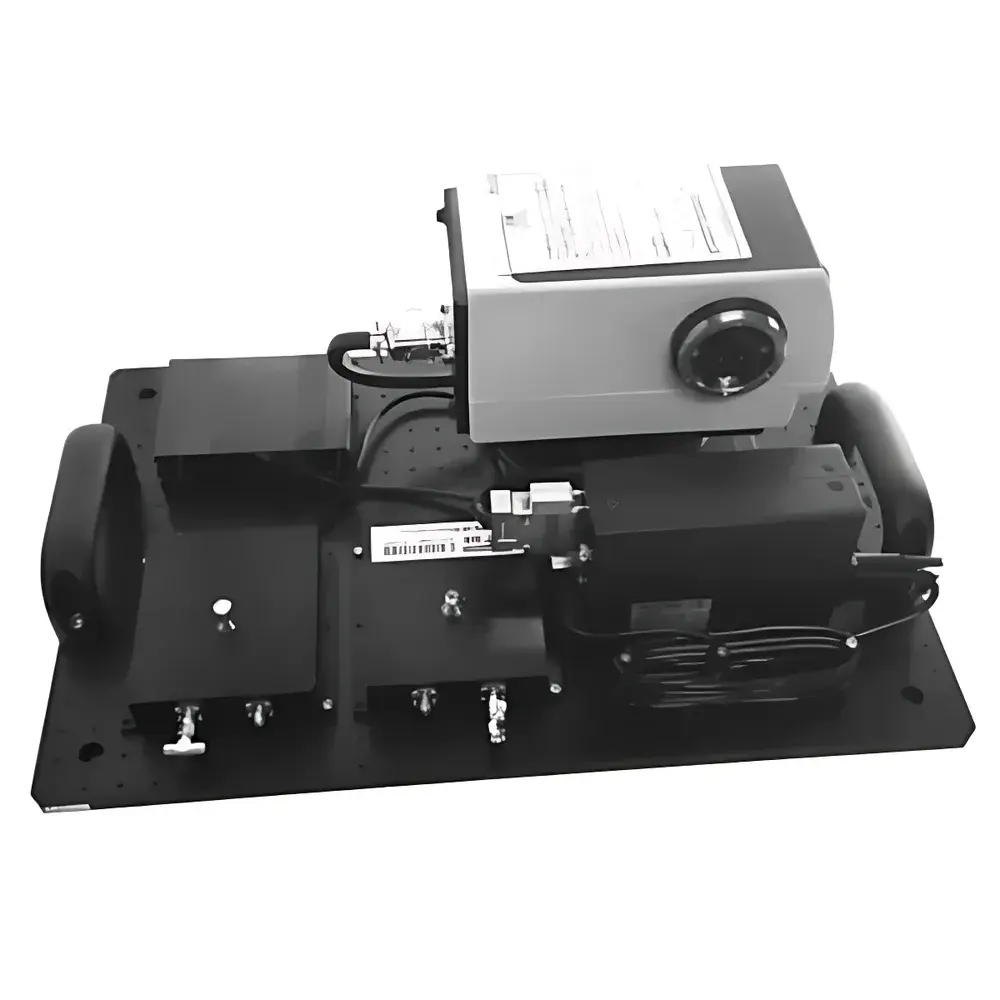
Auniontech SPS-100 Single-Photon Spectrometer
| Brand | Auniontech |
|---|---|
| Origin | Shanghai, China |
| Model | SPS-100 |
| Wavelength Range | 200–900 nm |
| Grating | Concave holographic blazed grating, 1200 lines/mm |
| F-number | F = 3 |
| Spectral Resolution (FWHM) | 1 nm |
| Wavelength Step Accuracy | 0.1 nm |
| Scanning Speed | 500 nm/s |
| Input/Output Coupling | FC-terminated fiber ports |
| Slit Width (standard) | 0.2 mm |
| Detector Interface | Compatible with PDS-100 single-photon counting system |
| Software | CS-001 control suite with gated photon counting (1 ms – 9.999 s), real-time spectral display, linear/log scaling, CSV export |
Overview
The Auniontech SPS-100 Single-Photon Spectrometer is a precision optical instrument engineered for quantitative spectral analysis in the ultraviolet–visible (UV–Vis) range (200–900 nm). It operates on the principle of monochromator-based dispersive spectroscopy, integrating a motorized Czerny–Turner monochromator with a concave holographic blazed grating to deliver high-fidelity wavelength selection and minimal stray light. Designed explicitly for low-light applications—including time-resolved fluorescence, laser-induced breakdown spectroscopy (LIBS), quantum optics experiments, and single-molecule detection—the SPS-100 interfaces natively with the PDS-100 single-photon detection system. Its architecture enables photon-counting measurements across six orders of magnitude in intensity, supporting both continuous and time-gated acquisition modes. The system’s optical design prioritizes throughput and signal fidelity: optimized fiber coupling (NA 0.16–0.30), F/3 optics, and a mechanically stable monochromator platform ensure reproducible alignment and long-term calibration stability.
Key Features
- Motorized single-channel monochromator with 0.1 nm wavelength step resolution and 500 nm/s scanning speed
- Concave holographic blazed grating (1200 lines/mm) delivering ultra-low stray light performance and enhanced UV throughput
- FC-connectorized input and output fiber ports enabling seamless integration into existing optical setups
- Standard 0.2 mm entrance slit; optional slit widths available for trade-off between resolution and sensitivity
- F/3 optical design balancing étendue and dispersion efficiency across the full 200–900 nm range
- Modular internal layout facilitating field-replaceable components including grating, slit assembly, and detector interface board
- Scalable platform: compatible with UV-enhanced or IR-extended monochromator modules via mechanical and software reconfiguration
Sample Compatibility & Compliance
The SPS-100 accepts free-space or fiber-coupled input from a wide variety of excitation sources—including pulsed lasers (ns–ps duration), CW diodes, and supercontinuum sources—making it suitable for both steady-state and time-resolved measurements. Its spectral response has been validated against NIST-traceable calibration standards (e.g., Hg/Ar emission lamps) and supports wavelength calibration routines embedded in CS-001 software. While not certified to ISO/IEC 17025 as a standalone metrology instrument, the system meets functional requirements for GLP-compliant laboratories when operated with documented procedures and periodic verification. All firmware and software modules comply with standard USB 2.0 communication protocols and support deterministic timing for synchronization with external triggers (TTL-compatible I/O).
Software & Data Management
CS-001 is a native Windows application providing full instrument control, real-time spectral visualization, and photon-counting data handling. It supports user-defined gate windows (1 ms to 9.999 s), multi-cycle averaging, and background subtraction algorithms. Spectra are rendered in real time with selectable linear or logarithmic y-axis scaling and adjustable x-axis binning. All acquired data are saved in plain-text CSV format—including wavelength (nm), counts per second, and acquisition timestamp—ensuring full interoperability with MATLAB, Python (NumPy/Pandas), Origin, and Excel for post-processing, spectral deconvolution, or calibration modeling. Audit trails, parameter logging, and session metadata are recorded automatically; raw count files retain full temporal resolution for retrospective gating analysis.
Applications
- Laser-induced plasma spectroscopy (LIPS/LIBS) for elemental analysis in solids, liquids, and gases
- Time-resolved photoluminescence (TRPL) of semiconductors, perovskites, and quantum dots
- Single-photon-level Raman spectroscopy in biological tissue and nanomaterials
- Fluorescence lifetime imaging (FLIM) spectral channeling in confocal and widefield systems
- Quantum optics experiments requiring spectral filtering of heralded photons
- Calibration and characterization of broadband light sources and detector quantum efficiency
FAQ
What is the minimum detectable photon flux for the SPS-100 when paired with the PDS-100?
The system achieves sub-kHz dark-count-limited sensitivity under optimal cooling and shielding conditions; actual limit depends on integration time, gate width, and ambient background.
Can the SPS-100 be synchronized with external laser pulses?
Yes—via TTL trigger input/output ports supporting master–slave and gated acquisition modes with <100 ns jitter.
Is spectral calibration traceable to NIST standards?
Yes; factory calibration uses mercury–argon lamp lines; users may perform recalibration using any known emission source.
Does CS-001 support scripting or API access for automated workflows?
CS-001 includes a documented DLL interface for C/C++/C# integration and basic Python bindings via ctypes; no REST or LabVIEW drivers are provided by default.
What maintenance is required for long-term wavelength accuracy?
Annual verification using reference lamps is recommended; grating alignment and slit centering tools are included with the system.




