
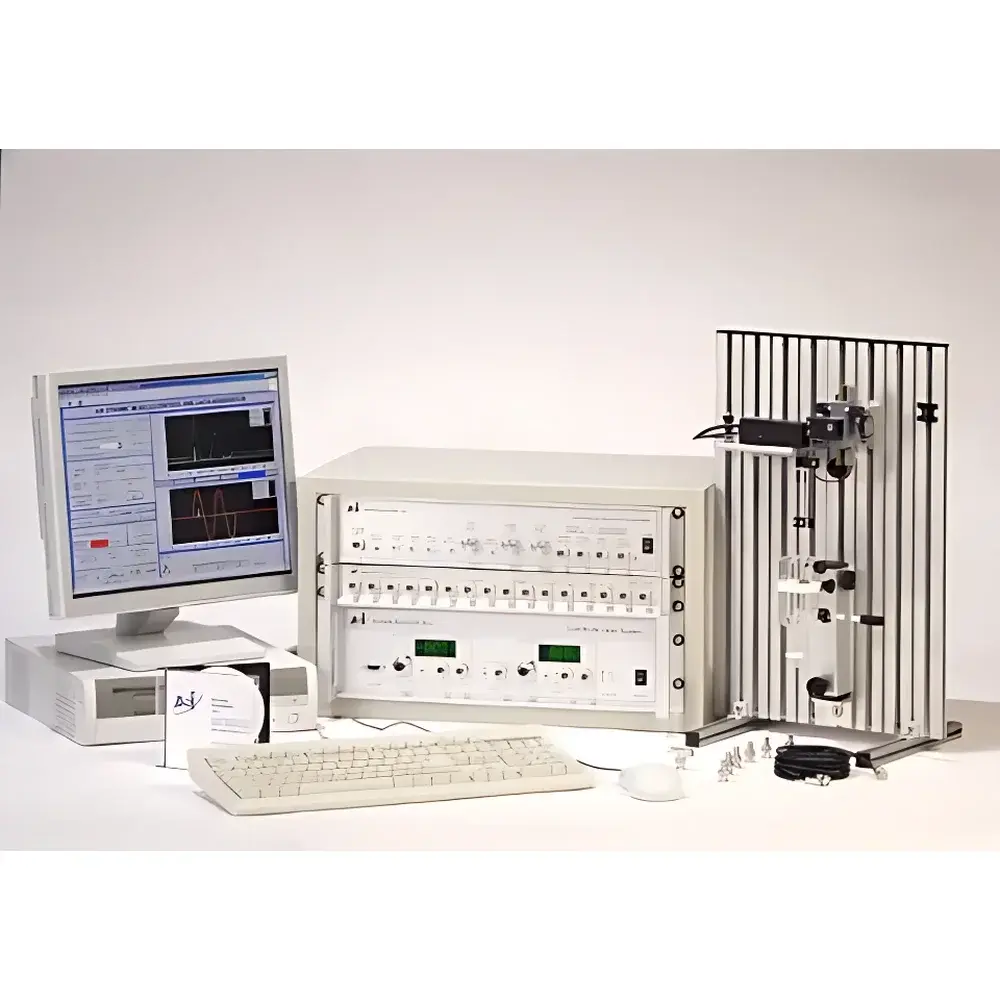
Aurora 1200A In Vitro Mouse Skeletal Muscle Mechanics Testing System
| Origin | USA |
|---|---|
| Manufacturer Type | Authorized Distributor |
| Origin Category | Imported |
| Model | 1200A |
| Pricing | Available Upon Request |
Overview
The Aurora 1200A In Vitro Mouse Skeletal Muscle Mechanics Testing System is a high-precision, integrated platform engineered for quantitative assessment of contractile function in isolated intact skeletal muscle preparations. Based on the fundamental principles of isometric and isotonic force-length dynamics, the system employs a calibrated lever-arm transducer architecture to simultaneously measure active and passive mechanical parameters—including peak tetanic force (up to 10 N), shortening velocity, work output, fatigue index, length-tension relationships, and force-frequency responses. Designed specifically for murine models (C57BL/6, BALB/c, FVB, etc.), it supports standardized ex vivo physiological interrogation under controlled oxygenated superfusion (95% O₂ / 5% CO₂ carbogen-saturated Krebs-Henseleit or similar physiological saline). The system operates within a temperature-regulated tissue bath (30–37 °C), enabling reproducible measurement of dynamic contractile properties while preserving sarcomere integrity and metabolic viability over extended experimental durations.
Key Features
- Integrated dual-mode muscle lever system with ±10 N force capacity and sub-micron length resolution, enabling both force-controlled and length-controlled protocols
- Temperature-stabilized water-jacketed organ bath with precise thermal regulation (±0.1 °C) and continuous perfusion via peristaltic pump
- High-power biphasic electrical stimulator (Model 701C) delivering programmable current/voltage pulses (0.1–100 V, 0.1–500 mA) with adjustable pulse width (0.1–20 ms) and frequency (0.1–200 Hz)
- Modular electrode configuration with platinum wire electrodes positioned bilaterally for uniform field stimulation across muscle cross-section
- Motorized XYZ positioning stage facilitating rapid alignment of tendon attachment, lever arm, and stimulation electrodes
- Real-time synchronization of force, length, stimulation timing, and environmental parameters via embedded DAQ hardware
Sample Compatibility & Compliance
The 1200A system accommodates a broad spectrum of intact, dissected skeletal muscle preparations from mice (e.g., extensor digitorum longus [EDL], tibialis anterior [TA], soleus, diaphragm, flexor digitorum brevis [FDB]) and small rodents (e.g., rats, guinea pigs). It is validated for use with enzymatically dissociated single fibers, bioengineered muscle constructs, synthetic elastomeric films, and hydrogel-based contractile tissues. All hardware components comply with IEC 61000-6-3 (EMC emissions) and IEC 61010-1 (safety requirements for laboratory equipment). Experimental protocols align with established guidelines from the American Physiological Society (APS) and are compatible with GLP-compliant data acquisition workflows when paired with audit-trail-enabled software configurations.
Software & Data Management
Control and analysis are executed via Dynamic Muscle Control (DMC) and Dynamic Muscle Analysis (DMA) software suite—Windows-based applications supporting full protocol scripting, real-time visualization, and post-hoc parameter extraction. DMC enables definition of multi-phase stimulation paradigms (e.g., twitch, tetanus, fatigue ramp, stretch-shortening cycles), while DMA computes derived metrics including specific force (kN/m²), maximal shortening velocity (Vmax), power output (W/kg), and relaxation kinetics (RT₅₀, RT₉₀). Raw data are stored in HDF5 format with embedded metadata (sample ID, bath temperature, stimulus parameters, calibration coefficients), ensuring FAIR (Findable, Accessible, Interoperable, Reusable) compliance. Optional integration with MATLAB, Python (via PyHDF), or LabVIEW permits advanced custom modeling and machine-learning–driven feature extraction.
Applications
- Preclinical evaluation of neuromuscular disease models (e.g., Duchenne muscular dystrophy, spinal muscular atrophy, myotonic dystrophy)
- Mechanistic studies of excitation-contraction coupling, calcium handling, and sarcomeric protein function
- Pharmacological screening of contractility modulators (e.g., myosin activators/inhibitors, SERCA regulators, RyR stabilizers)
- Assessment of age-related sarcopenia, disuse atrophy, and rehabilitation-induced functional recovery
- Validation of tissue-engineered skeletal muscle constructs for regenerative medicine applications
- Biomechanical characterization of biomimetic actuators and soft robotics materials
FAQ
What species and muscle types are supported by the 1200A system?
The system is optimized for mouse skeletal muscles (EDL, soleus, TA, diaphragm, FDB) but also accommodates rat, guinea pig, and rabbit preparations with appropriate lever arm and bath modifications.
Is the system compliant with FDA 21 CFR Part 11 for regulated research?
While the base configuration does not include electronic signature or audit trail features by default, optional software licensing and validation packages are available to support 21 CFR Part 11–compliant workflows in GCP/GLP environments.
Can the 1200A be upgraded to support in situ or in vivo measurements?
Yes—the Aurora 1300A tri-modal platform shares core transduction and stimulation architecture; users may transition via modular add-ons including motorized treadmill interface, stereotactic animal platform, and 25 mL perfused bath assembly.
What level of technical support and application training is provided?
Aurora-certified field application scientists deliver on-site installation, SOP development, and hands-on operator training covering tissue dissection, calibration, protocol optimization, and data interpretation—typically completed within two business days.
Are calibration standards and traceable documentation included?
Each system ships with NIST-traceable force calibration weights (100 mN to 10 N), certified temperature probe calibration report, and full metrological documentation aligned with ISO/IEC 17025 requirements.




