
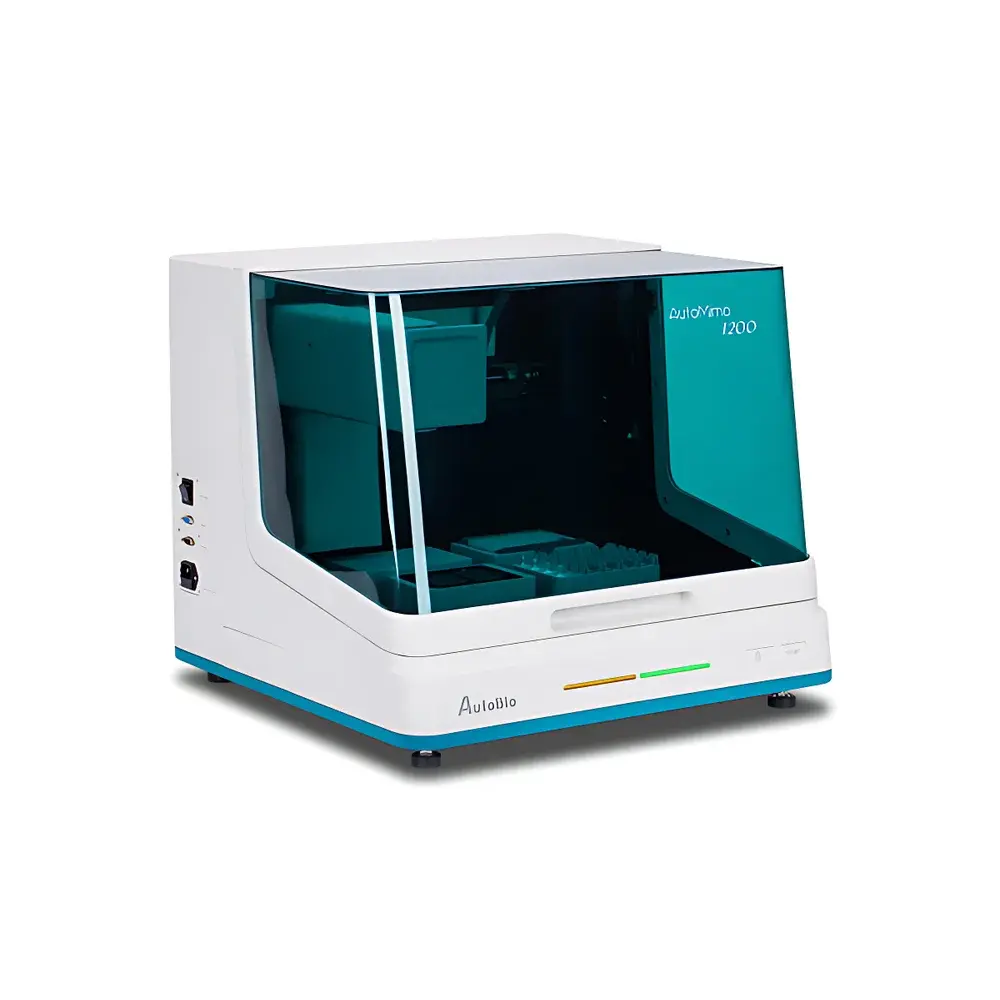
Autobio AutoMimo1200 Automated Liquid Handling System
| Brand | Autobio |
|---|---|
| Model | AutoMimo1200 |
| Origin | Henan, China |
| Instrument Type | Benchtop Automated Sample Dispensing System |
| Throughput | Up to 800 assay positions per hour |
| Compliant with ISO 13485 | 2016 Quality Management System |
Overview
The Autobio AutoMimo1200 Automated Liquid Handling System is an IVD-dedicated benchtop platform engineered for high-integrity sample and reagent dispensing in clinical diagnostic laboratories. It employs a positive-pressure air displacement architecture—distinct from piston-driven or magnetic bead-based systems—to deliver consistent volumetric accuracy across variable viscosity fluids (e.g., serum, plasma, lysates, and conjugated antibody solutions) without cross-contamination risk. Unlike gravity-fed or peristaltic approaches, this pneumatic dispensing mechanism ensures traceable, low-maintenance operation with minimal carryover (<0.1 µL), meeting the precision requirements of ELISA, chemiluminescence immunoassay (CLIA), and molecular pre-analytical workflows. Designed for integration into mid-throughput testing environments, the AutoMimo1200 supports walk-away automation for primary tube processing, multi-step reagent addition, and plate-based assay setup—reducing manual intervention while maintaining full auditability under GLP and ISO 15189 frameworks.
Key Features
- High-fidelity air-displacement dispensing with calibrated volume ranges from 5 µL to 1000 µL, optimized for reproducible transfer of biological matrices without tip washing or recalibration between runs.
- Throughput-optimized workflow engine enabling up to 800 discrete assay positions per hour—configurable for single- or multi-channel dispensing across 96-well, 384-well, and custom microplate formats.
- Integrated biosafety architecture: dual-stage HEPA filtration (H14 grade) combined with pulsed 254 nm UV-C irradiation cycles between operations, validated per ISO 15714:2019 for surface decontamination efficacy.
- Real-time system telemetry displayed via 10.1-inch capacitive touchscreen interface; audible alerts triggered by pressure deviation, tip clog detection, or thermal excursion beyond ±0.5°C of setpoint.
- Native reagent compatibility: direct aspiration from original manufacturer vials (including screw-cap, crimp-seal, and vacuum-sealed containers) using adaptive gripper and piercing module—eliminating manual aliquoting and associated error vectors.
- Onboard temperature-controlled incubation zone (30–45°C, ±0.3°C stability) with programmable dwell time, supporting antigen-antibody binding kinetics and enzymatic reaction priming prior to downstream detection.
- Role-based user access control with encrypted login, session logging, and electronic signature support aligned with FDA 21 CFR Part 11 Annex 11 requirements for regulated diagnostics.
Sample Compatibility & Compliance
The AutoMimo1200 accommodates human-derived specimens including whole blood (EDTA/K2EDTA/K3EDTA/Li-Heparin), serum, plasma, cerebrospinal fluid (CSF), urine, and extracted nucleic acids. It complies with IVD regulatory pathways applicable to its intended use: CE-IVD marking under Directive 98/79/EC (now harmonized under IVDR 2017/746), adherence to ISO 13485:2016 quality management standards, and design validation per ISO 14971:2019 for risk management. All fluidic pathways are constructed from medical-grade PTFE and borosilicate glass components certified for biocompatibility (ISO 10993-5). The system’s software architecture supports audit trail generation—including operator ID, timestamp, parameter changes, and error recovery logs—for inspection readiness in CAP, CLIA, and NABL-accredited laboratories.
Software & Data Management
The AutoMimo1200 Control Suite is a Windows-based application offering protocol templating, drag-and-drop step sequencing, and version-controlled method storage. Each run generates a machine-readable .csv log file containing dispense volumes, pressure profiles, temperature history, and alarm events—exportable for LIMS integration via ASTM E1384-compliant HL7 messaging or direct SQL database push. Software updates follow a formal change control process documented per ISO 13485 clause 7.5.6; all firmware revisions undergo regression testing against reference protocols defined in the system validation master plan (VMP). Electronic records include digital signatures compliant with ALCOA+ principles (Attributable, Legible, Contemporaneous, Original, Accurate, Complete, Consistent, Enduring, Available).
Applications
- Automated setup of immunoassays (ELISA, CLIA, LFIA) requiring precise multi-reagent addition sequences.
- Pre-analytical processing for PCR and RT-qPCR workflows—including master mix dispensing, template dilution, and internal control spiking.
- Calibrator and control line preparation with traceable serial dilution capability.
- High-reproducibility sample distribution for proficiency testing (PT) and external quality assessment (EQA) schemes.
- Support for ISO/IEC 17043-accredited interlaboratory comparison studies through standardized dispensing metadata capture.
FAQ
Does the AutoMimo1200 require routine calibration with gravimetric verification?
Yes—autocalibration is performed at startup using factory-traceable reference weights; optional daily verification per ISO 8655-6 is supported via integrated balance interface.
Can the system be integrated with third-party LIMS or middleware platforms?
Yes—API-enabled communication via TCP/IP and RESTful endpoints supports bidirectional data exchange with major clinical informatics systems.
Is onboard incubation suitable for heat-sensitive reagents such as enzymes or labeled antibodies?
The incubation zone maintains thermal uniformity within ±0.3°C and offers programmable ramp rates to minimize thermal shock; recommended for short-duration stabilization only.
What documentation is provided for regulatory submission support?
A complete validation package—including IQ/OQ/PQ protocols, risk analysis reports, and software lifecycle documentation—is supplied with each unit.
How is carryover performance verified during installation qualification?
Carryover testing follows CLSI EP30-A guidelines using fluorescent dye spikes; acceptance criterion is ≤0.05% residual volume measured by fluorimetry.



