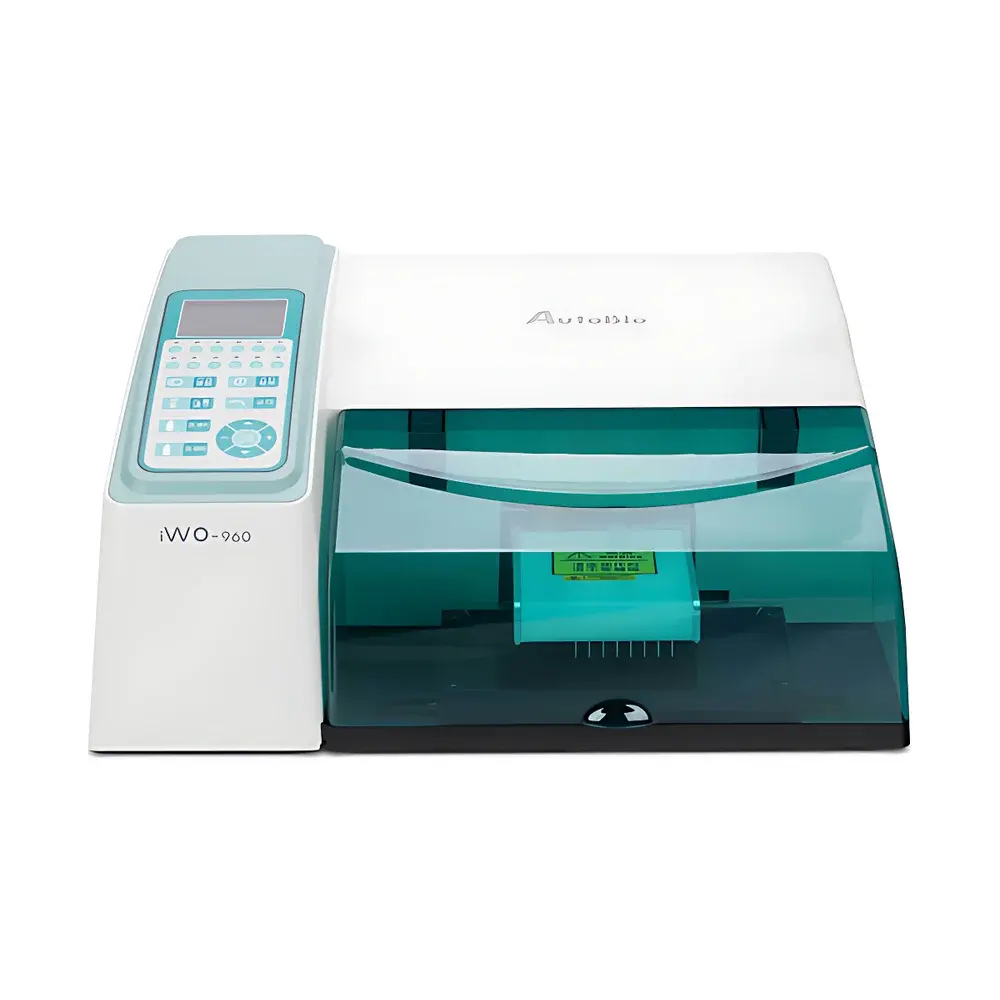
Autobio iWO-960 Multifunctional Microplate Washer
| Brand | Autobio |
|---|---|
| Origin | Henan, China |
| Manufacturer Type | Authorized Distributor |
| Product Category | Domestic |
| Model | iWO-960 |
| Price Range | USD 7,000–14,000 (FOB) |
| Instrument Type | Multifunctional Plate Washer |
| Wash Head Configuration | 12-channel |
| Rinse Head Design | Integrated Anti-Clogging Mesh Filter |
| Fluid Channels | One wash solution channel + one waste aspiration channel |
| Soak Time Range | 0–10 seconds (adjustable in 1-s increments) |
| Wash Cycles | Manual or programmable auto-mode (1–10 cycles) |
| Residual Volume per Well | ≤1 µL |
| Orbital Shaking Function | Yes, with acoustic-dampened motor and vibration-isolated platform |
| Waste Bottle Capacity | Standard 2 L, with full-level optical sensor and audible/visual alarm |
Overview
The Autobio iWO-960 is a CE-marked, ISO 13485–compliant multifunctional microplate washer engineered for high-throughput ELISA, immunoassay, and cell-based assay workflows in clinical diagnostics, contract research organizations (CROs), and academic core facilities. It operates on the principle of precise, synchronized aspiration and dispensing across 96- and 384-well microplates using a 12-channel parallel fluidic architecture. The system employs positive-displacement peristaltic pumps for wash solution delivery and vacuum-assisted aspiration with pressure-regulated waste recovery—ensuring consistent volumetric accuracy and minimal cross-well carryover. Its closed-loop fluid path design, combined with integrated mist capture in the waste manifold, mitigates aerosol generation and protects internal components from corrosive reagents—directly supporting long-term operational reliability under GLP and CLIA-aligned laboratory practices.
Key Features
- 12-channel wash head with independent vertical positioning control to accommodate plate height variations (standard ANSI/SLAS footprint; compatible with flat-bottom, U-bottom, and V-bottom plates)
- Proprietary mesh-filter rinse head assembly reduces clogging incidence by >65% compared to conventional stainless-steel capillary arrays—validated with viscous buffers (e.g., 5% BSA in PBS) and detergent-containing wash solutions
- Dual-channel fluid management: dedicated low-pulsation peristaltic pump for wash solution delivery and regulated vacuum circuit for aspiration—enabling simultaneous dispense-aspirate operation in “wash-and-aspirate” mode
- Programmable soak time (0–10 s, 1-s resolution) and cycle count (1–10), configurable via intuitive touchscreen interface with password-protected method storage (up to 99 protocols)
- Acoustic-dampened orbital shaking (100–1,200 rpm, adjustable amplitude) with real-time speed feedback and motor thermal protection—designed to minimize mechanical noise (<52 dB[A] at 1 m) without compromising mixing efficacy
- Integrated waste level monitoring: infrared optical sensor triggers dual-stage alert (visual icon + audible tone) when 2 L waste reservoir reaches 90% capacity, preventing overflow and maintaining vacuum integrity
Sample Compatibility & Compliance
The iWO-960 supports standard SBS-format microplates (96-well and 384-well), including coated ELISA plates, cell culture plates, and specialty assay plates with hydrophobic or high-binding surfaces. All wetted components—including tubing, gaskets, and rinse nozzles—are chemically resistant to common assay reagents (e.g., 0.1% Tween-20, 0.5 M NaOH, 10% bleach). The instrument complies with IEC 61010-1 (Safety Requirements for Electrical Equipment for Measurement, Control, and Laboratory Use) and meets electromagnetic compatibility (EMC) requirements per IEC 61326-1. Firmware includes audit trail logging (user ID, timestamp, protocol executed, parameter changes) to support FDA 21 CFR Part 11 readiness when deployed with networked LIMS integration.
Software & Data Management
Operation is managed via an embedded 7-inch capacitive touchscreen running Autobio’s proprietary WashControl™ firmware (v3.2+). Protocols are stored locally with SHA-256 hash verification; USB export of run logs (CSV format) includes aspirate/dispense volume verification, residual volume validation data, and error codes. Optional Ethernet connectivity enables remote status monitoring and centralized protocol deployment via Autobio LabLink™ server software—compatible with Windows-based laboratory networks. All firmware updates undergo regression testing against ISO/IEC 17025 traceable performance benchmarks prior to release.
Applications
- Routine ELISA washing in clinical microbiology and serology laboratories (e.g., HIV, HBV, HCV antibody detection)
- High-sensitivity cytokine array wash steps requiring ultra-low residual volume to suppress background signal
- Cell-based assays involving adherent or suspension cultures where gentle yet thorough buffer exchange is critical
- Automated sample preparation for downstream LC-MS/MS workflows where carryover minimization directly impacts limit-of-quantitation
- QC/QA environments requiring documented, repeatable washing parameters aligned with ISO 15189 accreditation criteria
FAQ
Does the iWO-960 support 384-well plates?
Yes—when used with optional 384-well compatible wash head adapter (Part No. WH-384A), the system maintains ≤1.2 µL residual volume per well under validated conditions.
Can wash parameters be exported for regulatory submission?
Yes—run logs include operator ID, timestamp, selected protocol, actual soak time, cycle count, and system self-test results; all fields comply with ALCOA+ data integrity principles.
Is maintenance documentation available in English?
Yes—full technical manual, preventive maintenance schedule, and calibration certificate templates are provided in English upon installation.
What is the recommended service interval?
Autobio recommends quarterly preventive maintenance (PM) including pump tubing replacement, filter cleaning, and vacuum calibration—performed by certified field service engineers.
How is cross-contamination prevented between plates?
The system performs automatic post-run prime-and-rinse sequence using deionized water, followed by air purge of all fluid paths; aspiration channels are independently sealed during dispensing to eliminate backflow risk.