
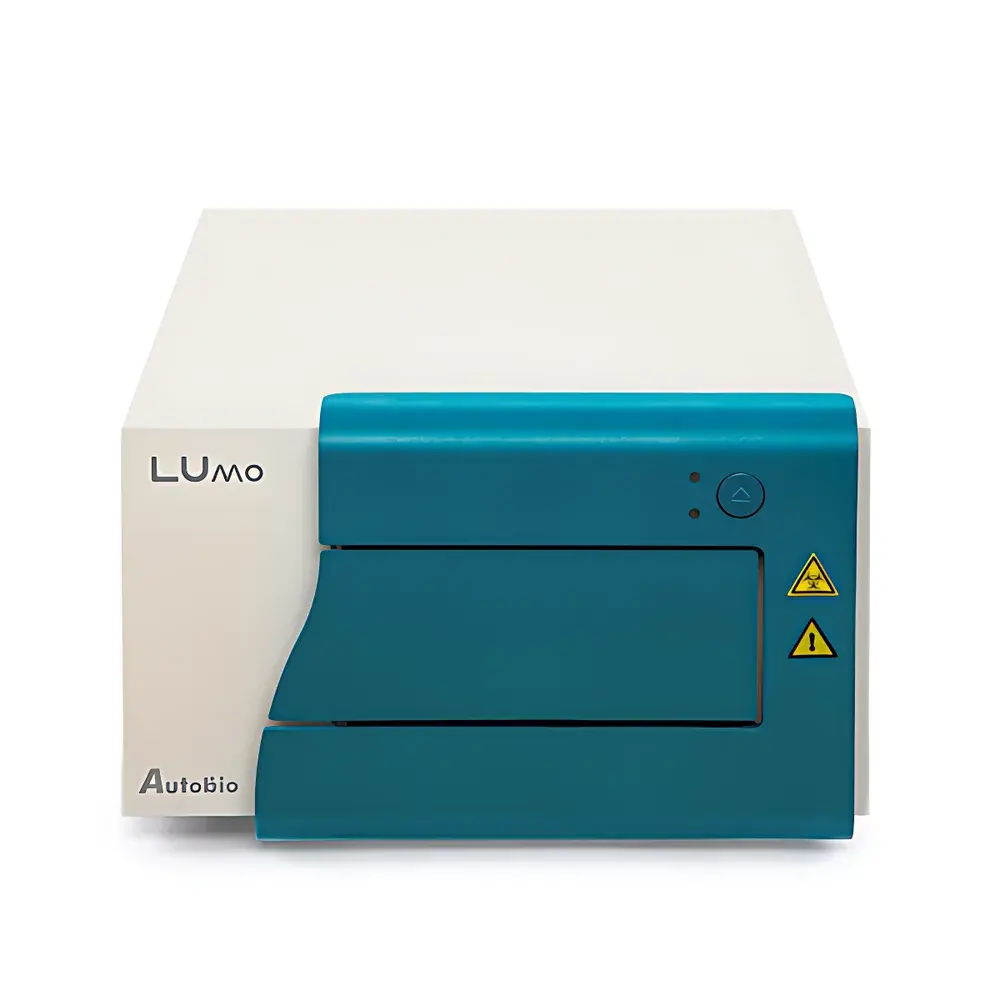
Autobio LUMO Chemiluminescence Microplate Reader
| Brand | Autobio |
|---|---|
| Model | LUMO |
| Detection Method | Chemiluminescence |
| Detector Type | Imported Photomultiplier Tube (PMT) |
| Luminescence Range | 10⁰–10⁹ RLU |
| Plate Format | 96-well and 48-well microplates |
| Read Time per Well | 0.1–10 s |
| Full 96-Well Plate Read Time | <32 s |
| Sensitivity | 10⁻² mol/plate |
| Precision (CV) | <2% |
| Inter-well Cross-Talk | <5×10⁻⁷ |
| Plate Shaking Modes | 3 programmable patterns (speed & duration adjustable) |
| Power Input | 220 V ± 22 V AC |
| Power Consumption | <32.4 VA |
| Dimensions (L×W×H) | 470 × 335 × 205 mm |
| Weight | 13 kg |
| Safety Compliance | CE-marked, 24 V DC internal supply, ISO 13485 certified |
Overview
The Autobio LUMO Chemiluminescence Microplate Reader is a dedicated, high-performance luminometer engineered for quantitative detection of chemiluminescent signals in standard microplate formats. Operating on the principle of photon counting via a high-gain, low-noise photomultiplier tube (PMT), the LUMO delivers exceptional sensitivity and dynamic range for glow-type luminescent assays—particularly suited for applications requiring low-background, long-integration measurements such as ELISA-based immunoassays, reporter gene assays (e.g., luciferase), nucleic acid hybridization, and apoptosis detection. Its optical architecture is optimized for minimal inter-well crosstalk and consistent signal capture across all wells, ensuring high reproducibility in regulated laboratory environments. Designed and validated under ISO 13485 quality management standards, the instrument meets essential EU safety and electromagnetic compatibility requirements (CE marking), with internal power conversion to 24 V DC eliminating mains-borne noise and enhancing operational safety.
Key Features
- Imported high-quantum-efficiency PMT detector with thermoelectric stabilization for low dark current and enhanced signal-to-noise ratio
- Wide linear dynamic range spanning nine orders of magnitude (10⁰–10⁹ RLU), enabling accurate quantification from trace-level to saturated signals without manual gain adjustment
- Sub-32-second full-plate read time for 96-well plates, achieved through synchronized plate positioning, rapid PMT settling, and optimized analog-to-digital conversion
- Patented conical reflector optics per well—reducing optical cross-talk to <5×10⁻⁷ and improving collection efficiency for weak emissions
- Three programmable shaking modes (linear, orbital, and dual-axis) with independently adjustable speed (200–1,200 rpm) and duration (0–600 s) to ensure homogeneous reagent mixing prior to measurement
- Robust mechanical design with precision stepper-motor-driven XY stage and optical encoder feedback for repeatable well-to-well positioning accuracy within ±0.1 mm
Sample Compatibility & Compliance
The LUMO supports standard ANSI/SBS-compliant 96-well and 48-well microplates—including opaque white, black, and specialized low-binding plates—enabling flexibility across assay chemistries (e.g., alkaline phosphatase- or horseradish peroxidase-based substrates). It is compatible with common chemiluminescent substrates including Luminol, Peroxyoxalate, and D-luciferin systems. From a regulatory standpoint, the system’s design and documentation support alignment with GLP and GMP practices: audit-trail-capable software (via external PC interface), user-access control, and electronic record integrity features are configurable. While the hardware itself does not embed FDA 21 CFR Part 11 compliance, its integration-ready architecture permits deployment within validated workflows meeting ISO/IEC 17025, CLIA, and ICH-GCP requirements when paired with compliant data acquisition software.
Software & Data Management
Controlled via an external Windows-based PC, the LUMO operates with Autobio’s proprietary LUMO Control & Analysis Suite—a bilingual (English/Chinese) application supporting method setup, real-time monitoring, kinetic and endpoint reading, and basic curve fitting (4PL, linear, log-log). Raw RLU values are timestamped and stored in structured CSV and XLSX formats, with optional metadata tagging (operator ID, plate barcode, protocol version). The software enforces role-based access levels (administrator, technician, viewer), logs all critical actions (e.g., parameter changes, calibration events), and allows export of audit-ready reports compliant with internal QA review protocols. Data export pathways support seamless integration into LIMS and ELN platforms via standardized ODBC or RESTful API extensions.
Applications
- Quantitative detection of cytokines, hormones, and infectious disease biomarkers in clinical diagnostics using chemiluminescent immunoassays (CLIA)
- High-throughput screening of kinase inhibitors and GPCR modulators via luciferase reporter systems
- Measurement of reactive oxygen species (ROS) and caspase activity in cell-based toxicity and apoptosis studies
- Validation of CRISPR/Cas9 editing efficiency using luminescent DNA repair reporters
- Quality control testing of recombinant enzymes and labeled antibodies where signal stability and low detection limits are critical
FAQ
What types of microplates are supported by the LUMO?
The LUMO accommodates ANSI/SBS-standard 96-well and 48-well plates, including opaque white, black, and specialty low-autofluorescence plates. Non-standard or custom plate geometries require mechanical adaptation and are not guaranteed for optimal performance.
Is the PMT module field-replaceable or serviceable?
Yes—the PMT assembly is modular and designed for factory-level recalibration after replacement; Autobio-certified service centers perform PMT swaps with post-installation sensitivity verification and dark-current profiling.
Does the LUMO support kinetic luminescence measurements?
Yes, it supports multi-point kinetic reads with user-defined intervals ranging from 0.1 s to 10 s per well, up to 1,000 readings per well, with continuous plate temperature monitoring (ambient only; no active incubation).
Can the instrument be integrated into automated liquid handling workflows?
The LUMO includes TTL-compatible trigger I/O ports and RS-232/USB virtual COM interfaces, allowing synchronization with third-party stackers, robotic arms, and dispensers using standard handshake protocols.
What is the calibration procedure and frequency recommendation?
A factory-supplied RLU standard kit enables user-performed linearity and sensitivity verification. Autobio recommends calibration verification every 3 months or after major maintenance, with full recalibration performed annually by authorized service personnel.





