
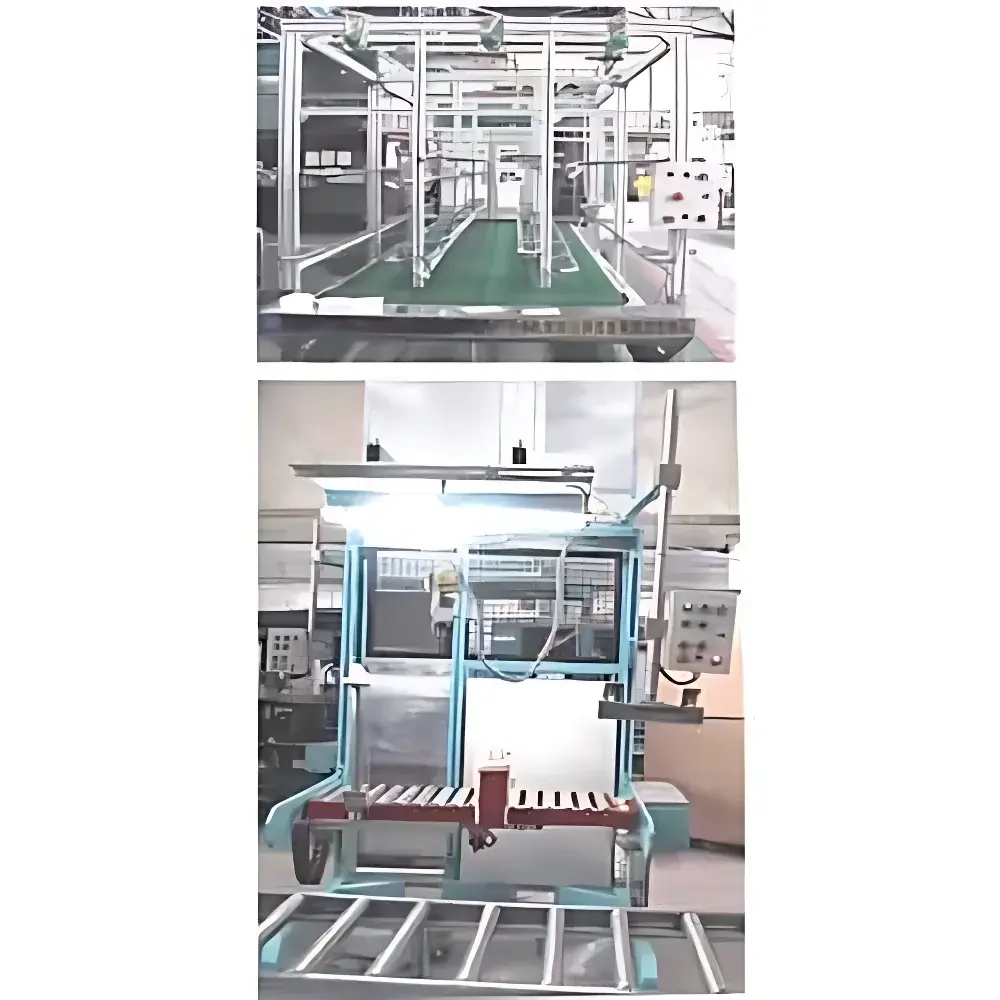
Automotive Fuel Tank Cap Seal Integrity Test System QC-II
| Key | Origin: Jilin, China |
|---|---|
| Manufacturer Type | Authorized Distributor |
| Country of Origin | China |
| Model | QC-II |
| Pricing | Available Upon Request |
Overview
The Automotive Fuel Tank Cap Seal Integrity Test System QC-II is an engineered solution for evaluating the sealing performance of fuel tank caps under dynamic angular displacement and controlled hydrostatic pressure conditions. Designed in strict alignment with ISO 16750-4 (Road vehicles — Environmental conditions and testing for electrical and electronic equipment — Part 4: Climatic loads) and SAE J1740 (Fuel System Component Leakage Test Procedure), this system employs a programmable rotational platform coupled with real-time mass-based leakage quantification to assess cap integrity across standardized test profiles—including 90° and 180° inversion cycles mandated by EU R115 and GB 18352.6–2016. The system operates on the principle of hydrostatic immersion testing: after pressurization and inversion, any leakage through the cap interface is collected and gravimetrically measured using a high-resolution analytical balance interfaced via RS-232/USB to the control PC. Its modular architecture integrates a sealed water reservoir (1.5 m³), servo-driven tilting mechanism, precision pressure regulation (1–100 kPa), and load-cell-based mass detection (1–100 g range, ±0.5% F.S.), enabling repeatable, traceable, and audit-ready test execution.
Key Features
- Programmable dual-axis tilting platform with 0–180° continuous rotation and position-locking capability at any angle—fully compliant with both EU 90° tilt requirements and global 180° inversion standards.
- Integrated pressure regulation module with 0.1 kPa resolution and ±0.5% F.S. accuracy, supporting static and ramped pressure application up to 100 kPa during submersion.
- Modular, mobile water injection and extraction system compatible with cross-test station integration—enabling shared use across multiple validation protocols without hardware reconfiguration.
- Dedicated cap-sealing interface fixtures accommodate varying neck geometries, including extended filler tubes up to 1000 mm in length, ensuring clearance during full-range rotation.
- Embedded optical safety curtain with immediate motor cutoff upon beam interruption—certified to IEC 61496-1 compliance for personnel protection during automated operation.
- Real-time data acquisition synchronized across pressure, tilt angle, elapsed time, and leakage mass—with configurable dwell periods, stabilization delays (e.g., 15 s post-inversion hold), and measurement windows (e.g., 60 s net collection).
Sample Compatibility & Compliance
The QC-II accommodates a broad spectrum of production-grade fuel tanks: metallic units up to 2000 × 872 × 700 mm (L×W×H) and polymeric tanks up to 1300 × 500 × 400 mm, with maximum nominal volume of 1.22 m³. Fixturing is CNC-machined for dimensional repeatability and clamping force uniformity. All mechanical and software subsystems conform to CE marking directives (2006/42/EC Machinery Directive, 2014/30/EU EMC Directive). Data logging meets GLP/GMP documentation requirements, with timestamped records, user authentication, and optional 21 CFR Part 11-compliant electronic signatures when paired with validated LabVIEW-based or custom SCADA software.
Software & Data Management
Control and analysis are executed via a研祥 (Advantech) industrial PC running Windows OS and proprietary test sequencing software. The interface supports multi-step protocol definition—including pressure ramp rate, dwell duration, inversion speed (0.1–720°/min, ±0.5% F.S. control accuracy), and automatic start/stop triggers. All raw sensor outputs (pressure, angle encoder, load cell) are logged at ≥10 Hz with millisecond-level timestamping. Export formats include CSV, PDF reports (with embedded pass/fail criteria per ISO 20653 or OEM-specific thresholds), and XML for LIMS integration. Audit trails record operator ID, parameter changes, calibration events, and system errors—retained for ≥36 months as required under ISO/IEC 17025.
Applications
This system is deployed in Tier-1 supplier quality labs, OEM engineering validation centers, and third-party certification bodies for: cap design verification against thermal cycling + pressure + inversion stress combinations; comparative evaluation of elastomer gasket materials under fuel-simulant exposure; validation of tamper-resistant locking mechanisms; and production line final inspection per PPAP Level 3 submission requirements. It further supports development of EV battery enclosure vent caps where analogous hydrostatic seal integrity assessment applies.
FAQ
What international standards does the QC-II system support?
It is configured to execute test sequences aligned with ISO 16750-4, SAE J1740, EU Regulation R115, and GB 18352.6–2016.
Can the system be integrated into an existing lab automation network?
Yes—the control software provides OPC UA and Modbus TCP interfaces for PLC synchronization and MES data handshaking.
Is calibration documentation included with delivery?
A NIST-traceable calibration certificate for pressure transducer, load cell, and angular encoder is supplied; annual recalibration services are available under service agreement.
What safety certifications apply to the tilting mechanism?
The servo drive and optical guard system comply with EN ISO 13857 (safety distances) and EN 61800-5-1 (adjustable speed electrical power drive systems).
Does the system support custom test protocols beyond standard norms?
Yes—users may define arbitrary pressure-angle-time profiles using the script editor, with validation logic and conditional branching for adaptive testing.



