
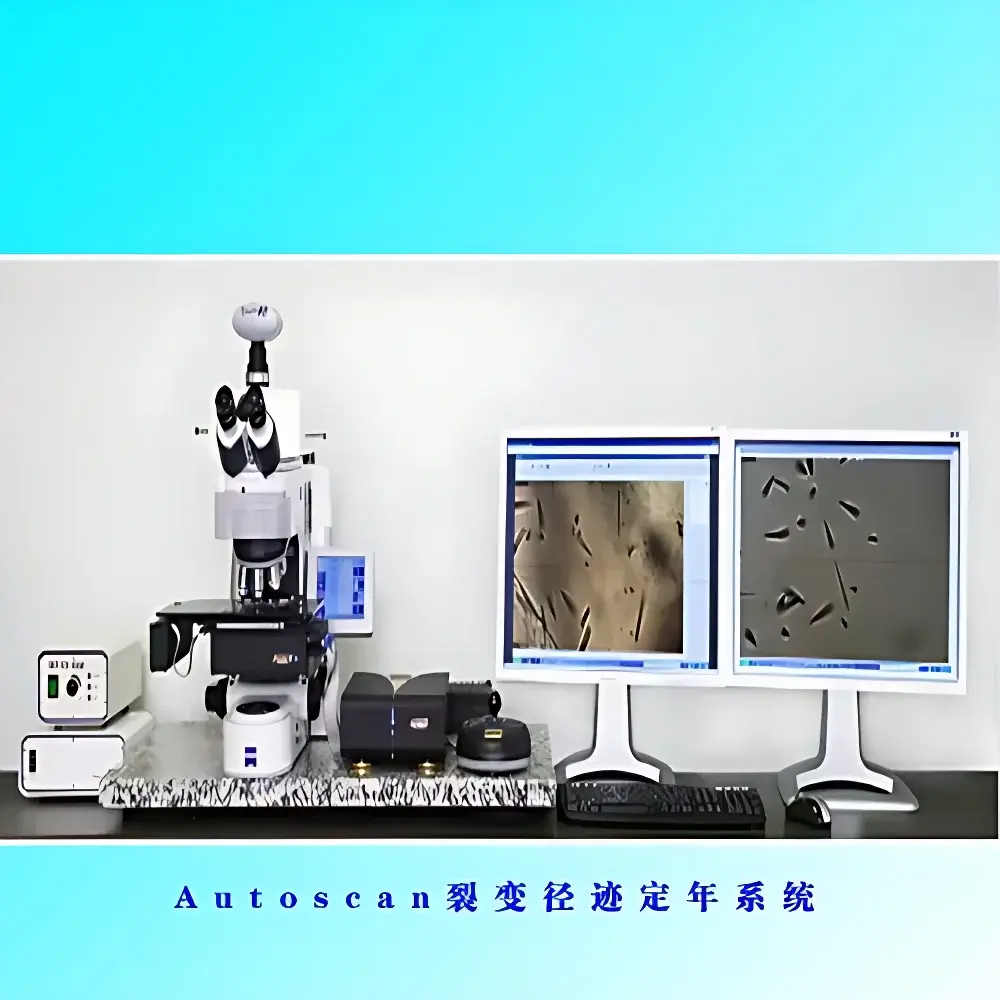
Autoscan Autoscan-6 Wide-Format Color Scanner
| Brand | AUTOSCAN |
|---|---|
| Origin | Australia |
| Manufacturer Type | Authorized Distributor |
| Origin Category | Imported |
| Model | Autoscan-6 |
| Pricing | Available Upon Request |
Overview
The Autoscans Autoscan-6 Wide-Format Color Scanner is an industrial-grade, high-resolution imaging system engineered for geoscientific applications—particularly fission-track analysis (FTA), thin-section digitization, and geological sample documentation. Unlike legacy monochrome flatbed or drum scanners, the Autoscan-6 employs a linear RGB trichromatic sensor array with synchronized illumination to capture true-color reflectance data across a 1067 mm (42-inch) maximum scan width. Its optical architecture follows principles of precision photogrammetric scanning: calibrated white-light LED illumination, motorized gantry motion control, and pixel-aligned color channel registration ensure spatial fidelity and spectral consistency across large-format specimens. Designed for integration into laboratory workflows compliant with ISO/IEC 17025-accredited geoanalytical facilities, the system supports traceable calibration protocols and repeatable acquisition under controlled ambient conditions.
Key Features
- 1067 mm maximum scan width accommodates standard geological core trays, petrographic thin sections (up to 300 × 200 mm), and fossil-bearing sediment slabs without tiling or stitching artifacts.
- True RGB color capture at configurable optical resolutions up to 1200 dpi, enabling discrimination of subtle mineralogical variations, staining patterns, and organic-inorganic interfaces not resolvable in grayscale.
- Integrated Z-axis auto-focus subsystem—mechanically coupled to the scanning carriage—enables dynamic focus adjustment across topographically uneven samples (e.g., rough-cut rock surfaces or unpolished core segments), maintaining diffraction-limited sharpness throughout the scan volume.
- High signal-to-noise ratio (SNR > 58 dB) and 16-bit per channel depth ensure quantifiable colorimetric reproducibility across sequential acquisitions, critical for longitudinal studies of thermal history modeling via fission-track length distribution analysis.
- Ruggedized aluminum chassis and vibration-damped optical bench provide mechanical stability during extended acquisition cycles (>8 hours continuous operation), minimizing drift-induced geometric distortion.
- Intuitive touchscreen interface with context-sensitive guidance reduces operator dependency; no specialized training beyond standard lab safety and instrument SOPs is required for routine operation.
Sample Compatibility & Compliance
The Autoscan-6 accepts rigid, semi-rigid, and planar samples up to 50 mm thickness—including polished thin sections, impregnated rock chips, microfossil slides, and archival geological maps. It complies with IUGS-recommended practices for digital specimen documentation and meets mechanical and electrical safety requirements per AS/NZS 61010.1:2019 (Safety Requirements for Electrical Equipment for Measurement, Control, and Laboratory Use). Data integrity features include hardware timestamping, checksummed image output (TIFF/BigTIFF), and optional audit trail logging aligned with GLP and GMP documentation frameworks.
Software & Data Management
Bundled ScanStudio v4.x software provides real-time preview, batch processing, color space calibration (sRGB, Adobe RGB, and custom ICC profiles), and export to industry-standard formats (GeoTIFF, JPEG2000, HDF5). The software supports metadata embedding per ASTM E2912-21 (Standard Guide for Digital Image Management in Geosciences) and integrates with laboratory information management systems (LIMS) via RESTful API. For fission-track workflows, optional FTA-Analyzer module enables automated track detection, length measurement, and thermal history inversion using published kinetic models (e.g., Laslett et al., 1987; Ketcham et al., 2018).
Applications
- Fission-track thermochronology: High-fidelity digitization of etched apatite and zircon grains for statistical length distribution analysis.
- Petrographic archive digitization: Preservation of museum and core repository collections with color-accurate, resolution-matched reproduction.
- Stratigraphic correlation: Rapid scanning of sediment core logs and slabbed outcrop samples for texture-based facies classification.
- Teaching and outreach: Creation of interactive, zoomable digital atlases for undergraduate structural geology and sedimentology curricula.
- Regulatory reporting: Generation of auditable image datasets satisfying documentation requirements under USGS, BGS, and state geological survey submission guidelines.
FAQ
What types of geological samples are compatible with the Autoscan-6?
Standard petrographic thin sections (27 × 46 mm, 46 × 76 mm), rock slabs up to 1067 × 400 mm, core trays (standard 1.5 m lengths), and archival paper maps or field sketches.
Does the system support calibration traceability to national standards?
Yes—factory calibration includes NIST-traceable color targets and spatial reference grids; users may perform in-house verification using supplied ISO 12233 resolution charts and CIELAB color patches.
Can scan data be exported for use in GIS or numerical modeling platforms?
All raster outputs include embedded georeferencing metadata (World File + GeoTIFF tags); vector overlays (e.g., grain boundaries, track annotations) export as ESRI Shapefile or GeoJSON.
Is remote operation or networked deployment supported?
The scanner operates as a standalone USB 3.2 Gen 2 device; optional Ethernet-enabled controller module allows centralized management across multi-instrument lab networks.
What maintenance intervals are recommended for sustained accuracy?
Optical path cleaning every 200 operational hours; annual recalibration of focus actuator and color balance is advised per ISO/IEC 17025 Clause 6.4.10.
Related Products





