
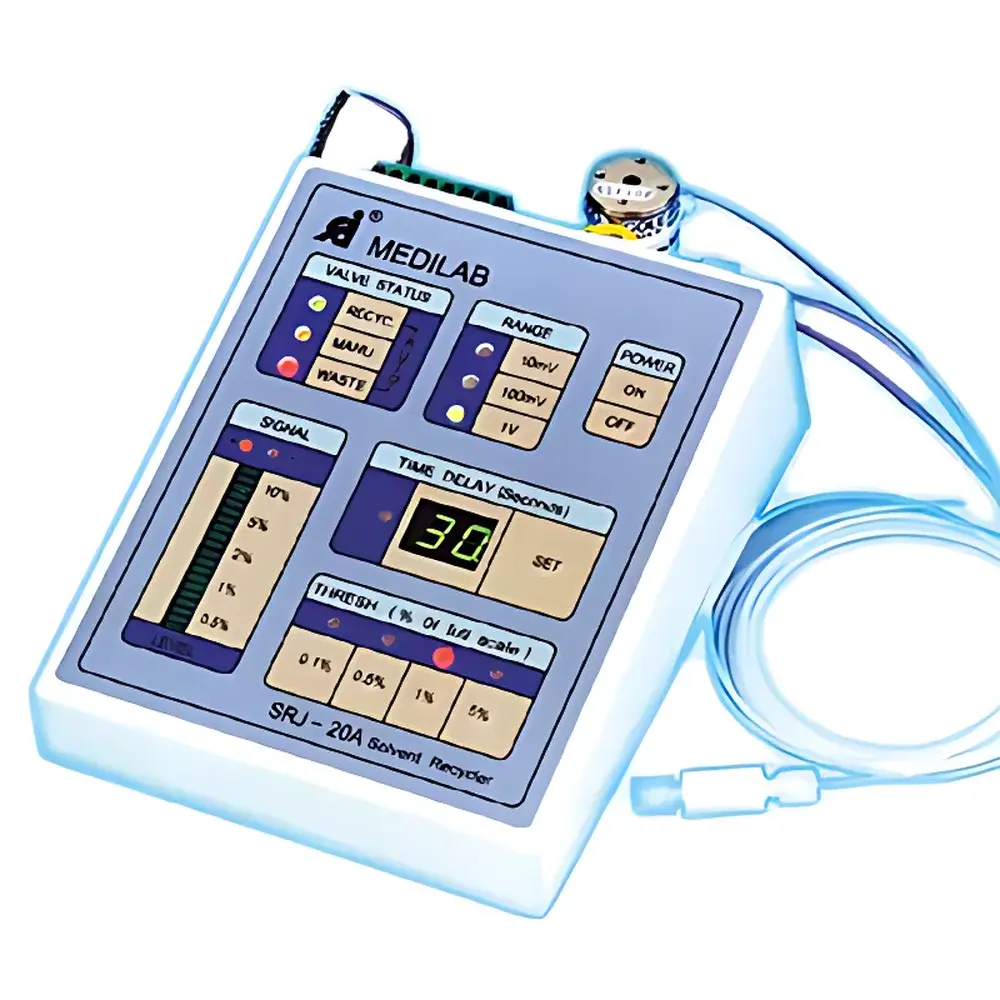
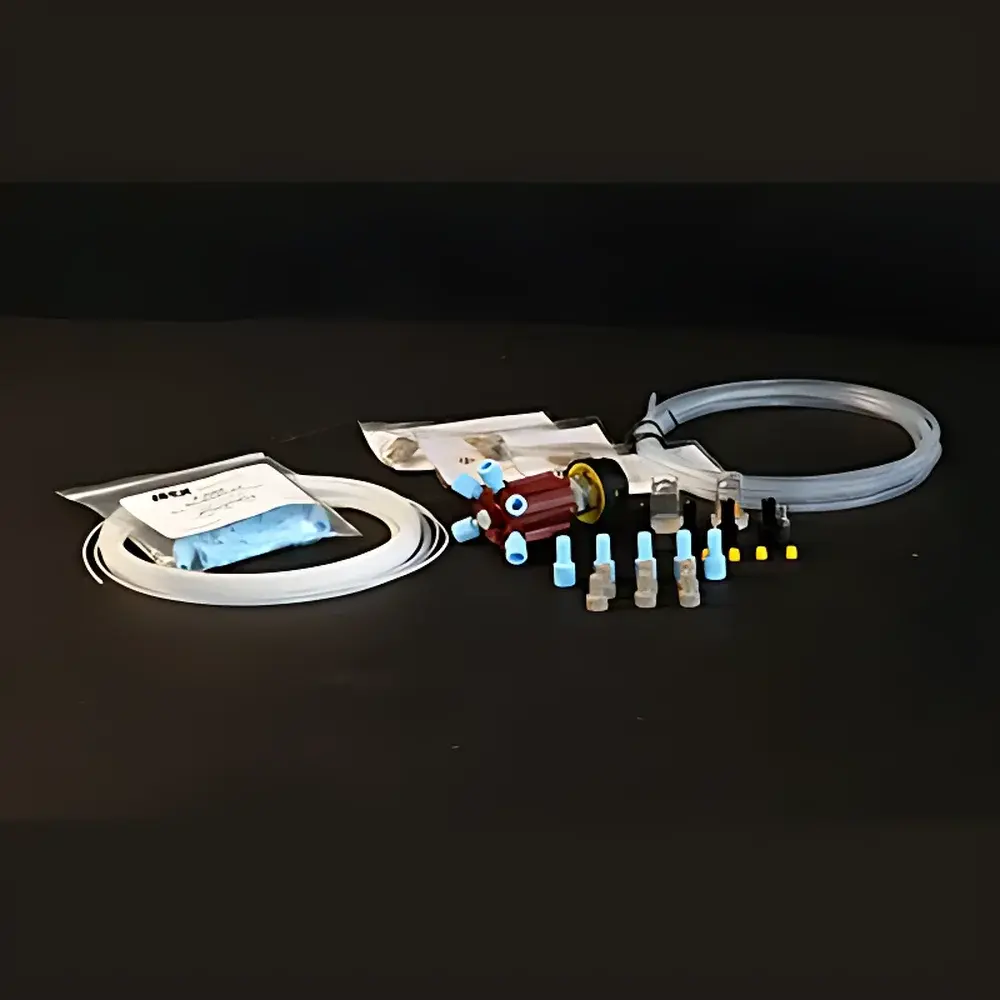
Autoscience SRJ-20A Solvent Recovery System
| Brand | Autoscience |
|---|---|
| Origin | Tianjin, China |
| Manufacturer Type | Authorized Distributor |
| Country of Origin | China |
| Model | SRJ-20A |
| Input Signal Range | 10 mV / 100 mV / 1 V |
| Valve Delay Time | 10–90 s |
| Maximum Flow Rate | 50 mL/min (through 1/16" tubing) |
| Display | Dual-color (red/green) LCD |
| Zero Adjustment | Auto-zero tracking baseline drift |
| Power Supply | 13.5 V / 500 mA |
| Dimensions (L×W×H) | 14.2 × 18.5 × 6.28 cm |
| Weight | 1.0 kg |
Overview
The Autoscience SRJ-20A Solvent Recovery System is an intelligent, programmable solvent fraction collector engineered for integration with high-performance liquid chromatography (HPLC) and ultra-high-performance liquid chromatography (UHPLC) platforms. It operates on a real-time signal-triggered valve actuation principle, using analog detector output (e.g., UV-Vis absorbance or conductivity signals) to discriminate between eluting analyte peaks and solvent-rich fractions. By dynamically routing effluent based on user-defined voltage thresholds and configurable delay logic, the SRJ-20A enables selective recovery of >90% of unused mobile phase—significantly reducing operational costs, solvent procurement frequency, and hazardous waste generation per analytical run. Its compact, benchtop architecture supports seamless placement beneath standard HPLC detector compartments or within integrated LC workstations, requiring no external pneumatic or vacuum interfaces.
Key Features
- Four-level threshold programming allows precise discrimination of peak elution windows, supporting gradient-compatible solvent recycling even under shifting baseline conditions.
- Adjustable valve activation delay (10–90 seconds) compensates for system dwell volume and detector response lag, minimizing cross-contamination between fractions.
- Triple-range analog input sensitivity (10 mV / 100 mV / 1 V) ensures compatibility with diverse HPLC detectors—including photodiode array (PDA), fluorescence, electrochemical, and refractive index units—without external signal conditioning.
- Real-time polarity and amplitude monitoring via dual-color LED bar graph provides immediate visual feedback on detector signal dynamics during method development or troubleshooting.
- Auto-zero baseline tracking continuously recalibrates the zero-reference point to accommodate slow thermal or electronic drift, maintaining consistent trigger fidelity across multi-hour runs.
- Manual override and remote TTL control inputs enable operator-initiated fraction diversion or emergency waste routing, supporting GLP-compliant method validation protocols.
Sample Compatibility & Compliance
The SRJ-20A is compatible with common HPLC mobile phases including aqueous buffers (e.g., phosphate, acetate), organic modifiers (acetonitrile, methanol, tetrahydrofuran), and low-viscosity ion-pairing reagents. It is not rated for halogenated solvents (e.g., chloroform, dichloromethane), strong acids/bases (pH 12), or suspensions containing particulates >5 µm. The device meets IEC 61010-1 safety requirements for laboratory electrical equipment and complies with RoHS 2011/65/EU restrictions on hazardous substances. While not intrinsically explosion-proof, its 13.5 V DC power architecture minimizes spark risk in standard lab environments. For regulated environments, the manual override function and deterministic analog triggering support audit-ready documentation per FDA 21 CFR Part 11 when paired with validated LIMS or ELN systems.
Software & Data Management
The SRJ-20A operates as a standalone hardware controller with no embedded firmware or network interface. All configuration—including threshold levels, delay times, input range selection, and zero-reset behavior—is performed via front-panel membrane buttons and confirmed through the red/green LCD. No proprietary software installation is required; however, its TTL-compatible remote input permits synchronization with third-party acquisition software (e.g., Empower, Chromeleon, OpenLab CDS) via digital I/O modules. Event logs (valve actuation timestamps, signal polarity transitions) are not stored internally but may be captured externally via oscilloscope or data acquisition hardware connected to the status output lines. This design prioritizes deterministic operation, electromagnetic immunity, and long-term calibration stability over digital feature creep.
Applications
- Routine QC/QA labs performing daily HPLC assays where mobile phase consumption exceeds 2 L/day—enabling payback periods under 6 months at typical solvent pricing.
- Academic and pharmaceutical research groups optimizing gradient methods, where repeated solvent recycling accelerates method scouting while preserving column lifetime.
- Environmental testing laboratories complying with ISO/IEC 17025:2017 clause 5.9.1 (waste minimization) and EPA Method 8081B solvent usage guidelines.
- Contract development and manufacturing organizations (CDMOs) implementing green chemistry principles aligned with ACS GCI Pharmaceutical Roundtable metrics.
- Core facilities managing shared HPLC infrastructure, where reduced solvent ordering, storage, and disposal burden lowers total cost of ownership (TCO).
FAQ
Does the SRJ-20A require calibration against a reference standard?
No. As an analog threshold comparator without internal A/D conversion, it requires only verification of input signal amplitude using a calibrated function generator or detector test mode—no traceable calibration certificate is needed.
Can it be used with preparative HPLC systems operating above 10 mL/min?
Not recommended. Its 50 mL/min maximum flow rating assumes laminar flow in 1/16″ PTFE tubing. Higher flow rates induce pressure spikes that may compromise valve seal integrity and timing accuracy.
Is the device compatible with UHPLC systems using sub-2 µm particles?
Yes—provided the detector’s analog output bandwidth exceeds 10 Hz and system dwell volume is accounted for in delay time configuration. Baseline noise filtering is not applied; users must set thresholds above RMS noise floor.
What maintenance is required for long-term reliability?
Annual inspection of solenoid valve seals and cleaning of input BNC contacts with isopropyl alcohol. No consumables or firmware updates are specified.
Does it support Ethernet or USB connectivity?
No. It is intentionally designed as a hardwired, deterministic signal router to eliminate latency, cybersecurity exposure, and driver dependency inherent in networked peripherals.






