
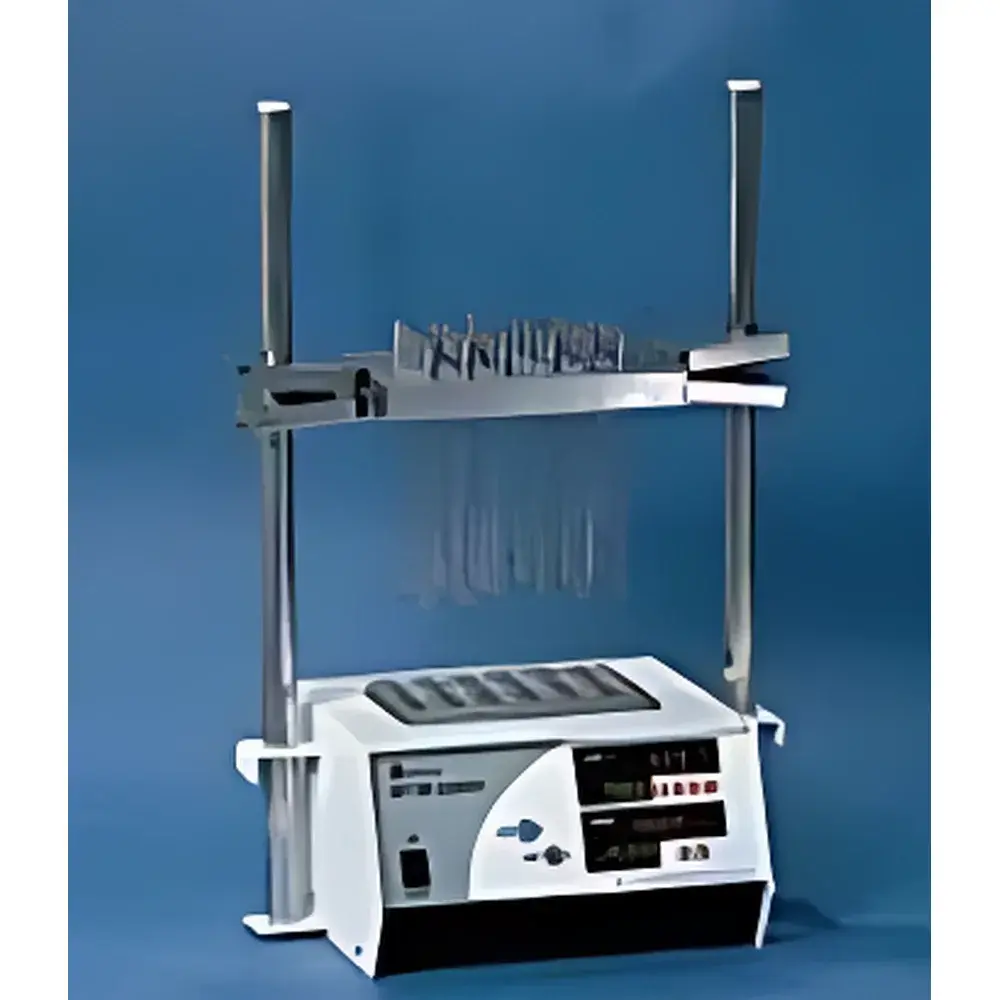
Autosense MTN-2800D Nitrogen Evaporator
| Brand | Autosense |
|---|---|
| Origin | Tianjin, China |
| Manufacturer Type | Authorized Distributor |
| Country of Origin | China |
| Model | MTN-2800D |
| Heating Method | Dry-block heating |
| Temperature Range | +5°C to 180°C |
| Temperature Stability | ±0.1°C |
| Sample Tube Diameter Compatibility | 10–30 mm |
| Nitrogen Flow Rate | 0–15 mL/min |
| Sample Positions | 12 |
| Heating Power | 350 W |
| Block Dimensions (Standard) | 95 W × 70 H × 75 L mm |
| External Dimensions (excl. support rod) | 240 W × 130 H × 215 D mm |
| Operating Ambient Temperature | 5–35°C |
| Power Supply | 220 V / 50 Hz |
| Safety Protections | Dual-mode overtemperature protection (upper-limit setpoint or deviation-based), integrated spill containment tray, continuous-duty thermal architecture |
Overview
The Autosense MTN-2800D Nitrogen Evaporator is an engineered solution for gentle, reproducible solvent removal in analytical sample preparation workflows. It operates on the principle of inert gas-assisted surface evaporation—introducing a controlled stream of high-purity nitrogen directly above the liquid meniscus of samples held in test tubes or vials. By combining precise dry-block heating with laminar, low-flow nitrogen delivery (0–15 mL/min), the system minimizes compound degradation, oxidation, and analyte loss—critical for thermally labile compounds encountered in LC-MS, GC-MS, and HPLC applications. Unlike rotary evaporation—which subjects samples to vacuum-induced foaming, bumping, and potential cross-contamination—the MTN-2800D delivers localized, non-turbulent concentration under ambient pressure. Its aluminum heating block (70 mm thick) ensures exceptional thermal mass and uniformity, enabling stable setpoint maintenance within ±0.1°C across all 12 positions—a prerequisite for inter-sample comparability in regulated environments.
Key Features
- Dual-mode overtemperature safety: Configurable upper-limit cutoff or deviation-based thermal shutdown (e.g., >±5°C from setpoint), compliant with IEC 61010-1 requirements for laboratory equipment.
- Integrated spill containment tray beneath the heating block prevents liquid ingress into electronics—supporting GLP-compliant operation and extended service life.
- Independent, vertically aligned nitrogen delivery nozzles per position eliminate cross-contamination; no shared manifolds or recirculated gas paths.
- High-thermal-mass aluminum block (70 mm height) ensures minimal radial and axial temperature gradients—validated by ASTM E2251-22 methodology for dry-block uniformity assessment.
- Four-digit dual-display interface shows both setpoint and real-time block temperature, plus independent timer display (10 min to 99 h 59 min) with countdown and hold functions.
- Supports continuous-duty operation at elevated temperatures (up to 180°C), validated for 72-hour uninterrupted use without thermal drift exceeding specification limits.
Sample Compatibility & Compliance
The MTN-2800D accommodates standard round-bottom and flat-bottom tubes with outer diameters from 10 mm to 30 mm—including common formats such as 13 × 100 mm, 16 × 150 mm, and 20 × 150 mm culture tubes. Its modular block design allows field-replacement with alternative configurations (e.g., 24- or 40-position variants, per MH-2800 series compatibility). The instrument meets essential electrical safety standards (IEC 61010-1, GB 4793.1), and its closed-loop thermal control architecture supports audit-ready documentation for ISO/IEC 17025-accredited laboratories. While not inherently 21 CFR Part 11–compliant, its deterministic timer logic, non-volatile parameter storage, and absence of user-modifiable firmware enable integration into Part 11–governed workflows when paired with validated electronic lab notebook (ELN) systems.
Software & Data Management
The MTN-2800D operates as a standalone benchtop device with no embedded software or network interface. All operational parameters—including temperature setpoint, timer duration, and safety thresholds—are configured via front-panel membrane keys and retained in non-volatile memory after power cycling. For traceability in regulated settings, users are advised to log instrument ID, batch-specific calibration certificates (traceable to NIST standards), and daily performance verification records (e.g., block uniformity checks using calibrated PT100 probes). Optional external data loggers (e.g., Omega OM-DAQPRO-5300) may be connected via analog output (0–5 V) for continuous temperature trending and long-term stability analysis.
Applications
- Routine concentration of extracts following solid-phase extraction (SPE) prior to GC or LC injection—replacing labor-intensive rotary evaporation and reducing turnaround time by >40%.
- Preparation of calibration standards and QC samples in environmental testing (EPA Methods 502.2, 8081B) and pharmaceutical impurity profiling (ICH Q2(R2)).
- Concentration of volatile organic compounds (VOCs) in water analysis without thermal decomposition—leveraging nitrogen’s inertness versus air or helium.
- Parallel processing of biological matrices (plasma, urine, tissue homogenates) in clinical toxicology labs where analyte stability at elevated temperatures must be preserved.
- Method development support for AOAC 2017.16 and EN 15662:2018 workflows requiring reproducible, low-oxygen evaporation conditions.
FAQ
What is the maximum recommended nitrogen pressure for optimal performance?
The system is designed for low-pressure, high-purity nitrogen delivery (typically 0.1–0.3 MPa inlet pressure). Exceeding 0.4 MPa may cause turbulent flow, reduced evaporation efficiency, and mechanical stress on the nozzle assembly.
Can the MTN-2800D be used with solvents other than acetonitrile or methanol?
Yes—provided the solvent’s boiling point falls within the operational temperature range and its vapor pressure permits efficient removal at ≤15 mL/min N₂ flow. Chlorinated solvents (e.g., DCM) require fume hood operation due to volatility and density.
Is calibration required before first use?
A factory calibration certificate (traceable to national standards) is supplied. Users should perform initial verification using a calibrated reference thermometer inserted into representative block wells, per ISO/IEC 17025 Section 6.4.
How often should the heating block be cleaned?
After each use involving volatile or corrosive solvents, wipe the block surface with lint-free cloth dampened with isopropanol. Avoid abrasive cleaners or immersion—aluminum oxide layer integrity is critical for thermal response fidelity.
Does the unit support programmable ramping or multi-step protocols?
No—the MTN-2800D provides only static setpoint control. For gradient evaporation (e.g., stepwise temperature reduction), external programmable controllers or manual intervention are required.
Related Products



