
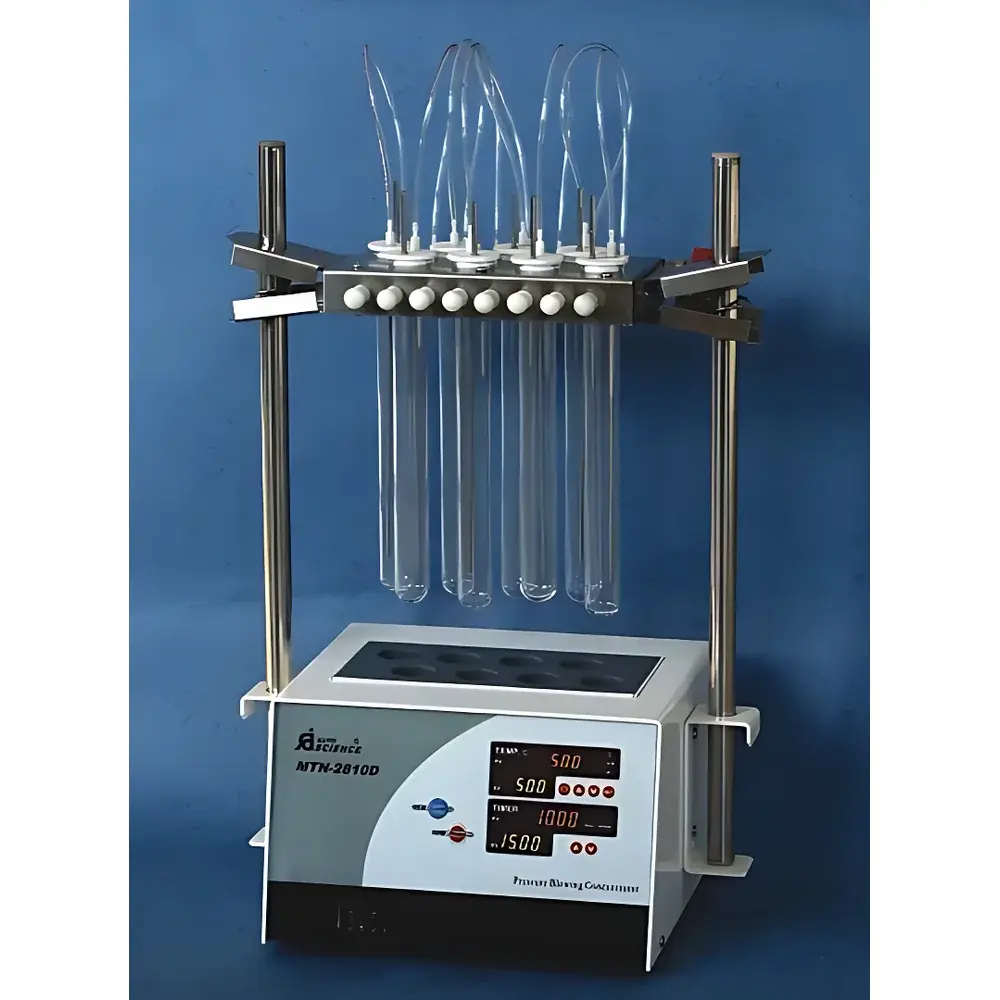
Autosense MTN-2810D Dry-Block Nitrogen Evaporator
| Brand | Autosense |
|---|---|
| Origin | Tianjin, China |
| Model | MTN-2810D |
| Heating Method | Dry-block heating |
| Temperature Range | Ambient +5°C to 300°C |
| Temperature Stability | ±0.1°C |
| Sample Capacity | 8 or 12 positions |
| Tube Diameter Compatibility | 10–29 mm |
| Nitrogen Flow Rate | 0–15 L/min |
| Heating Power | 1350 W |
| Timer Range | 10 min to 99 h 59 min |
| Over-Temperature Protection | Dual-mode (upper-limit & deviation-based) |
| Temperature Output Interface | Analog signal output (0–5 V or 4–20 mA, configurable) |
| Dimensions (W×L×H, excluding support rod) | 268 × 230 × 165 mm |
| Operating Ambient | 5–35°C |
| Power Supply | 220 V / 50 Hz |
Overview
The Autosense MTN-2810D is a precision-engineered dry-block nitrogen evaporator designed for reproducible, low-oxidation concentration and solvent removal in analytical laboratories. It operates on the principle of gentle, inert gas (nitrogen) stream impingement onto sample surfaces within temperature-controlled aluminum heating blocks—minimizing thermal degradation while accelerating solvent evaporation. Unlike water-bath systems, its dry-block architecture eliminates cross-contamination risks, condensation issues, and maintenance associated with liquid media. The unit is optimized for post-extraction workflows in environmental analysis, food safety testing, clinical toxicology, and pharmaceutical QC/QA labs where batch consistency, trace-level recovery, and GLP-compliant documentation are critical.
Key Features
- High-stability dry-block heating system with ±0.1°C temperature uniformity across all wells—validated per ASTM E220 for thermal performance in laboratory heating devices.
- Dual-mode over-temperature protection: user-selectable upper-limit cutoff (e.g., 300°C max) or deviation-based alarm (e.g., ±5°C from setpoint), ensuring instrument and sample integrity under fault conditions.
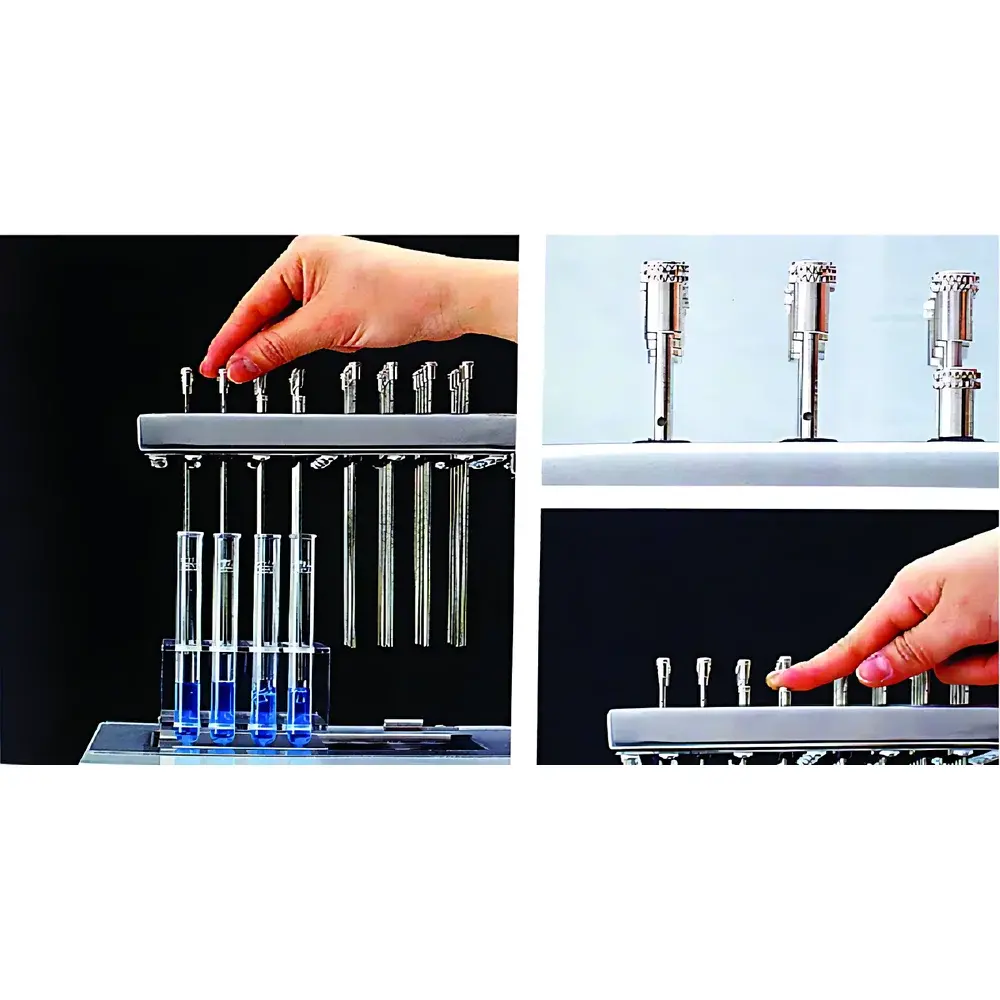
- Motorized vertical lift mechanism enables smooth, repeatable elevation and lowering of the entire sample rack—reducing operator fatigue and improving ergonomics during high-throughput workflows.
- Quadruple digital LED display showing set temperature, real-time block temperature, programmed timer value, and countdown status—enabling simultaneous monitoring without menu navigation.
- Analog temperature output interface (0–5 V or 4–20 mA, switchable) supports integration with external data loggers, SCADA systems, or LIMS for audit-ready temperature traceability.
- Modular well configuration: interchangeable 8-position and 12-position aluminum heating blocks with precisely machined bores (10–29 mm ID) accommodate standard test tubes, culture tubes, and GC vials without adapters.
Sample Compatibility & Compliance
The MTN-2810D accommodates common laboratory vessels—including 10 mL, 15 mL, and 50 mL conical centrifuge tubes; 4 mL and 16 mL autosampler vials; and custom-diameter glass or polypropylene tubes within the 10–29 mm range. Its closed-loop temperature control meets ISO/IEC 17025 requirements for equipment calibration validity when used with NIST-traceable reference thermometers. The device complies with IEC 61010-1:2010 for electrical safety in laboratory equipment and incorporates CE-marked internal circuitry. While not FDA 21 CFR Part 11–certified out-of-the-box, its analog output and deterministic timer behavior support validation protocols required for GMP/GLP environments when paired with compliant data acquisition software.
Software & Data Management
The MTN-2810D operates as a standalone instrument with no embedded firmware or proprietary software—ensuring long-term operational stability and eliminating update-related downtime. All parameter settings (temperature, timer, protection mode) are retained in non-volatile memory after power cycling. For regulated environments, users integrate the analog temperature output with third-party validated systems (e.g., LabVIEW-based DAQ, DeltaV DCS, or electronic lab notebooks with 21 CFR Part 11 add-ons) to generate time-stamped, tamper-evident records. Audit trails—including start/stop timestamps, temperature deviations >±0.5°C, and manual override events—can be reconstructed using synchronized external logging.
Applications
- Concentration of pesticide residues in soil/water extracts prior to GC-MS analysis (per EPA Method 525.3).
- Pre-concentration of mycotoxins (e.g., aflatoxin B1) from immunoaffinity-purified samples in food testing labs.
- Removal of acetonitrile or methanol from SPE-eluted fractions in pharmaceutical stability studies (ICH Q5C).
- Routine solvent exchange in lipidomics workflows—transferring analytes from chloroform/methanol mixtures into LC-compatible mobile phase solvents.
- Parallel evaporation of calibration standards and QC samples in clinical toxicology labs processing urine or plasma specimens for LC-MS/MS quantitation.
FAQ
What is the maximum recommended nitrogen pressure for safe operation?
The MTN-2810D is rated for inlet pressures up to 100 psi (6.9 bar); however, optimal flow control is achieved at 30–60 psi with a calibrated mass-flow controller. Excessive pressure may cause splashing or uneven evaporation.
Can the heating block be replaced with a custom geometry?
Yes—Autosense provides OEM-compatible replacement blocks (e.g., 24-position 12 mm bore, or deep-well 50 mL format) upon request. Block interchange requires recalibration verification per ISO/IEC 17025 Clause 6.5.2.
Is the unit compatible with argon or other inert gases?
Yes. The gas delivery path is chemically inert (stainless steel and PTFE-lined). Argon, helium, or nitrogen may be substituted without modification—though nitrogen remains preferred due to cost and density advantages for surface agitation.
Does the timer support pause/resume functionality?
No—the timer is a continuous countdown with auto-shutdown at zero. Pause/resume requires external relay control via the temperature output signal or manual intervention.
How often should temperature uniformity be verified?
Per CLSI EP25-A2 guidelines, uniformity verification is recommended before first use, after relocation, following major maintenance, and at least quarterly in routine operation using a minimum of 3 calibrated probes per block quadrant.



