
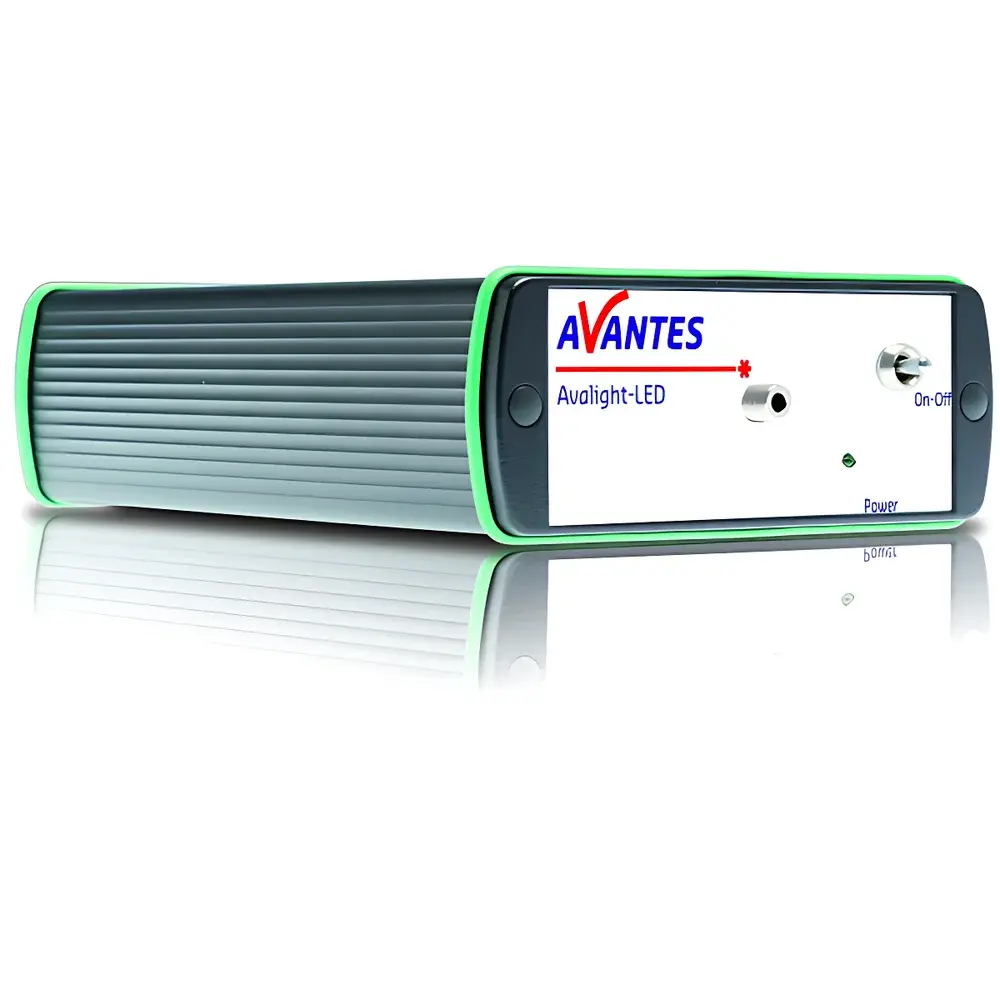
AvaLight-LED Fluorescence Excitation Light Source by Avantes
| Brand | Avantes |
|---|---|
| Origin | Netherlands |
| Model | AvaLight-LED |
| Light Source Type | High-Stability LED Array |
| Illumination Mode | External Illumination |
| Connector | SMA 905 |
| Power Supply | 12 VDC, 40 mA |
| Dimensions & Weight | 175 × 110 × 44 mm, 480 g |
| Spectral Options | 355/380 nm, 400/410/430 nm, 450/470/490 nm, 530/590/780 nm |
| FWHM | 11–30 nm (model-dependent) |
| Output Power (into 600 µm fiber) | 10–25 µW |
| Control Interface | TTL-compatible pulse modulation via IC-DB26-2 cable (optional, for synchronization with AvaSpec-USB2 spectrometers) |
| Compliance | CE, RoHS |
Overview
The AvaLight-LED is a compact, high-stability LED-based excitation light source engineered specifically for quantitative fluorescence measurement in laboratory and industrial analytical settings. Unlike broadband arc lamps or lasers, this solid-state source delivers narrowband spectral output with excellent temporal stability and minimal thermal drift—critical for reproducible fluorophore excitation across repeated measurements. Its operation is based on discrete, temperature-stabilized LED emitters selected for peak wavelength accuracy and low spectral sideband emission. The device supports both continuous-wave (CW) and externally triggered pulsed operation, enabling time-resolved fluorescence studies when synchronized with compatible spectrometers such as the AvaSpec-USB2 series. Designed for integration into optical bench setups, fiber-coupled probe systems, or OEM instrumentation, the AvaLight-LED complies with IEC 61000-6-3 (EMC emissions) and IEC 61000-6-2 (immunity), ensuring reliable performance in regulated laboratory environments.
Key Features
- Modular LED array architecture with factory-calibrated center wavelengths and tight spectral bandwidths (FWHM 11–30 nm)
- Low-power consumption (12 VDC, 40 mA) and passive thermal management—no active cooling required
- SMA 905 fiber-optic interface compatible with standard 600 µm core fibers and commercial fluorescence probes
- TTL-triggered pulse modulation capability (via optional IC-DB26-2 interface cable) for gated detection and lifetime-sensitive applications
- Compact footprint (175 × 110 × 44 mm) and lightweight design (480 g) ideal for space-constrained optical tables or portable systems
- CE-marked and RoHS-compliant construction meeting EU regulatory requirements for electrical safety and hazardous substance restriction
Sample Compatibility & Compliance
The AvaLight-LED is optimized for excitation of common organic fluorophores, quantum dots, and biological markers—including but not limited to fluorescein (FITC), rhodamine B, Alexa Fluor dyes, GFP derivatives, and lanthanide chelates. Its discrete wavelength options align with established excitation maxima defined in ISO 17025-accredited fluorescence protocols. When used in conjunction with calibrated reference standards (e.g., NIST-traceable fluorescent solutions), the system supports GLP-compliant data acquisition workflows. While the AvaLight-LED itself does not include onboard calibration certificates, its spectral output stability (<0.5% RMS intensity variation over 8 hours at constant ambient temperature) enables traceable method validation under ISO/IEC 17025 clause 5.9. All models are supplied with conformity documentation suitable for inclusion in instrument qualification (IQ/OQ) packages per FDA 21 CFR Part 11 and EU Annex 11 guidelines.
Software & Data Management
The AvaLight-LED operates as a hardware-synchronized peripheral rather than a standalone instrument. Pulse timing and duration are controlled externally through digital TTL signals generated by supported Avantes spectrometers (e.g., AvaSpec-USB2) using the AvaSoft software suite (v8.9+). AvaSoft provides scripting support (VBScript/Python API) for automated sequence control, including variable pulse width sweeps and multi-wavelength excitation cycling. Raw intensity data acquired during LED-triggered acquisitions are timestamped and stored with metadata (wavelength setting, pulse width, trigger delay), supporting audit-ready export in CSV, HDF5, or vendor-neutral JCAMP-DX formats. No proprietary drivers or runtime dependencies are required—communication occurs via standard USB HID protocol.
Applications
- Steady-state and time-gated fluorescence spectroscopy in life science research laboratories
- In-line process monitoring of dye concentration, protein folding, or enzymatic activity in bioreactors
- Calibration and verification of fluorescence microplate readers and flow cytometers
- Development and validation of point-of-care diagnostic assays requiring stable, low-noise excitation
- OEM integration into handheld fluorescence sensors for environmental contaminant detection (e.g., PAHs, chlorophyll-a)
- Education and training platforms for teaching photophysics principles and spectral deconvolution techniques
FAQ
Is the AvaLight-LED suitable for quantitative fluorescence intensity measurements?
Yes—when paired with a calibrated spectrometer and reference standards, its intensity stability and spectral repeatability support quantitative analysis per ISO 8579 and ASTM E275.
Can multiple AvaLight-LED units be operated simultaneously on one optical setup?
Yes—each unit features independent TTL input and SMA output; wavelength selection is fixed per model, so multi-excitation configurations require physically separate units.
Does the AvaLight-LED include built-in power regulation or current control?
No—it requires an external stabilized 12 VDC, 40 mA power supply (PS-12V/1A, sold separately); current regulation is handled externally to ensure long-term LED lifetime and spectral consistency.
Are NIST-traceable calibration reports available for individual units?
Avantes provides spectral output characterization reports (peak wavelength, FWHM, relative intensity) upon request; full NIST-traceable calibration requires third-party lab services and is not included standard.
What is the expected operational lifetime of the LEDs under continuous use?
Based on accelerated aging tests per IES LM-80, median L70 lifetime exceeds 25,000 hours at rated drive current and ambient temperatures ≤35°C.



