
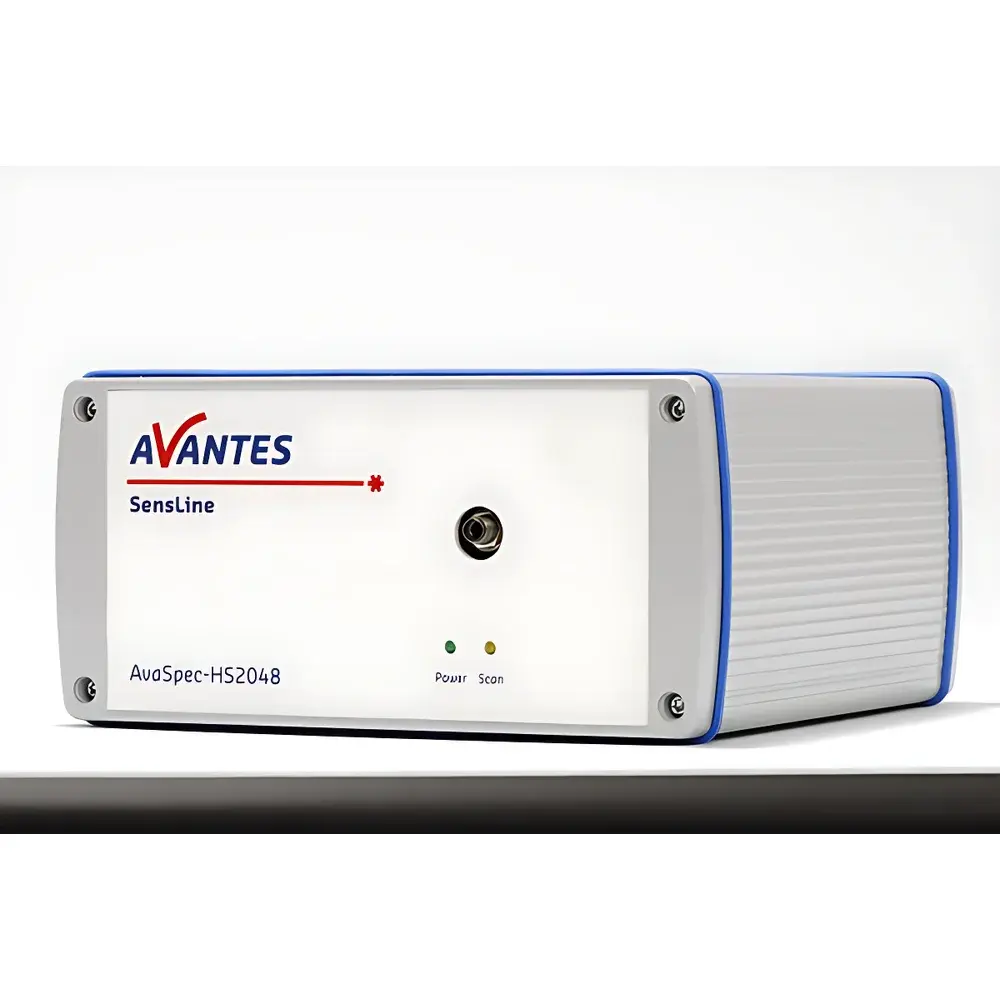
Avantes AvaSpec-HS2048XL-EVO Fiber Optic Spectrometer
| Brand | Avantes |
|---|---|
| Origin | Netherlands |
| Model | AvaSpec-HS2048XL-EVO |
| Spectral Range | 200–1160 nm |
| Detector | Back-Illuminated CCD (2048 pixels) |
| Resolution (FWHM) | 1–20 nm (configuration-dependent) |
| Sensitivity | 1,250,000 counts/µW·ms |
| Signal-to-Noise Ratio | 525:1 |
| Stray Light | < 1% |
| Dynamic Range | 200–1160 nm |
| Numerical Aperture | 0.22 |
| Focal Length | 37.5 mm |
| Integration Time | 2 µs – 600 s |
| A/D Conversion | 16-bit, 1 MHz |
| Interface | USB 3.0 (5 Gbps) / Gigabit Ethernet (1 Gbps) |
| Data Acquisition Rate | 2.44 ms per scan (with on-board averaging) |
| Digital I/O | HD-26 connector with 2 analog inputs, 2 analog outputs, 3 digital inputs, 12 digital outputs, trigger & sync support |
| Power Supply | USB-powered (700 mA) or external 12 VDC (360 mA) |
| Dimensions & Weight | 175 × 165 × 85 mm, 1.95 kg |
Overview
The Avantes AvaSpec-HS2048XL-EVO is a high-performance, back-illuminated CCD fiber optic spectrometer engineered for demanding applications requiring both high sensitivity and spectral resolution across the ultraviolet, visible, and near-infrared (UV-VIS-NIR) range (200–1160 nm). Built upon Avantes’ proprietary High-Sensitivity (HS) asymmetric optical platform with an f/2.27 design and numerical aperture of 0.22, the instrument delivers exceptional light throughput—critical for low-light measurements such as fluorescence, Raman scattering, and weak-emission plasma diagnostics. Its core detector is a custom 2048-pixel back-illuminated CCD featuring large individual pixels (14 × 500 µm), enabling superior quantum efficiency—up to 60% in the deep UV (200–250 nm) and consistently high response across both UV (200–400 nm) and NIR (950–1160 nm) bands. Unlike conventional back-illuminated array spectrometers that sacrifice uniformity or dynamic response, the HS2048XL-EVO maintains high pixel-to-pixel responsivity homogeneity and minimal etaloning effects, ensuring measurement stability over extended integration periods.
Key Features
- Back-illuminated 2048-pixel CCD detector with large-area pixels (14 × 500 µm) optimized for UV and NIR quantum efficiency
- HS asymmetric Czerny-Turner optical bench (f/2.27, 37.5 mm focal length) delivering high optical throughput and minimized aberrations
- Electronic shutter enabling ultrafast integration times down to 2 µs—ideal for time-resolved spectroscopy and pulsed source characterization
- Dual high-speed interfaces: USB 3.0 (5 Gbps) and Gigabit Ethernet (1 Gbps), supporting real-time streaming and remote operation in industrial or lab environments
- On-board hardware averaging and programmable trigger/synchronization via HD-26 digital I/O (12 digital outputs, 3 digital inputs, 2 analog I/O channels)
- 16-bit A/D conversion at 1 MHz sampling rate, yielding a true dynamic range exceeding 60 dB without software binning
- Modular grating selection—eight standard gratings available—including UV-optimized (HS600-0.30), VIS-NIR (HS500-0.56), and broadband (HS500-0.33) options—each calibrated and traceable to NIST standards
Sample Compatibility & Compliance
The AvaSpec-HS2048XL-EVO is compatible with standard SMA 905 fiber-optic coupling (core diameters from 50 µm to 1000 µm), enabling seamless integration into OEM systems, process monitoring setups, and benchtop analytical configurations. It supports both free-space and fiber-coupled illumination geometries, including transmission, reflectance, fluorescence, and absorption modes. The spectrometer complies with CE, RoHS, and FCC regulatory requirements. Its firmware architecture supports audit-trail-capable operation when integrated with compliant data acquisition software, facilitating alignment with GLP, GMP, and FDA 21 CFR Part 11 requirements for regulated laboratories. All factory calibrations—including wavelength, intensity, and stray light characterization—are performed under ISO/IEC 17025-accredited conditions and documented with certificate of calibration.
Software & Data Management
Avantes provides the cross-platform AvaSoft-Basic and AvaSoft-Advanced software suites, supporting full spectral acquisition, real-time processing, multi-channel synchronization, and automated calibration routines. Raw spectral data are exported in ASCII, CSV, or binary formats compatible with MATLAB, Python (NumPy/Pandas), LabVIEW, and third-party chemometric platforms (e.g., Unscrambler, SIMCA). The SDK includes C/C++, .NET, and Python APIs for embedded integration and custom control logic. Firmware updates and configuration persistence are managed via secure USB or Ethernet, with version-controlled parameter sets stored locally on device memory. Data integrity is reinforced through timestamped metadata embedding (including integration time, grating ID, slit width, temperature, and detector gain), enabling full traceability in QA/QC and regulatory submissions.
Applications
- UV-VIS-NIR absorbance and transmittance quantification in pharmaceutical dissolution testing (aligned with USP & EP monographs)
- Plasma emission monitoring in semiconductor process chambers (OES for endpoint detection and species tracking)
- Fluorescence lifetime and spectral fingerprinting in life science research (e.g., NADH/FAD ratio analysis, protein conformation studies)
- In-line colorimetry and pigment concentration monitoring in food, paint, and textile manufacturing
- Raman excitation profiling and Stokes/anti-Stokes band separation in material science labs
- LED and laser diode spectral characterization—including peak wavelength, FWHM, and side-mode suppression ratio (SMSR)
- Environmental sensing: dissolved organic carbon (DOC), nitrate, and chlorophyll-a quantification in water quality systems
FAQ
What is the minimum achievable integration time?
The electronic shutter enables integration times as short as 2 µs—critical for capturing transient events such as laser-induced breakdown or fast chemical kinetics.
Can this spectrometer be used in vacuum or controlled atmosphere enclosures?
Yes—the sealed aluminum housing and absence of internal desiccants or outgassing components make it suitable for operation in dry nitrogen or vacuum environments (down to 10⁻² mbar) with appropriate feedthroughs.
Is wavelength calibration stable over temperature fluctuations?
The HS optical platform incorporates thermally compensated mechanical design; typical wavelength drift is ≤ 0.02 nm/°C within the operating range (10–40 °C), and optional Peltier stabilization reduces drift to < 0.005 nm/°C.
How does stray light performance compare to other high-end CCD spectrometers?
With < 1% stray light across the full 200–1160 nm range—verified per ASTM E275 and ISO 17123-8—the HS2048XL-EVO exceeds typical specifications for non-CTE-corrected instruments and approaches performance levels seen in double-monochromator systems.
Are OEM integration services available?
Avantes offers full OEM support including custom firmware builds, mechanical housing modifications, API abstraction layers, and IEC 61508-compliant functional safety documentation for industrial automation deployment.






