
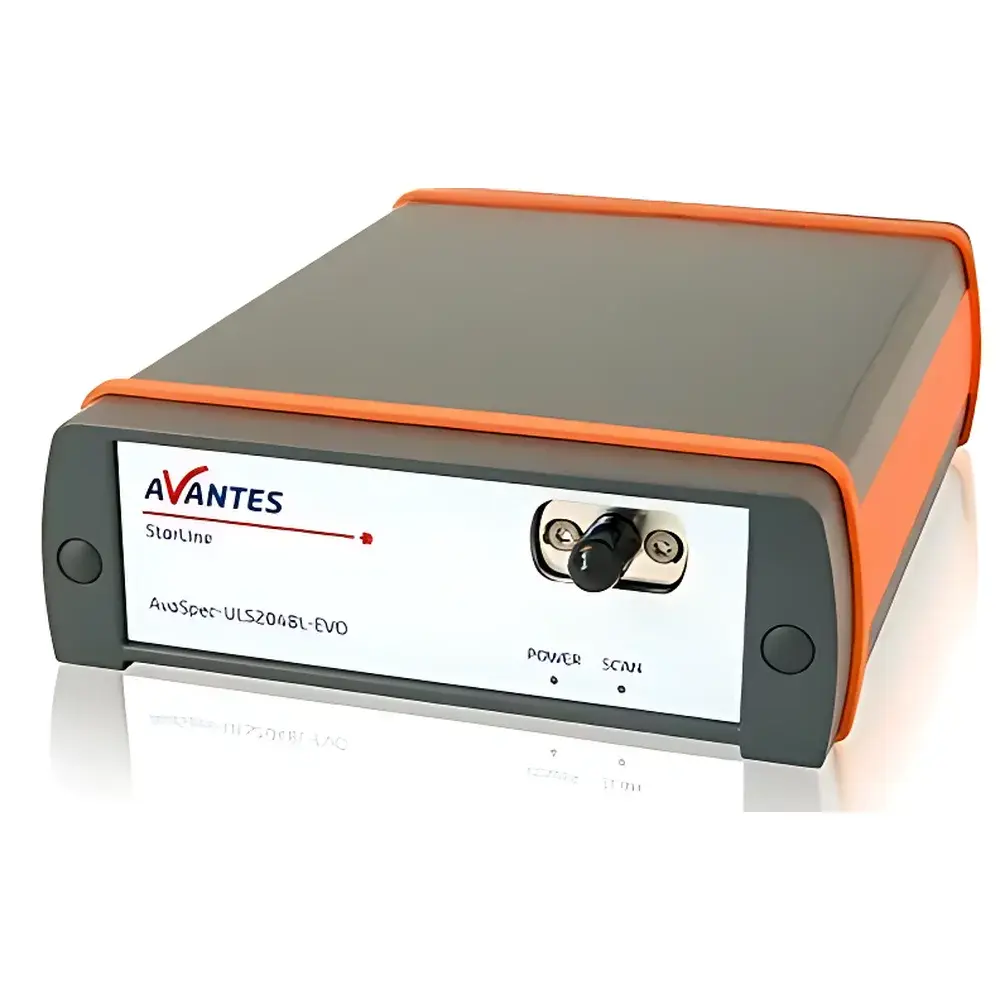
Avantes AvaSpec-ULS2048CL-EVO Fiber Optic Spectrometer
| Brand | Avantes |
|---|---|
| Origin | Netherlands |
| Model | AvaSpec-ULS2048CL-EVO |
| Spectral Range | 200–1100 nm |
| Detector | CMOS linear array (2048 pixels) |
| Optical Resolution (FWHM) | 0.06–20 nm (configuration-dependent) |
| Sensitivity | 375,000 counts/µW per ms integration time |
| Signal-to-Noise Ratio | 300:1 |
| Dynamic Range | 4000:1 |
| Stray Light | 0.19–1.0% (grating-dependent) |
| AD Converter | 16-bit, 6 MHz |
| Integration Time | 9 µs – 59 s |
| Interface | USB 3.0 (5 Gbps) / Gigabit Ethernet (1 Gbps) |
| Sampling Speed | 0.38 ms/spectrum (USB3), 1.0 ms/spectrum (Ethernet) |
| I/O | HD-26 connector with 2 analog in/out, 13 digital I/O, trigger/sync/laser control |
| Power | USB 3.0 (500 mA) or 12 VDC (300 mA) |
| Dimensions & Weight | 177 × 127 × 44.5 mm, 1135 g |
Overview
The Avantes AvaSpec-ULS2048CL-EVO is a high-performance fiber optic spectrometer engineered for precision spectral acquisition across the ultraviolet, visible, and near-infrared (UV-VIS-NIR) spectrum (200–1100 nm). Built upon a symmetrical Czerny-Turner optical layout with a 75 mm focal length, it delivers ultra-low stray light performance (0.19–1.0%, dependent on grating selection) and stable wavelength calibration—critical for quantitative reflectance, absorbance, fluorescence, and radiometric applications. Unlike legacy CCD-based instruments, the EVO integrates a high-speed 2048-pixel CMOS linear image sensor, offering superior quantum efficiency in the UV region, faster readout, and immunity to blooming and vertical smear. Its modular architecture supports customizable configurations—including slit width (10–500 µm), grating options (300–3600 lines/mm), and fiber coupling (SMA905, FC/PC, or custom), enabling optimization for resolution, sensitivity, or spectral coverage without hardware redesign.
Key Features
- CMOS detector platform delivering enhanced UV sensitivity (375,000 counts/µW/ms) and improved resistance to saturation versus traditional CCDs
- Dual high-bandwidth interfaces: USB 3.0 (5 Gbps) and Gigabit Ethernet (1 Gbps), enabling real-time streaming in industrial PLC environments or networked lab infrastructures
- AS-7010 electronics board featuring an embedded microprocessor and expanded on-board memory (>50× previous generation), supporting extended dark/baseline storage and firmware-upgradable functionality
- Low-noise 16-bit ADC operating at 6 MHz sampling rate, achieving a dynamic range of 4000:1 and signal-to-noise ratio of 300:1 (at full well)
- Flexible triggering and synchronization: HD-26 I/O interface includes TTL-compatible trigger input/output, laser enable, pulse source control, and 13 programmable digital I/O lines
- Thermally stabilized optical bench design minimizes wavelength drift (<0.02 nm/°C typical), ensuring long-term measurement repeatability under variable ambient conditions
Sample Compatibility & Compliance
The AvaSpec-ULS2048CL-EVO is compatible with standard 200 µm–1000 µm core silica optical fibers (e.g., UV-VIS optimized, solarization-resistant, or NIR-transmissive), and supports direct coupling to integrating spheres, cuvette holders, remote probes, and OEM flow cells. Its optical design conforms to ISO 17025-relevant traceability requirements when calibrated using NIST-traceable standards (e.g., HG/Na/Cd/Ne lamps or calibrated halogen sources). The instrument’s firmware and AvaSoft software support audit trail logging and user access controls aligned with GLP and FDA 21 CFR Part 11 compliance frameworks—enabling validated deployment in regulated pharmaceutical, environmental monitoring, and quality control laboratories.
Software & Data Management
AvaSoft-Basic is provided as standard, offering intuitive spectral acquisition, real-time peak detection, baseline correction, and export to CSV, ASCII, or binary formats. For advanced workflows, AvaSoft-Complete adds multichannel synchronization, chemometric modeling (PLS, PCA), automated calibration curve generation, and batch processing with scriptable macros (VBScript/Python API). All data files include embedded metadata (integration time, grating ID, slit width, calibration date), facilitating FAIR (Findable, Accessible, Interoperable, Reusable) data practices. Gigabit Ethernet connectivity allows seamless integration into LabView, MATLAB, or Python-based control systems via TCP/IP or SCPI command sets—supporting distributed spectroscopic sensor networks in process analytical technology (PAT) environments.
Applications
- UV-VIS absorption and transmission measurements in pharmaceutical dissolution testing and excipient characterization
- NIR reflectance analysis for agricultural product grading (moisture, protein, starch content)
- Plasma emission monitoring in semiconductor etch and deposition processes
- LED and OLED spectral power distribution (SPD) and colorimetric analysis (CIE x,y, CCT, CRI)
- Fluorescence lifetime precursor studies requiring high temporal resolution and low-latency triggering
- OEM integration into handheld analyzers, environmental sensors (e.g., water quality NO₃⁻/NO₂⁻ detection), and educational instrumentation platforms
FAQ
What is the minimum achievable optical resolution (FWHM) with this spectrometer?
The theoretical minimum FWHM is 0.06 nm, attainable using a 10 µm slit and a high-line-density grating (e.g., 3600 l/mm) in the UV range—subject to optical alignment stability and signal-to-noise constraints.
Can the AvaSpec-ULS2048CL-EVO operate in continuous streaming mode over Gigabit Ethernet?
Yes—its dedicated Ethernet firmware supports sustained packetized spectral transmission at up to 2.6 kHz (with on-board averaging disabled), making it suitable for real-time spectral monitoring in closed-loop feedback systems.
Is NIST-traceable calibration available as a factory option?
Yes—Avantes offers optional factory calibration against NIST-traceable tungsten-halogen and mercury-argon lamp standards, including uncertainty budgets and certificate documentation compliant with ISO/IEC 17025.
Does the spectrometer support external triggering with sub-microsecond jitter?
Yes—the HD-26 I/O interface provides hardware-level trigger input with <100 ns timing jitter, enabling precise synchronization with pulsed lasers, flash lamps, or gated detectors.
Are OEM mechanical variants (e.g., rackmount or bare-board) supported?
Yes—Avantes supplies RACK, OEM-BOARD, and CUSTOM-HOUSING versions with modified thermal management, mounting flanges, and stripped-down firmware for embedded integration.



