
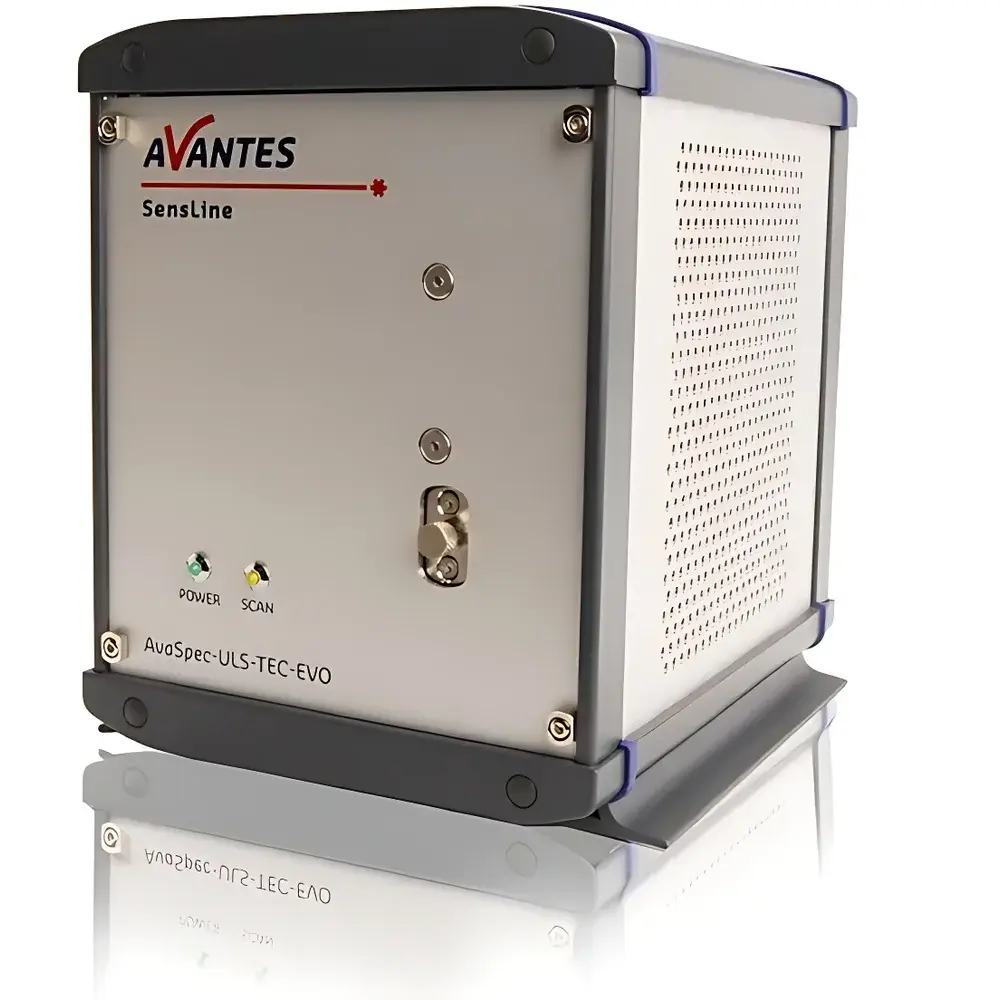
Avantes AvaSpec-ULS2048x64TEC-EVO Fiber Optic Spectrometer
| Brand | Avantes |
|---|---|
| Origin | Netherlands |
| Model | AvaSpec-ULS2048x64TEC-EVO |
| Spectral Range | 200–1160 nm |
| Detector | Back-Illuminated CCD (2048 × 64 pixels) |
| Resolution (FWHM) | 0.09–20 nm (configurable via slit width & grating) |
| Sensitivity | 300,000 counts/µW per ms integration time |
| Signal-to-Noise Ratio | 550:1 |
| Stray Light | <1% |
| Dark Noise Reduction | 2–3× via thermoelectric cooling |
| Cooling Delta | −35 °C relative to ambient |
| Integration Time | 9.7 ms – 500 s |
| A/D Converter | 16-bit, 500 kHz |
| Interface | USB 2.0 (480 Mbps) / RS-232 (115.2 kbps) |
| Optical Design | Symmetric Czerny-Turner, 75 mm focal length |
| Power Supply | 5 VDC, 3.0 A (instrument) |
| Dimensions & Weight | 250 × 179 × 144 mm, 3.6 kg |
Overview
The Avantes AvaSpec-ULS2048x64TEC-EVO is a high-performance, thermoelectrically cooled fiber optic spectrometer engineered for demanding low-light spectroscopic applications requiring extended integration times and exceptional signal fidelity. Based on the proven ULS platform and upgraded with the advanced 7010 electronics board, this instrument integrates a back-illuminated 2048 × 64-pixel CCD detector mounted on a three-stage Peltier cooler—capable of stabilizing the sensor at up to 35 °C below ambient temperature. This active thermal management directly suppresses dark current, improves photon response non-uniformity (PRNU), and enables stable, high-dynamic-range acquisitions over integration periods up to 500 seconds. Its symmetric Czerny-Turner optical layout (75 mm focal length) delivers ultra-low stray light (<1%), while the modular design supports interchangeable slits and gratings—allowing spectral resolution tuning from 0.09 nm (FWHM) to 20 nm across the full 200–1160 nm range. The spectrometer operates natively in UV-VIS-NIR domains and is optimized for applications where photon-starved signals must be resolved with high reproducibility and minimal baseline drift.
Key Features
- Back-illuminated CCD detector with 2048 × 64 pixel architecture—enhanced quantum efficiency in UV (200–400 nm) and NIR (900–1160 nm) regions
- Three-stage thermoelectric cooling system achieving ΔT = −35 °C relative to ambient—reducing dark noise by 2–3× and enabling 500 s integration without saturation
- Ultra-low stray light optical bench (<1%) based on symmetric Czerny-Turner geometry with precision-aligned optics and black-anodized housing
- Configurable resolution via interchangeable slits (10–500 µm) and diffraction gratings (300–3600 l/mm), with documented FWHM values traceable to NIST-traceable calibration sources
- High-speed 16-bit A/D conversion at 500 kHz sampling rate; real-time onboard averaging and dark reference subtraction
- Flexible I/O interface (HD-26 connector) supporting hardware triggering, synchronous multi-device operation, analog monitoring, and digital control for automated lab integration
Sample Compatibility & Compliance
The AvaSpec-ULS2048x64TEC-EVO interfaces seamlessly with standard SMA 905 fiber optic cables (e.g., UV/VIS/NIR optimized silica fibers, solarization-resistant quartz, or armored patch cords), enabling coupling to diverse sample interfaces—including cuvette holders, integrating spheres, flow cells, remote probes, and microscope spectrometers. Its broad spectral coverage supports compliance-critical measurements aligned with ASTM E308 (colorimetry), ISO 13406-2 (display luminance), USP (UV-Vis spectrophotometer qualification), and IEC 61000-4-3 (EMC immunity). While not intrinsically certified for GMP/GLP environments, its deterministic firmware architecture, audit-ready data logging (via AvaSoft-Basic or AvaSoft-Advanced), and optional 21 CFR Part 11-compliant software modules support regulated workflows when deployed with validated SOPs and periodic performance verification (e.g., wavelength accuracy ±0.1 nm, photometric linearity R² > 0.9999).
Software & Data Management
Controlled via Avantes’ cross-platform AvaSoft suite (Windows/macOS/Linux), the spectrometer supports both scripting (Python, MATLAB, LabVIEW SDKs) and GUI-driven acquisition. AvaSoft-Advanced provides real-time spectral processing—including Savitzky-Golay smoothing, baseline correction, peak deconvolution, multivariate analysis (PCA, PLS), and batch calibration transfer. All raw spectra are stored in HDF5 format with embedded metadata (timestamp, integration time, temperature, grating ID, slit width, lamp reference status), ensuring FAIR (Findable, Accessible, Interoperable, Reusable) data principles. Export options include CSV, ASCII, and industry-standard JCAMP-DX for LIMS integration. Firmware updates are delivered via signed binary packages verified against Avantes’ public key infrastructure, satisfying secure device update requirements under ISO/IEC 27001-aligned IT policies.
Applications
- Time-resolved fluorescence spectroscopy (e.g., lifetime decay fitting, quantum yield quantification)
- Low-intensity Raman spectroscopy—especially for biological tissues, pharmaceutical polymorphs, and 2D materials
- Plasma emission monitoring in semiconductor process chambers (O, N, F, Cl lines at 200–800 nm)
- LED and laser diode characterization: spectral power distribution (SPD), centroid wavelength shift, and mode stability under thermal load
- Environmental sensing: dissolved organic matter (DOM) fluorescence excitation-emission matrices (EEMs), NO₂/NO absorption in open-path configurations
- Thin-film interference analysis and optical coating reflectance/transmittance mapping (200–1100 nm)
FAQ
What is the maximum usable integration time before dark current dominates the signal?
With detector stabilized at −35 °C, dark current remains linear and predictable up to 500 s; beyond this, thermal drift in PRNU requires re-calibration. For routine measurements, 60–300 s integrations deliver optimal SNR in UV fluorescence applications.
Can the spectrometer operate in continuous scanning mode with external triggering?
Yes—the HD-26 I/O port supports TTL-level hardware trigger input (rising/falling edge selectable), enabling synchronization with pulsed lasers, motorized stages, or process controllers at rates up to 100 Hz (USB) or 2.3 Hz (RS-232).
Is the wavelength calibration stable over long-term operation and temperature cycling?
Factory calibration uses Hg(Ar) and Ne spectral lamps; thermal drift is compensated via built-in temperature sensor and polynomial correction coefficients stored in EEPROM. Drift remains within ±0.05 nm over 8 h at constant ambient (±2 °C), verified per ISO 17025 internal validation protocols.
Does Avantes provide NIST-traceable calibration certificates?
Yes—optional factory-certified wavelength and radiometric calibration services are available, including uncertainty budgets compliant with EURACHEM/CITAC guidelines and traceability to NIST SRM 2036 (deuterium lamp) and SRM 2035 (tungsten halogen lamp).
How is detector uniformity corrected during data acquisition?
AvaSoft applies pixel-by-pixel responsivity correction using user-acquired or factory-supplied flat-field references; PRNU improvement from ±8% (uncorrected) to ±0.5% (corrected) is typical after two-point dark/light normalization.




