
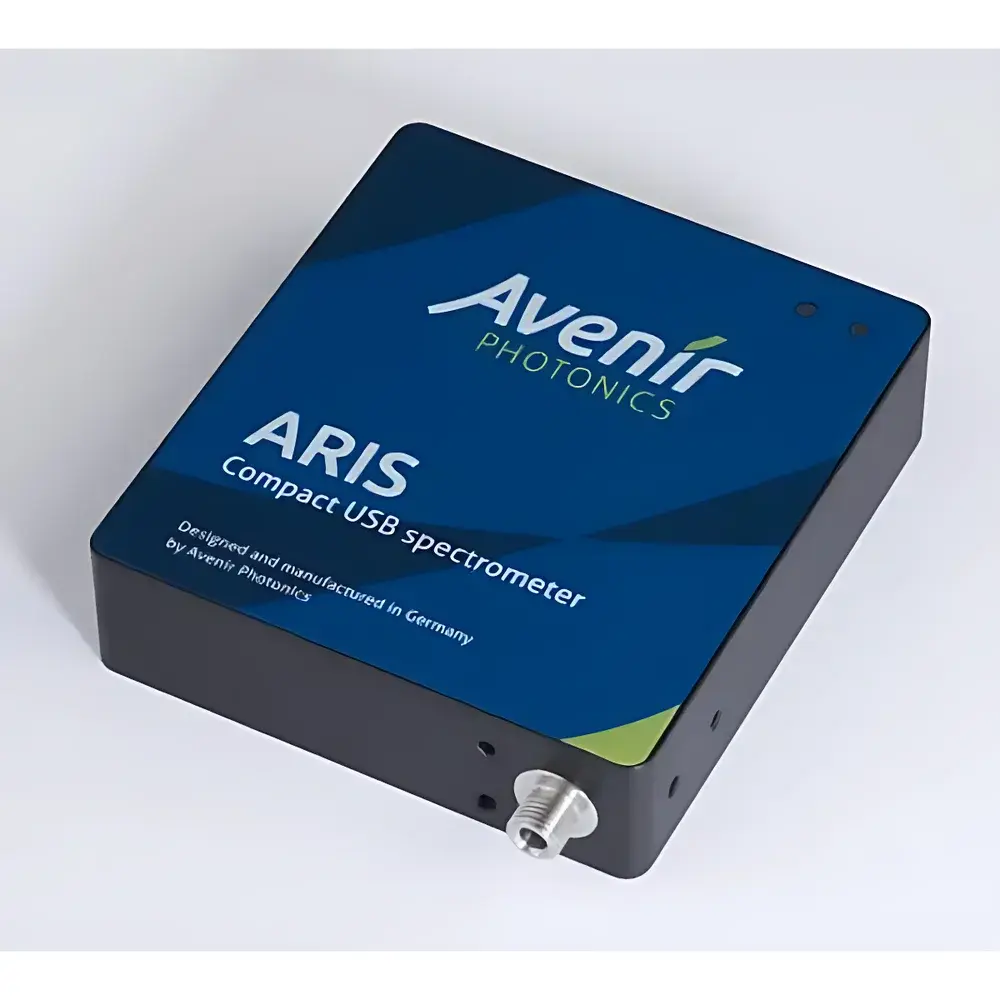
Avenir ARIS Compact High-Resolution Fiber Optic Spectrometer
| Brand | Avenir |
|---|---|
| Origin | Germany |
| Type | Fiber Optic Spectrometer |
| Model | ARIS Compact |
| Spectral Range | UV–VIS–NIR (configurable) |
| Optical Resolution (FWHM, typical) | 0.33–1.10 nm |
| Detector Options | Toshiba TCD1304DG (3648 px) or Hamamatsu S11639-01 (2048 px) |
| Integration Time | 3 µs – 35 min (TCD1304DG) |
| Stray Light Suppression | < 0.01% @ 600 nm |
| SNR | 350:1 (TCD1304DG), 600:1 (S11639-01) |
| Dynamic Range | 1900:1 (TCD1304DG), 5000:1 (S11639-01) |
| Pixel Readout Rate | 1 MHz / 2 MHz |
| Trigger Jitter | ≤10 µs |
| Slit | User-replaceable 20 µm default (optional slits available) |
Overview
The Avenir ARIS Compact High-Resolution Fiber Optic Spectrometer is an engineered solution for precision optical spectroscopy in space-constrained, field-deployable, and industrial OEM environments. Based on Czerny–Turner optical architecture with high-throughput reflective optics and selectable diffraction gratings, the ARIS delivers laboratory-grade spectral fidelity without compromising on mechanical robustness or thermal stability. Its core design principle centers on maximizing photon collection efficiency while minimizing stray light—achieving <0.01% stray light at 600 nm—enabling accurate absorbance measurements up to 3.5 AU without saturation artifacts. Unlike conventional benchtop spectrometers, the ARIS integrates a dedicated microcontroller unit (MCU) that performs real-time onboard signal processing including auto-exposure control, multi-scan averaging, dark-current compensation, and user-defined spectral evaluation algorithms—eliminating latency associated with host-dependent computation.
Key Features
- High optical throughput design yielding 2×–4× higher sensitivity than comparable price-class spectrometers
- Five standardized spectral configurations covering UV (185–420 nm), UV/VIS (185–550 nm), VIS (350–840 nm), VIS/NIR (510–1020 nm), and wide-range (185–970 nm)
- User-interchangeable entrance slit (default 20 µm; optional 10 µm, 50 µm, and 100 µm) enabling application-specific optimization of resolution vs. sensitivity trade-offs
- Dual-detector compatibility: Toshiba TCD1304DG (3648-pixel linear CCD) for enhanced UV response and broad dynamic range, or Hamamatsu S11639-01 (2048-pixel CMOS) for faster readout (2 MHz) and superior temporal response to rapidly varying signals
- Onboard MCU supporting programmable exposure sequencing, buffer management, and embedded spectral preprocessing—reducing dependency on external computing resources
- Industrial-grade enclosure rated for operation across −10 °C to +60 °C ambient, with vibration resistance validated per IEC 60068-2-6 and shock tolerance compliant with MIL-STD-810G
Sample Compatibility & Compliance
The ARIS interfaces seamlessly with standard SMA905 fiber-optic cables (core diameters 50–600 µm), enabling direct coupling to flow cells, immersion probes, integrating spheres, and remote sampling heads. Its compact footprint (125 × 80 × 45 mm) and low power consumption (<2.5 W) support integration into portable analyzers, handheld inspection tools, and inline process monitoring systems. From a regulatory standpoint, the ARIS supports audit-ready data acquisition workflows compatible with GLP and GMP environments: timestamped spectra include metadata (integration time, gain setting, detector temperature, slit ID), and firmware supports optional digital signature logging for FDA 21 CFR Part 11 compliance when paired with validated host software. While not certified as medical device hardware, its optical performance meets ASTM E275 and ISO 17025 traceability requirements when calibrated using NIST-traceable standards.
Software & Data Management
Avenir provides the ARIS SDK (C/C++, Python, LabVIEW, and MATLAB APIs) enabling full low-level instrument control—including grating selection, slit configuration, trigger mode setup (external TTL, internal sync, or software-initiated), and raw pixel data streaming. The optional SpectraView Pro desktop application offers real-time visualization, baseline correction (asymmetric least squares), peak detection (second-derivative method), and quantitative analysis via multivariate calibration (PLS, PCR). All spectral datasets are saved in HDF5 format, preserving hierarchical metadata and ensuring long-term interoperability with chemometric platforms such as Unscrambler X and MATLAB Statistics Toolbox. Firmware updates are delivered via signed binary packages with SHA-256 verification to maintain system integrity across deployments.
Applications
- Inline quality assurance in food & beverage production: quantification of anthocyanins, chlorophyll, and ethanol concentration via UV–VIS absorption fingerprinting
- Counterfeit detection in pharmaceuticals and luxury goods: identification of spectral anomalies in ink, polymer packaging, or dye formulations
- Hazardous substance screening: standoff detection of nitroaromatic explosives (e.g., TNT, RDX) and opioid analogues using characteristic absorption bands in the 200–230 nm region
- Chemical process monitoring: real-time tracking of reaction kinetics in catalytic hydrogenation or polymerization processes using fiber-coupled flow cells
- Environmental field analysis: measurement of NO₂, SO₂, and aromatic hydrocarbons in ambient air via differential optical absorption spectroscopy (DOAS) configurations
FAQ
Is the ARIS suitable for UV-critical applications requiring deep-UV sensitivity below 200 nm?
Yes—the UV-optimized configuration (185–420 nm) uses a solar-blind back-thinned CCD variant and MgF₂-coated optics, achieving quantum efficiency >25% at 185 nm. Optional deuterium lamp calibration ensures traceable photometric accuracy down to 190 nm.
Can the ARIS operate in triggered acquisition mode synchronized to external events?
Yes—it supports hardware triggering with sub-10 µs jitter and configurable delay/width parameters. Both rising-edge and falling-edge trigger modes are supported, with programmable pre-trigger buffer capture for transient event analysis.
What calibration options are available for traceable wavelength and radiometric accuracy?
Avenir offers factory calibration against NIST-traceable Hg/Ar and tungsten-halogen sources. Optional annual recalibration services include full uncertainty budget reporting per ISO/IEC 17025 guidelines.
How is thermal drift managed during extended integrations?
The ARIS incorporates a thermoelectric cooler (TEC) on the detector housing, maintaining sensor temperature within ±0.1 °C over ambient variations. Dark reference acquisition is automatically scheduled before each measurement sequence to correct for thermal offset drift.
Does the ARIS support OEM integration into custom hardware platforms?
Yes—mechanical drawings, pinout schematics, and USB CDC/DFU bootloader documentation are provided under NDA. Custom firmware builds (e.g., fixed-wavelength ROI readout, embedded PLS model inference) are available upon request.




