
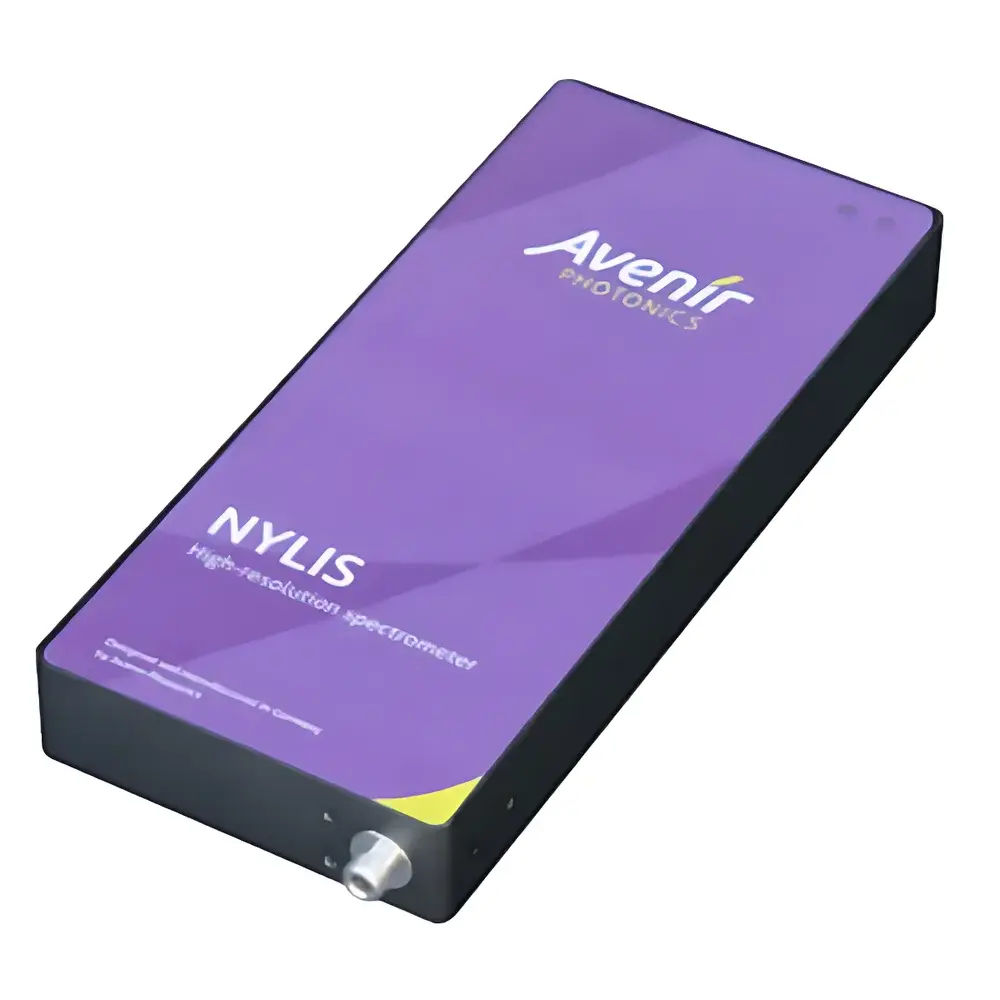
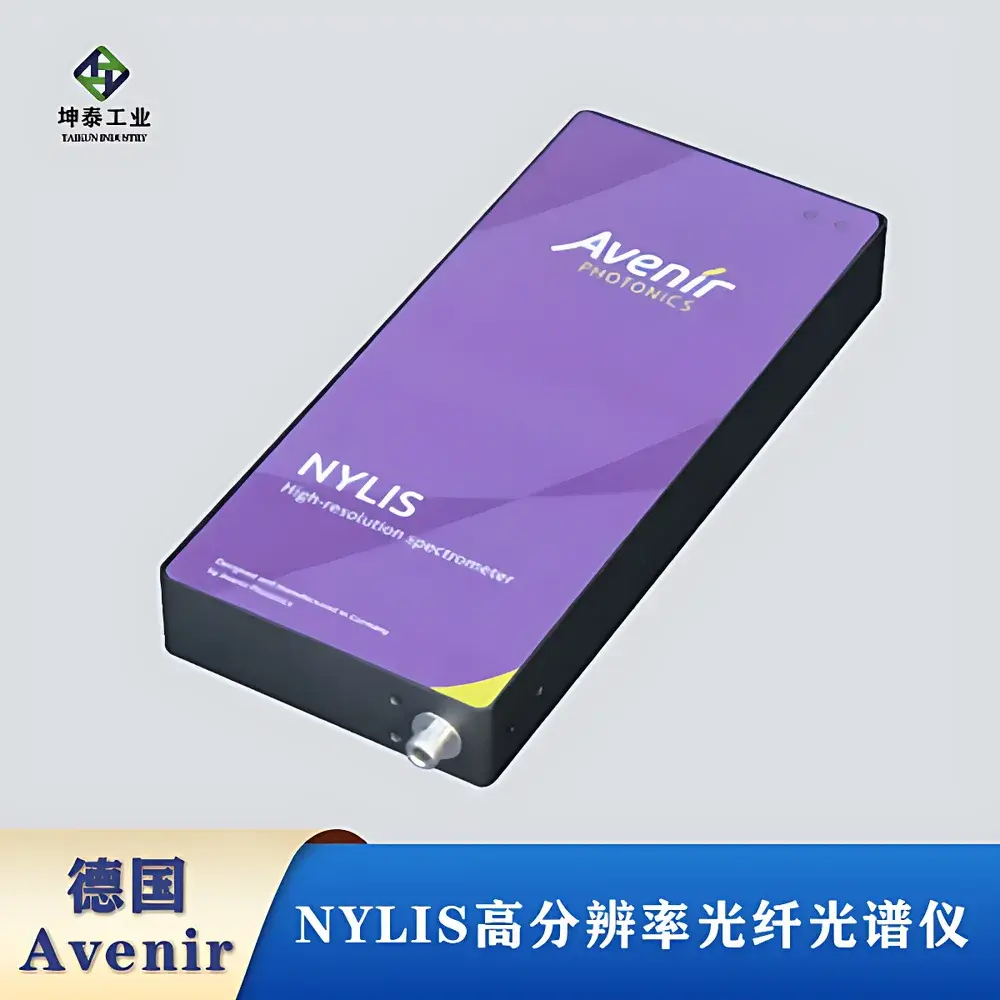
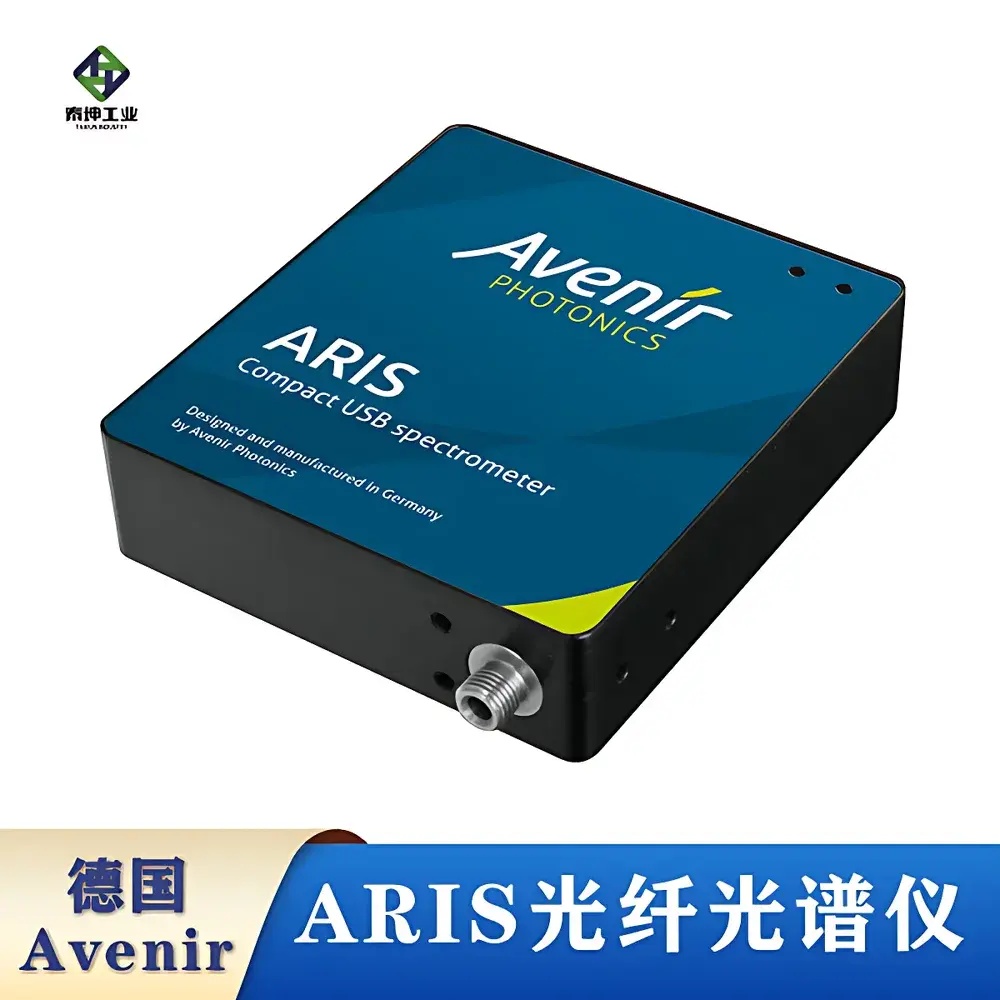
Avenir NYLIS High-Resolution Fiber Optic Spectrometer
| Brand | Avenir |
|---|---|
| Origin | Germany |
| Model | NYLIS |
| Spectral Range | 185–970 nm, 185–550 nm, 185–420 nm, 350–840 nm, 510–1020 nm |
| Detector Type | CMOS (Hamamatsu S13496) |
| Resolution (FWHM) | down to 0.05 nm |
| Spectral Sampling | 4096 pixels |
| Slit Width (standard) | 10 µm |
| Stray Light | < 0.1% |
| Dynamic Range | 5500:1 (typ.), 1900:1 to 5000:1 (configurable) |
| Signal-to-Noise Ratio | 350–600 (typ. 550, unaveraged) |
| Optical Design | Symmetric Czerny-Turner |
| Focal Length | 120 mm |
| Numerical Aperture | 0.07 |
| Interface | USB 2.0 Full-Speed (Type-C), UART, optional SPI/I²C |
| Power Supply | 4.4–5.5 V DC (via USB or Aux), ≤70 mA |
| Dimensions | 67.0 × 150.0 × 19.0 mm |
| Weight | 178 g |
Overview
The Avenir NYLIS High-Resolution Fiber Optic Spectrometer is a compact, research-grade Czerny-Turner spectrometer engineered for applications demanding exceptional spectral resolution without compromising optical robustness or integration flexibility. Unlike conventional array-based spectrometers optimized for sensitivity or speed, the NYLIS series prioritizes resolving power—achieving full-width at half-maximum (FWHM) values as low as 0.05 nm across narrow, user-selectable wavelength bands. This performance is realized through a symmetric optical layout with a 120 mm focal length, significantly longer than standard benchtop designs (typically 50–75 mm), and a precision-machined 10 µm entrance slit. The extended focal length improves dispersion linearity and reduces aberrations, while the narrow slit enforces strict wavelength discrimination—both critical for high-fidelity laser line profiling, atomic emission analysis, Raman shift validation, and narrow-band LED characterization. The instrument employs a back-thinned CMOS linear sensor (Hamamatsu S13496, 4096 pixels), selected for its low read noise (<11 e⁻ RMS), wide dynamic range (5500:1, single-pixel, unaveraged), and stable quantum efficiency across the deep UV to NIR (185–1100 nm). Its modular architecture supports OEM integration, laboratory deployment, and field-portable configurations via standardized SMA fiber coupling and USB 2.0 Full-Speed communication.
Key Features
- Sub-0.1 nm Resolution Capability: Achieves FWHM ≤0.05 nm in selected bands (e.g., 400–500 nm, 620–700 nm) — among the highest resolution values attainable in a USB-powered, benchtop-format fiber spectrometer.
- Configurable Spectral Coverage: Twelve factory-standard wavelength ranges available (e.g., 380–750 nm, 750–1100 nm, 470–630 nm); custom grating/slit/filter combinations supported per application requirements.
- Optimized Czerny-Turner Optics: Symmetric design with 120 mm focal length ensures minimal astigmatism, high wavefront fidelity, and consistent resolution across the detector array.
- High-Fidelity CMOS Detection: Hamamatsu S13496 sensor delivers 16-bit digitization, 54 µs to 35 min exposure control, and on-board dark/offset/nonlinearity correction—enabling quantitative intensity calibration traceable to NIST standards.
- Low Stray Light Performance: Optical design and integrated order-sorting filters limit stray light to <0.1%, critical for accurate measurement of weak emission lines adjacent to intense peaks.
- Embedded Real-Time Processing: On-device spectral averaging, auto-exposure calculation, and reference/dark subtraction reduce host CPU load and improve measurement reproducibility in automated systems.
Sample Compatibility & Compliance
The NYLIS spectrometer interfaces seamlessly with standard 200–600 µm core silica optical fibers (SMA 905 connector), enabling direct coupling to lasers, plasma sources, fluorescence cuvettes, integrating spheres, and process monitoring probes. Its deep-UV capability (down to 185 nm) requires optional quartz or fused-silica transmission optics and careful handling to avoid ozone absorption artifacts. For regulated environments—including pharmaceutical QC labs, environmental emission testing, and academic GLP-compliant research—the system supports audit-ready data acquisition when paired with validated software (e.g., Avenir SpectraSuite Pro with 21 CFR Part 11-compliant logging). While the spectrometer itself carries no CE/UKCA marking as a standalone component, it complies with EN 61326-1:2013 (EMC) and EN 61010-1:2010 (safety) when operated within specified voltage (4.4–5.5 V), temperature (–20 °C to +60 °C), and humidity (0–90% RH, non-condensing) limits. Calibration reports include traceable wavelength and radiometric verification against NIST-traceable standards.
Software & Data Management
Avenir provides native SDKs (C/C++, Python, LabVIEW, MATLAB) and SpectraSuite Pro—a feature-rich GUI supporting real-time spectrum display, multi-channel time-series acquisition, spectral math (ratio, derivative, peak integration), and batch export in CSV, ASCII, and HDF5 formats. All spectral data includes embedded metadata: timestamp, integration time, sensor temperature, slit width, grating ID, and calibration coefficients. The firmware implements hardware-level exposure optimization and automatic gain selection, reducing operator dependency. For integration into LIMS or MES platforms, the spectrometer supports ASCII-over-USB serial emulation and TTL-triggered acquisition with ≤1 µs jitter—ensuring synchronization with pulsed lasers or fast-switching light sources. Data integrity is reinforced by onboard spectral buffering (31 spectra), cyclic redundancy checksums (CRC-16), and non-volatile storage of dark/reference references. Software updates are delivered via signed firmware packages, maintaining version control and traceability in production environments.
Applications
- Laser Characterization: Precise determination of central wavelength, linewidth (FWHM), mode structure, and side-mode suppression ratio (SMSR) for diode, DPSS, and fiber lasers.
- Atomic & Molecular Emission Analysis: Resolving closely spaced spectral lines in LIBS, ICP-OES, and hollow-cathode lamp spectra—particularly for alkali/alkaline earth elements (e.g., Na D-lines at 589.0/589.6 nm).
- Raman Spectroscopy Support: High-resolution verification of Raman shift calibration and detection of subtle peak splitting in stress/strain mapping or polymorph identification.
- Narrow-Band Light Source Validation: Metrology-grade assessment of LEDs, VCSELs, and tunable filters used in biomedical imaging and optical communications.
- Environmental Monitoring: Detection of low-concentration gas-phase absorption features (e.g., NO₂ at 400 nm, SO₂ at 280 nm) when coupled with long-path absorption cells.
- Academic & Industrial R&D: Platform for developing custom spectroscopic algorithms, validating optical models, and prototyping hyperspectral sensing subsystems.
FAQ
What is the minimum resolvable wavelength separation (FWHM) achievable with the NYLIS spectrometer?
The instrument achieves ≤0.05 nm FWHM in optimized configurations (e.g., 400–500 nm range with 10 µm slit). Actual resolution depends on grating groove density, slit width, and optical alignment—values are verified per unit calibration report.
Can the NYLIS be used for UV-VIS-NIR broadband measurements?
Yes—but not simultaneously. It operates over discrete, user-selected bands (e.g., 185–550 nm or 510–1020 nm). Broad coverage requires multiple units or scanning monochromator integration.
Is the 10 µm entrance slit replaceable by the user?
Yes. Avenir supplies interchangeable slit modules (10, 20, 50, 75, 100, 150, 200, and 300 µm) with tool-free installation—allowing trade-offs between resolution, throughput, and signal-to-noise ratio.
Does the spectrometer support external triggering and synchronization?
Yes. It features TTL-compatible trigger-in and trigger-out signals with ≤1 µs jitter, plus analog input/output for analog-gated acquisition or feedback control loops.
How is wavelength accuracy maintained over temperature and time?
Wavelength calibration is performed at three temperatures (–10 °C, 25 °C, 60 °C) during manufacturing. Onboard thermistor monitoring enables software-based thermal drift compensation using polynomial coefficients stored in EEPROM.





