
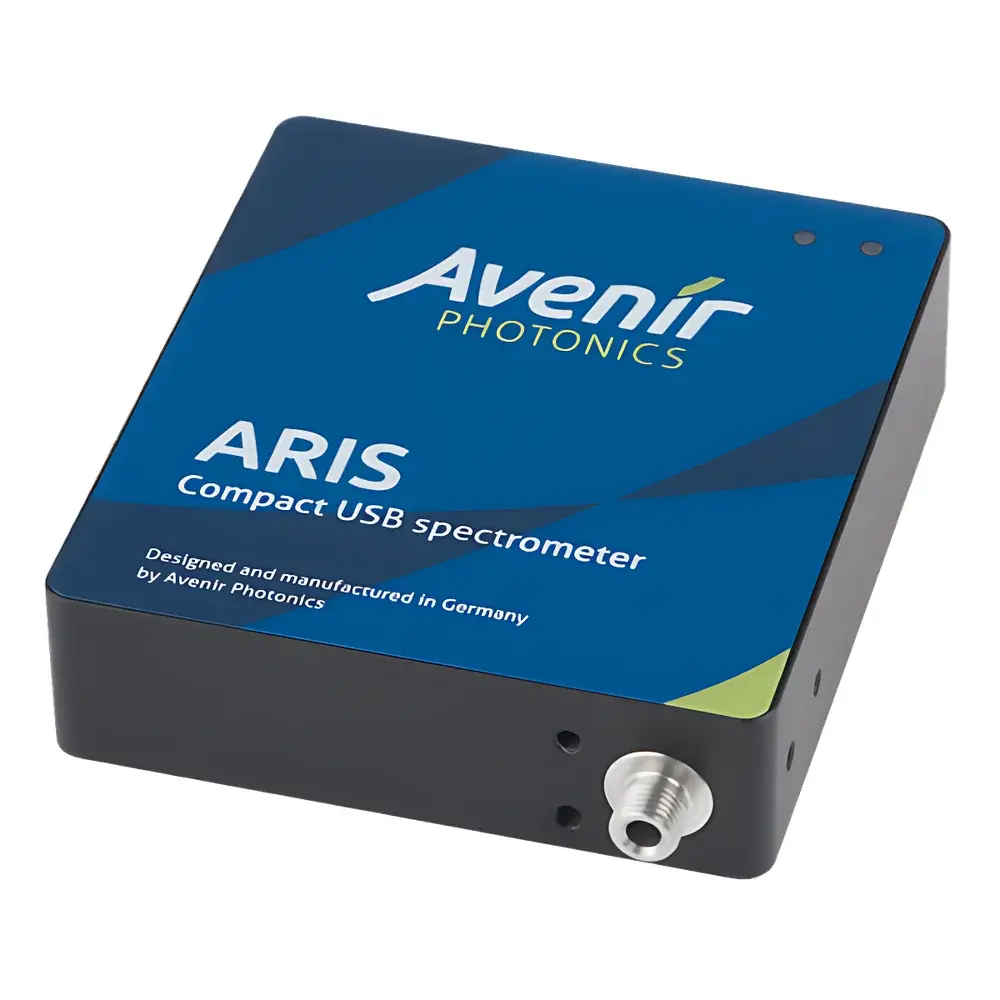
Avenir Photonics Aris Miniature Fiber Optic Spectrometer
| Brand | Avenir |
|---|---|
| Origin | Germany |
| Manufacturer Type | Authorized Distributor |
| Product Category | Imported |
| Model | Aris |
| Spectral Range | 185–970 nm, 185–550 nm, 185–420 nm, 350–840 nm, 510–1020 nm |
| Detector Type | CCD |
| Resolution (FWHM) | 0.33–1.40 nm |
| Signal-to-Noise Ratio | 350 or 600 (max, unaveraged) |
| Dynamic Range | 1900:1 or 5000:1 |
| Stray Light | < 0.08 % |
Overview
The Avenir Photonics Aris Miniature Fiber Optic Spectrometer is an OEM-optimized, high-performance spectrometer engineered for embedded and portable spectroscopic applications requiring laboratory-grade accuracy in a compact, robust form factor. Based on a symmetric high-throughput Czerny-Turner optical architecture with a 50 mm focal length and f/6.3 numerical aperture (NA = 0.16), the Aris delivers exceptional photon collection efficiency and wavelength fidelity across five standard spectral configurations. Its core measurement principle relies on dispersive spectroscopy using ruled or holographic diffraction gratings coupled with linear CCD array detectors—primarily the Toshiba TCD1304DG (3648 pixels) and Hamamatsu S11639-01 (2048 pixels)—enabling precise intensity-resolved spectral acquisition from deep UV (185 nm) to near-infrared (1020 nm). Designed for integration into analytical instrumentation, process monitoring systems, environmental sensors, and handheld diagnostic devices, the Aris meets stringent requirements for thermal stability, mechanical ruggedness, and low-power operation without compromising spectral resolution or radiometric consistency.
Key Features
- Compact dimensions: 67.0 × 74.0 × 19.0 mm; weight: 122 g — optimized for space-constrained OEM integration
- Five factory-configurable spectral ranges, each matched to optimal grating blaze and detector sensitivity
- User-replaceable entrance slit (standard 20 µm; optional wider slits available for enhanced throughput)
- On-board 16-bit ADC (2 MHz sampling), microcontroller-based real-time processing including auto-exposure, spectral averaging, dark/reference correction, and nonlinearity compensation
- Low stray light performance (< 0.08 %), critical for high-dynamic-range absorbance and fluorescence quantification
- Dual-detector support: Toshiba TCD1304DG (UV-enhanced, 3 µs–35 min exposure) and Hamamatsu S11639-01 (higher speed, 54 µs–35 min exposure)
- USB 2.0 Full-Speed interface (Type-C) with optional UART, SPI, and I²C for embedded control; analog I/O and programmable GPIO pins available upon request
- Operating temperature range: −20 °C to +60 °C; storage: −40 °C to +70 °C; humidity tolerance: 0–90 % RH (non-condensing)
Sample Compatibility & Compliance
The Aris accepts standard SMA-905 fiber-optic input (custom interfaces available), enabling seamless coupling to flow cells, integrating spheres, cuvette holders, or remote probe assemblies. Its deep-UV capability (down to 185 nm) supports aqueous and organic solvent analysis, while its VIS/NIR extension (up to 1020 nm) accommodates LED characterization, pigment identification, and NIR reflectance applications. The instrument complies with EU directives 2014/30/EU (EMC), 2011/65/EU (RoHS), and REACH SVHC regulations. It also conforms to U.S. conflict minerals reporting requirements under Section 1502 of the Dodd-Frank Act. While not certified for GMP/GLP environments out-of-the-box, its deterministic firmware behavior, audit-ready calibration reports, and traceable factory calibration (NIST-traceable tungsten-halogen and deuterium sources) support validation under ISO/IEC 17025 and FDA 21 CFR Part 11-compliant workflows when integrated with appropriate software controls.
Software & Data Management
Avenir provides a Windows-compatible application suite (Windows 7+) featuring real-time spectrum visualization, multi-curve overlay, peak detection, and basic chemometric tools. The included SDK delivers comprehensive C/C++, Python, and LabVIEW APIs with source-level documentation, sample code for USB streaming, trigger synchronization, and custom spectral evaluation algorithms. Raw data export supports CSV, ASCII, and binary formats with full metadata (wavelength calibration coefficients, slit width, grating ID, detector gain settings). On-device spectral buffering (35 spectra for Toshiba, 63 for Hamamatsu) enables burst-mode acquisition without host latency. All firmware updates and configuration parameters are managed via signed USB commands, ensuring integrity during field deployment.
Applications
- Real-time UV-Vis absorbance monitoring in bioreactors and pharmaceutical inline process analytics
- LED and laser diode spectral characterization in manufacturing QA/QC
- Portable water quality analysis (nitrate, nitrite, COD estimation via multivariate regression)
- Food authenticity screening (e.g., olive oil adulteration, honey purity)
- Plasma emission spectroscopy for semiconductor chamber endpoint detection
- Educational and research-grade spectroscopy in resource-limited or mobile lab environments
- OEM integration into handheld Raman or LIBS systems as a secondary broadband reference channel
FAQ
What spectral resolution can be achieved with the Aris, and how is it defined?
Resolution is specified as full-width-at-half-maximum (FWHM) under standard conditions (20 µm slit, Toshiba detector); typical values range from 0.33 nm (UV configuration) to 1.40 nm (broadband 185–970 nm). Actual resolution scales linearly with slit width and inversely with pixel binning.
Is the Aris suitable for quantitative absorbance measurements?
Yes—its low stray light (< 0.08 %), high dynamic range (up to 5000:1), and stable thermal response enable reliable Beer-Lambert law applications across OD 0–3.5, provided proper dark/reference correction and optical path calibration are applied.
Can the Aris operate independently without a host PC?
It features autonomous onboard processing (auto-exposure, averaging, spectral math), but full data logging, visualization, and advanced analysis require external software. Standalone operation is supported via optional UART/SPI firmware extensions.
How is wavelength calibration maintained over temperature?
Factory calibration includes temperature-dependent polynomial coefficients. For applications requiring < 0.05 nm drift over −20–60 °C, active thermal stabilization or periodic recalibration using internal LED references is recommended.
Are custom grating or detector options available for OEM volume orders?
Yes—Avenir Photonics offers tailored optical designs, including custom blaze wavelengths, UV-enhanced coatings, back-thinned CCDs, and modified electronics for extended dynamic range or faster frame rates, subject to minimum order quantities and NRE agreements.



